


New to the Innate Entitlement Framework™? Begin with Why the Innate Entitlement Framework™ Matters for an introduction to the Framework and its wider architecture.
The Symbol of Innate Entitlement™
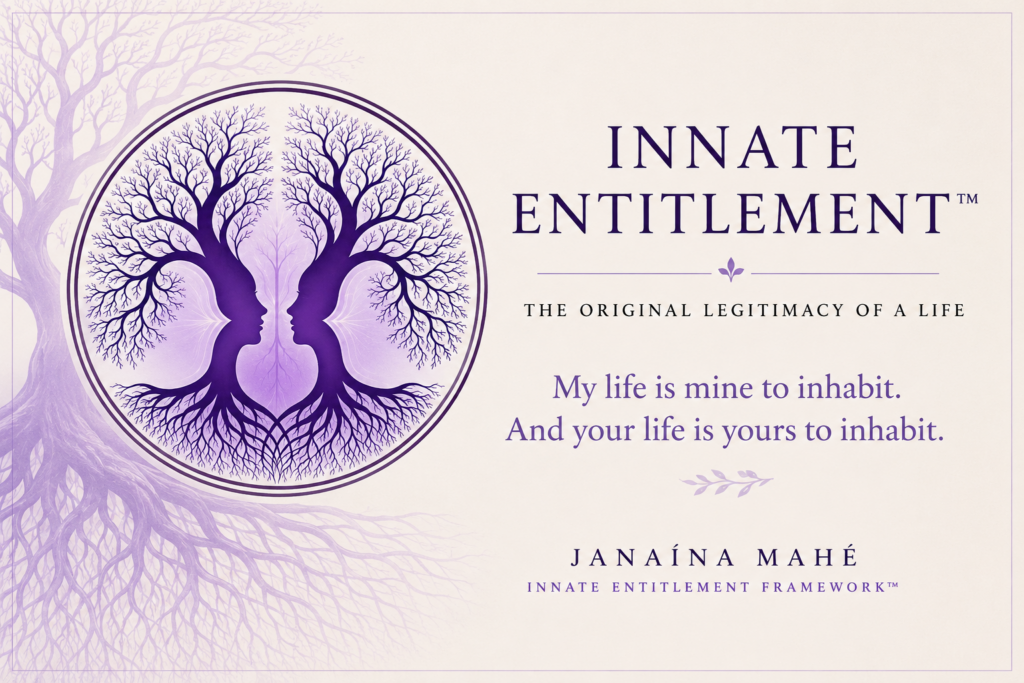
The emblem of the Innate Entitlement Framework™ holds something of the movement explored in this article.
A living form is rooted, particular and continually expanding. Two distinct human profiles remain recognisably themselves while existing within a shared field of life.
The tree also gives visible form to something that begins long before we can consciously think about it: a living being takes up space simply by existing.
Roots extend into the ground. A trunk occupies its place. Branches reach outward. Growth takes form and requires space in which to unfold. The tree does not first ask whether it is permitted to exist before its living presence begins to occupy and affect its environment.
Within Innate Entitlement™, this reflects the earliest embodied expression of original legitimacy. Before taking up space can become a psychological question, life is already taking up physical space.
But the symbol does not stop there.
As the tree branches outward, it can also represent the widening dimensions through which a human life increasingly comes to inhabit itself — bodily, emotionally, psychologically, expressively, relationally, socially and existentially.
The roots do not have to earn the right to grow. The branches do not create the legitimacy of the life from which they emerge. They express the continuing development of a life that is already here.
And the two human profiles matter equally.
They remain distinct while sharing the same field. Neither has to disappear for the other to exist. Neither person’s legitimacy originates in the other’s recognition.
Within the Framework, the emblem therefore holds a central distinction:
Life does not become legitimate through what it later achieves, receives or becomes.
There is already a particular life here.
Its earliest embodied presence takes up space.
Its development increasingly expands the ways in which that life can be expressed and inhabited.
And because human life never develops outside relationship and environment, that expansion continually meets the presence and responses of other lives.
The movement is therefore not toward occupying all available space.
It is toward increasingly inhabiting the space that is one’s own while recognising the equal legitimacy of another life to inhabit theirs.
My life is mine to inhabit. And your life is yours to inhabit.
A Particular Life Is Already Here
Before we have a name, a story about ourselves, or any conscious understanding of who we are, there is already a particular life here.
A particular developing organism.
A particular body forming.
A particular life taking place.
Long before we can consciously recognise ourselves as distinct, our biological particularity is already developing.
We can see one familiar expression of this in our fingertips.
The friction-ridge patterns that become our fingerprints develop before birth. Even identical twins do not have identical fingerprints.
We carry, quite literally, traces of our biological particularity.
Fingerprints do not establish the legitimacy of a human life. They simply give us a familiar and tangible way of recognising something more fundamental:
this particular life is not another life.
Within the Innate Entitlement Framework™, Innate Entitlement™ describes the original, non-conferred legitimacy of a particular life to exist and inhabit the life that is its own.
This is where the word innate matters.
The legitimacy does not arrive later as a developmental achievement.
It comes with life.
There is already a life here.
And before that life can consciously understand what it means to inhabit itself, its existence is already being expressed biologically.
Before Taking Up Space Becomes a Psychological Question
The earliest expression of Innate Entitlement™ is physical.
A developing human life occupies space.
During prenatal development, that space is within the maternal body.
The maternal body is the developing organism’s first biological environment.
The developing organism is not simply located there like an object placed inside a container.
Development is taking place within an active biological relationship.
The developing organism receives.
Responds.
Affects.
And is affected.
At the same time, pregnancy involves extensive physiological adaptation throughout the maternal body as development progresses. Cardiovascular, respiratory, renal, metabolic and other systems undergo changes that support pregnancy and fetal development.
Physical space changes.
Physiological systems adapt.
The conditions within which the developing organism exists are themselves dynamic.
The presence of this particular developing life is already having consequences within the biological environment in which it is developing.
None of this requires the developing organism to understand what it is doing.
There is no conscious idea of permission.
No psychological concept of whether it is acceptable to be present.
No question yet of:
Am I allowed to be here?
Those questions belong to a much later psychological capacity.
Long before we develop the conscious capacity to wonder whether we are allowed to take up space, our existence is already doing so.
Taking up space therefore begins as a biological fact before it can ever become a psychological question.
This does not mean that physically taking up space is Innate Entitlement™.
It is better understood as its earliest embodied expression.
There is a particular life here.
And because that life exists, its existence already has presence within life.
Legitimacy and Acceptance Are Different
There is an important distinction here.
The fact that a particular life carries original legitimacy within the Innate Entitlement Framework™ does not mean that every environment will respond to that life in the same way.
A life encounters conditions.
It encounters responses.
Those responses may include being welcomed.
Wanted.
Protected.
Responded to.
They may also include inconsistency.
Resistance.
Absence.
Intrusion.
Rejection.
Neglect.
Or harm.
These differences matter profoundly.
They can affect what happens to a developing life.
They can influence the conditions within which development unfolds.
They can eventually influence how the person experiences themselves, other people, relationships and the wider world.
But within the Innate Entitlement Framework™, the response to a life is distinguished from the original legitimacy of that life.
Acceptance is a response.
Recognition is a response.
Care is a response.
Rejection is a response.
None of these is the source from which Innate Entitlement™ originates.
The environment does not first create the legitimacy of a life by responding well to it.
And inadequate, inconsistent or harmful responses do not become the authority that determines whether that life was originally legitimate.
This distinction is fundamental because human beings develop within response.
The environment does matter.
Relationship does matter.
What happens to us matters.
But they matter because they become part of the conditions within which a particular life develops — not because they confer the original legitimacy of that life.
From Occupying Space to Inhabiting a Life
Physical space is only the beginning.
As human development continues, the dimensions through which a particular life can increasingly inhabit itself become more complex.
There is a body to inhabit and increasingly act through.
There are emotions to recognise and experience.
Needs.
Thoughts.
Perceptions.
Preferences.
Expression.
Difference.
Relationships.
Choices.
A developing position within the social world.
And, eventually, an increasingly conscious relationship with the fact of being this particular life.
But none of these dimensions develops in isolation.
Just as prenatal physical development is already taking place within a biological environment, the expanding dimensions of human life continue to develop within environments and relationships.
The body meets response.
Emotion meets response.
Need meets response.
Expression meets response.
Difference meets response.
Presence meets response.
And those repeated encounters become part of the developmental conditions through which a person increasingly learns what it is like to recognise, express and inhabit their own life.
This is where Innate Entitlement™ becomes particularly important.
The environment does not create the original legitimacy of that life.
But it can profoundly influence how that life develops the capacity to inhabit what was already its own.
To understand this more fully, we need to look at how those different dimensions of inhabiting a life develop within response.
A Life Expands Within Response
A particular life does not simply become larger.
Across development, the ways in which that life can be experienced, expressed and inhabited become increasingly complex.
What begins with the physical presence of a developing organism gradually includes bodily experience, emotion, thought, expression, relationship, social participation and an increasingly conscious experience of being this particular person.
But this expansion does not happen in isolation.
Each developing dimension of life meets an environment.
And the environment responds.
Those responses do not create Innate Entitlement™.
But they become part of the conditions within which a human develops the capacity to recognise, express and inhabit the life that is already their own.
Bodily Space
The earliest taking up of space is physical.
Prenatally, the developing organism already exists within the maternal biological environment, affecting and being affected within the conditions in which development is occurring.
After birth, the body continues within an expanded physical and relational environment.
And increasingly, that body becomes something the developing person can inhabit and act through.
Movement.
Touch.
Proximity.
Distance.
Comfort.
Discomfort.
Exploration.
Rest.
Reaching toward.
Moving away.
But bodily space is also being responded to.
Is touch gentle and responsive, or intrusive?
Are bodily signals noticed or repeatedly overlooked?
Is movement encouraged, excessively restricted, or experienced by others as troublesome?
Can the child move away when they have had enough?
Can they approach?
Can they explore?
Can their bodily responses communicate something that is noticed?
These encounters matter.
The environment does not create the legitimacy of the child’s body to exist.
But repeated bodily experiences become part of the conditions through which the developing human increasingly learns what it feels like to inhabit their own body in the presence of others.
Emotional Space
As emotional life develops, feelings also occupy space.
Fear.
Anger.
Excitement.
Sadness.
Joy.
Frustration.
Longing.
And feelings meet responses.
A frightened child may encounter comfort and curiosity.
Or dismissal.
An angry child may encounter somebody able to remain present with the emotion.
Or their anger may repeatedly evoke fear, punishment, withdrawal or escalation around them.
Excitement may be shared.
Or experienced as too loud.
Too energetic.
Too much.
Sadness may be received.
Or quickly shut down.
This does not mean that every emotion must be approved of, or that every behaviour arising from emotion should be permitted.
Making room for emotional experience is not the same as allowing every action that may arise from it.
A child can be angry and still encounter a limit on hitting.
A child can be disappointed and still hear no.
A child can be frightened without every frightening situation being removed.
What matters developmentally is that the emotional experience itself has been able to exist within relationship.
Through repeated encounters, the developing person is learning something about what happens when their emotional life becomes present in the presence of another.
There may gradually be greater room to recognise:
This is what I feel.
And eventually:
What I feel can be real for me even when you feel something different.
Or the developing person may increasingly discover that certain emotions need to be hidden, minimised, transformed or managed around other people in order to preserve connection.
The emotion still occurs.
What can change is how much space the person experiences themselves as having to recognise and inhabit it.
Psychological Space
As development continues, an increasingly complex inner world develops.
Thoughts.
Perceptions.
Imagination.
Questions.
Memories.
Interpretations.
Preferences.
Ideas.
A developing point of view.
These also meet responses.
Tell me what you think.
That’s interesting.
I hadn’t thought about it that way.
creates a different kind of encounter from:
Don’t be ridiculous.
You don’t know what you’re talking about.
That’s not what happened.
You shouldn’t think like that.
Psychological space does not mean that every thought is accurate.
It does not make every interpretation factual simply because it belongs to us.
Nor does another person have to agree with our perception in order for us to have one.
It means there can be room for a developing person to have an inner experience of their own.
To explore it.
Question it.
Revise it.
Learn from others.
Change their mind.
And increasingly recognise:
This is what I think.
This is how I understand it at the moment.
Repeated responses can therefore influence how confidently a person later inhabits their own psychological position.
A person can learn to think while remaining open to other minds.
Or they can become increasingly uncertain about whether their own inner experience is something they can trust, express or even consult.
Expressive Space
Something else happens as development unfolds.
What exists within us increasingly finds ways of moving outward.
Initially this may happen through the body.
Crying.
Movement.
Gesture.
Facial expression.
Reaching.
Turning away.
Play.
Sound.
Drawing.
And eventually, increasingly, through language.
The developing person becomes able to communicate more of their experience into a shared environment.
I need something.
I don’t like this.
Look at this.
Come closer.
Move away.
Listen to me.
This matters to me.
Expression gives something of our internal life a presence beyond ourselves.
And once again:
expression meets response.
Some expressions are noticed.
Some are misunderstood.
Some are welcomed.
Some evoke discomfort.
Some are ignored.
Some are interrupted.
Some become safer to express than others.
Over time, these encounters can influence whether expression becomes something the person can inhabit relatively freely, something they learn to carefully manage, or something that feels dangerous to make visible at all.
The person who later says:
I don’t know how to say what I need.
or:
I know what I want to say, but I can’t get the words out.
has not necessarily lost the capacity for expression.
There may be a developmental history behind what making oneself visible through expression has come to mean.
Relational Space
As differentiation develops, another dimension becomes increasingly important.
The person does not only have experiences.
They increasingly participate in relationships from a position becoming recognisably their own.
They want closeness.
They want distance.
They prefer something.
They dislike something.
They agree.
They disagree.
They need.
They receive.
They give.
And they increasingly encounter something fundamental about human relationship:
another person can have an experience that is different from theirs.
That developing relational position also meets response.
Can difference coexist with connection?
Can the child disagree without the relationship becoming emotionally unsafe?
Can closeness include two experiences rather than requiring one to disappear into the other?
Can another person’s feelings matter without completely replacing the developing person’s own?
Again, the environment is not granting the developing person legitimacy.
But relationship provides conditions within which the person learns what happens when their particularity becomes visible alongside somebody else’s.
This is where later concepts within the Innate Entitlement Framework™, including Boundary Coherence™, become increasingly relevant.
But at the level of Innate Entitlement™, the proposition remains simpler:
there is a particular life here increasingly learning what it is like to inhabit its own position while living among other particular lives.
Social Space
The environments through which development takes place continue to widen.
Home is no longer the only relational world.
Nursery.
School.
Friendships.
Groups.
Community.
Education.
Work.
Culture.
Society.
A person’s presence now encounters increasingly complex forms of response.
Inclusion.
Exclusion.
Opportunity.
Comparison.
Encouragement.
Judgement.
Recognition.
Rejection.
Social expectations.
The experience of having a place within the wider human world can therefore also be shaped developmentally.
Some environments make participation easier.
Others make it considerably harder.
And the same person can experience themselves very differently across different social environments.
They may speak freely with friends but become almost invisible within a group.
Feel capable at work but inadequate within their family.
Feel accepted in one community and intensely conscious of difference in another.
Innate Entitlement™ does not propose that society will automatically recognise every person equally, or that social conditions do not matter.
They matter enormously.
The distinction is that social recognition does not create the original legitimacy of the person seeking to participate.
Social experience can profoundly affect how freely someone experiences themselves as able to occupy and participate within the human world.
It does not become the original source of their legitimacy to be here.
Existential Space
And beneath these increasingly complex dimensions remains something more fundamental.
I am this particular life.
Not merely this body.
Not merely these emotions.
Not merely my thoughts.
Not merely my relationships.
Not merely my achievements, failures, roles or social position.
This life.
The life from which all of those experiences are being lived.
Existential space, within this discussion of Innate Entitlement™, concerns the increasing possibility of inhabiting the fact of being this particular life.
That becomes important because, across development, we can begin referring the legitimacy of our existence back to what happens around us.
Whether we are approved of.
Whether we succeed.
Whether somebody stays.
Whether we are useful.
Whether we are wanted.
Whether we are recognised.
Whether our life looks the way we thought it should.
Innate Entitlement™ proposes a more original reference point:
the life itself.
The person does not have to become detached from relationships or unaffected by experience.
Quite the opposite.
Human beings develop through relationship and remain affected by the world around them.
But how a life is responded to and the original legitimacy of that life remain different questions.
Innate Entitlement™ Is Not a Psychological Sense of Entitlement
The word entitlement already has an established meaning in everyday and psychological language.
It can describe an expectation of special treatment, exemption from ordinary limits, or the assumption that one’s wants should take precedence over the needs and boundaries of others.
That is not what the Innate Entitlement Framework™ means by Innate Entitlement™.
Within IEF™, Innate Entitlement™ describes:
the original, non-conferred legitimacy of a particular life to exist and inhabit the life that is its own.
That legitimacy is not exclusive.
If my life is legitimately mine to inhabit, your life is legitimately yours to inhabit.
Innate Entitlement™ therefore does not mean:
I can do whatever I want.
What I want should determine what happens.
Other people’s boundaries should move around me.
Because my experience matters, it matters more than yours.
Those positions would confuse the legitimacy of one’s own life with authority over another person’s life.
This distinction matters developmentally.
A child needs room to exist, explore, need, feel, express, differ and increasingly inhabit their own life.
But a child also develops in a world inhabited by other people.
Another person has needs.
Another person has limits.
Another person can say no.
Another person’s experience may differ from mine.
A child can experience frustration without losing their legitimacy. A boundary can limit what a child does without communicating that there is no place for the child themselves.
This means that healthy development cannot simply be understood as providing a child with more and more space.
For some children, the developmental environment provides too little room for their emerging participation.
For others, there may appear to be all the space in the world, but too little help in discovering where their space meets somebody else’s.
Within IEF™, neither developmental direction changes the child’s original Innate Entitlement™.
A person whose participation becomes organised around making themselves smaller has not developed less Innate Entitlement™.
A person whose participation becomes organised around occupying disproportionate space in relation to others has not developed more Innate Entitlement™.
The original legitimacy remains equal.
What can differ profoundly is how participation becomes organised around that legitimacy.
This distinction can be expressed simply:
Contracted participation: There is no room for me.
Inflated participation: There is only me.
Coherent differentiated participation: There is room for me, and there is room for you.
Psychological entitlement — in the familiar sense of expecting exceptional treatment or insufficiently recognising the legitimate needs and boundaries of others — should therefore not be confused with Innate Entitlement™.
Innate Entitlement™ does not elevate one life above another.
It establishes something more fundamental:
My life is mine to inhabit. And your life is yours to inhabit.
The Seed, the Pot and the Space to Grow
A simple analogy can help us understand how original legitimacy and developmental conditions can remain distinct while still profoundly affecting one another.
Imagine a seed.
The conditions in which that seed is planted matter enormously.
It needs an environment capable of supporting its development: nourishment, water, light, protection and sufficient space.
But those conditions do not make the seed legitimate.
The pot does not grant the seed permission to exist.
The soil does not decide whether it deserves to grow.
And the gardener does not create the living potential already present within it.
The environment affects how the life develops, not whether that life was originally legitimate.
But there is another dimension to the analogy.
When plants are grown in containers, good cultivation is not necessarily a matter of placing a very small plant immediately into the largest possible pot.
Plants are commonly potted on.
As the plant develops and its root system grows, it is moved into a somewhat larger container. As it develops further, the available growing space can increase again.
There are horticultural reasons for this practice. A small root system placed in a disproportionately large volume of growing medium can leave considerable compost unused and wet for too long, contributing to poor aeration and the problems associated with overpotting.
So the plant does not simply need the greatest possible amount of space.
The growing conditions need to be responsive to its stage of development.
This gives us a useful developmental metaphor.
It is a metaphor, rather than a claim that children develop psychologically in the same way that plants grow roots. But it helps illuminate something important about the relationship between space, boundary and developing capacity.
A pot that has become too small can restrict a developing plant.
Yet good cultivation does not therefore mean eliminating every edge.
There is sufficient room for development, and as the organism’s capacity grows, the environment responds.
Human development also involves a changing relationship between space, boundary, capacity and participation.
A young child requires considerable protection and containment.
As capacities develop, the child can increasingly explore, choose, take responsibility, encounter consequences and participate more independently.
The boundaries appropriate to a two-year-old are not the boundaries appropriate to a twelve-year-old.
And the boundaries appropriate to a twelve-year-old are not those through which we would expect an adult to organise their life.
Ideally, therefore, developmental space does not simply disappear or become unlimited.
It develops with the person.
Freedom can increase.
Participation can increase.
Responsibility can increase.
And the developing person can increasingly discover not only:
Is there room for me?
but also:
Where does my space meet yours?
This helps us understand two very different developmental experiences.
A child whose environment is persistently restrictive may encounter boundaries everywhere while receiving insufficient room to explore, express, differ or participate.
The developmental message can become:
There isn’t room for me.
But another child may receive extensive freedom, protection, attention or accommodation while encountering too few meaningful limits.
They may repeatedly experience:
You can do no wrong.
What you want should happen.
Someone else will sort this out.
The boundary will move.
Such a child can appear to have all the space in the world, while receiving too little help in discovering where that space ends.
In a developmental sense, they may have to find the edges for themselves.
The problem in the first environment is not that boundaries exist.
And the problem in the second is not that the child has been given space.
The issue is the developing relationship between space and boundary.
A boundary can communicate something very different from rejection:
Here I am. There you are. There is room for me, and there is room for you.
The child can want something and encounter a no.
They can be disappointed and remain loved.
They can become angry without being permitted to harm somebody.
They can encounter another person’s need without their own need becoming illegitimate.
They can discover that another person’s separate reality does not erase their own.
And gradually, they can learn that inhabiting their own life does not require either disappearing into another person’s space or requiring another person to disappear from theirs.
The seed-and-pot analogy therefore helps us hold two truths together.
The first concerns original legitimacy:
The conditions of growth can profoundly influence development without conferring the seed’s original legitimacy to exist.
The second concerns developmental space:
Supporting development is not simply a matter of providing more space. It involves a changing relationship between sufficient space, meaningful boundaries and developing capacity.
This returns us to the central distinction within Innate Entitlement™.
The child whose developmental space is severely restricted does not possess less original legitimacy.
The child whose environment repeatedly accommodates them at the expense of meaningful limits does not possess more.
The conditions may profoundly influence how each person eventually participates in relationships and in life.
But the original condition remains:
My life is legitimately mine to inhabit.
Your life is legitimately yours to inhabit.
The developmental question becomes how we learn to inhabit that legitimacy alongside one another.
When Space Becomes Conditional
The space occupied by a human life begins before permission can be consciously considered.
But as development continues, experience accumulates.
The body has met responses.
Needs have met responses.
Emotions have met responses.
Expression has met responses.
Difference has met responses.
The person’s presence has repeatedly met the people and environments around them.
And through these encounters, the developing person does not only learn about the world.
They also begin to learn something about what happens when they bring themselves into it.
This is where taking up space can gradually move from being an unquestioned fact of existence to something experienced psychologically as conditional.
A child may begin to discover:
There is room for me when I am quiet.
There is room for me when I am doing well.
There is room for my happiness, but not so much for my anger.
There is room for what I need, as long as it does not upset somebody else.
There is room for my opinion when it agrees with yours.
There is room for me when I am useful.
These conclusions do not necessarily form consciously.
Nobody has to sit a child down and say:
Your place here depends upon these conditions.
They can develop through repeated experience.
A look.
A withdrawal.
A change in somebody’s tone.
Repeated criticism.
Being ignored.
Being praised primarily for achievement.
Having distress repeatedly minimised.
Being expected to manage an adult’s emotions.
Learning that disagreement creates conflict.
Discovering that certain parts of oneself receive connection while others appear to threaten it.
Over time, the person can adapt.
And adaptation can be extraordinarily intelligent.
A child who becomes very quiet in an unpredictable home may be responding to what the environment requires.
A child who becomes exceptionally attentive to a parent’s emotional state may be learning how to preserve connection or anticipate what will happen next.
A child who achieves relentlessly may discover that achievement brings recognition that otherwise feels uncertain.
A child who rarely asks for anything may have learned that needing creates difficulty.
These adaptations can make sense within the conditions in which they developed.
But what was adaptive within one environment can later become part of how the person inhabits other environments and relationships.
The child grows.
The original environment may change.
But the organisation developed within it can continue.
And this is where, years later, we may hear:
Am I too much?
Can I say what I really think?
Am I selfish for needing something?
Will you still want me if I disagree with you?
Have I upset you?
Should I make myself smaller so that you remain comfortable?
If you reject me, what does that say about me?
These questions are very different from the biological reality with which we began.
Long before the person could ask whether they were taking up too much space, their life was already taking up space.
But now the capacity to inhabit emotional, psychological, expressive, relational or social space may have become organised around conditions.
Within the Innate Entitlement Framework™, an important distinction is therefore made:
Innate Entitlement™ does not become conditional.
The person’s experience of inhabiting it can.
The original legitimacy of the life has not expanded because somebody responded well.
It has not contracted because somebody responded badly.
What can expand or contract is the person’s capacity to recognise, experience, express and inhabit the different dimensions of the life that is already their own.
When Other People Become the Reference Point
This conditionality can gradually create another shift.
Instead of referring to one’s own life from within, the person may increasingly look outward to establish whether their place is secure.
Are you pleased with me?
Do you approve of me?
Do you still want me?
Am I successful enough?
Am I useful enough?
Have I disappointed you?
Do I belong here?
Other people’s responses begin to carry enormous psychological weight.
This is understandable.
We are relational beings.
What other people think and do matters to us.
Rejection hurts.
Recognition matters.
Love matters.
Belonging matters.
Innate Entitlement™ does not ask us to become indifferent to any of this.
The difficulty arises when another person’s response begins to function as the reference point for the legitimacy of one’s own life.
If you approve of me, I can settle into myself.
If you withdraw, I begin questioning myself.
If you want me, I have a place.
If you reject me, perhaps something is wrong with me.
If I succeed, I can feel legitimate.
If I fail, my place becomes uncertain.
The person’s life has not actually become more or less legitimate through these events.
But their experience of themselves can begin to move as though it has.
And this can happen not only through relationships.
Circumstances can become reference points too.
Achievement.
Failure.
Appearance.
Money.
Status.
Productivity.
Parenthood.
Career.
Health.
Being needed.
Being chosen.
A person may gradually organise their life around obtaining enough evidence from outside themselves to feel secure within it.
Yet the evidence never quite settles the deeper question, because the reference point remains external.
Within Innate Entitlement™, the movement is not toward believing that other people, relationships or circumstances no longer matter.
It is toward recognising that they were never the original source of the legitimacy they have come to represent.
When What Happened to Me Becomes Something About Me
This distinction becomes particularly important when we consider adversity and trauma.
Some experiences do much more than disappoint us.
They frighten us.
Overwhelm us.
Violate us.
Abandon us.
Humiliate us.
Leave us unprotected.
Or fundamentally alter the conditions within which we are developing.
What happens can have enduring psychological and relational consequences.
But another process can sometimes occur alongside the impact of the experience itself.
Something happened to me.
And gradually, consciously or unconsciously, its meaning can become organised as something about me.
A child who was not protected may not have the developmental capacity to understand all the limitations, histories, choices or failures of the adults around them.
The meaning can turn inward.
Why didn’t somebody protect me?
can become:
Perhaps I wasn’t worth protecting.
Someone leaving can become:
I wasn’t enough for them to stay.
Being repeatedly criticised can become:
There must be something wrong with me.
Being abused can become:
I caused it.
I should have stopped it.
It was my fault.
Being rejected can become:
Who I am is unacceptable.
These meanings are not inevitable responses to trauma, and people respond to adversity in many different ways.
But there is an established psychological basis for taking these possibilities seriously. PTSD criteria include persistent negative beliefs about oneself or the world and exaggerated blame of oneself or others following trauma.
Research also supports an association between childhood trauma or maltreatment and negative self-concept. A 2024 meta-analysis incorporating 134 studies and 255,334 children and adolescents found a small negative relationship between trauma exposure and self-concept, with the nature and repetition of trauma influencing that association.
This evidence supports the psychological observation that what happens to a person can influence how they subsequently understand themselves.
It does not establish the Innate Entitlement™ proposition itself.
That is the theoretical contribution being made within this Framework:
What happened to a life and the original legitimacy of that life are not the same thing.
What happened can change us.
It can affect our nervous system.
Our expectations.
Our relationships.
Our sense of safety.
Our trust.
Our behaviour.
Our capacity to receive.
Our capacity to express.
The amount of emotional, psychological or relational space we feel able to inhabit.
These effects can be profound.
They deserve to be understood rather than minimised.
But within Innate Entitlement™, the event did not create the original legitimacy of the life to whom it happened.
And therefore the event does not become the authority that determines that legitimacy.
What happened to me is part of my story.
How I was treated affected my development.
Neither determines the original legitimacy of the life to whom it happened.
Impact and Legitimacy Are Different
This distinction does not make experience less important.
It makes it possible to speak about its impact without turning that impact into a definition of the person.
There is a difference between:
This happened to me.
and:
This happened because of what I am.
There is a difference between:
I was not protected.
and:
I was not worth protecting.
Between:
I was rejected.
and:
I am inherently rejectable.
Between:
Someone did not recognise me.
and:
There was nothing in me worthy of recognition.
The first statement in each pair speaks about an experience.
The second turns that experience into a conclusion about the self.
That distinction can be extraordinarily difficult to feel from inside a life that has been organised around the second version for many years.
Innate Entitlement™ offers another point from which to understand it.
Impact and legitimacy are different categories.
How somebody treated me may tell us something important about what happened between us, about the circumstances surrounding us, about their capacities and limitations, and about the developmental effects those experiences had upon me.
It does not become the final authority on what my existence means.
The same is true of circumstance.
Failure can affect a life without defining its legitimacy.
Rejection can hurt without becoming proof against the person who was rejected.
Loss can transform a life without making that life less legitimate.
Trauma can become part of a person’s story without becoming the origin from which the legitimacy of the person is measured.
This is why Innate Entitlement™ provides a different reference point.
Not:
Who am I according to what happened to me?
Not:
Who am I according to how you treated me?
Not:
Who am I according to whether you stayed, approved, recognised or chose me?
But increasingly:
What changes when I begin from the fact that this life was already legitimate before those experiences became part of its story?
Clinical Relevance of Innate Entitlement™
Innate Entitlement™ often becomes clinically relevant precisely because people do not usually arrive in therapy saying:
I am struggling to inhabit the original legitimacy of my life.
They arrive with lived difficulties.
I don’t know what I want.
I feel guilty whenever I put myself first.
I don’t want to be a burden.
I know what I think, but I can’t say it.
I constantly need reassurance.
I feel responsible for everybody.
I don’t know why rejection affects me so deeply.
I always feel as though I have to prove myself.
I can never do enough.
I feel like I’m too much.
Or sometimes:
I don’t really know who I am anymore.
These experiences can appear very different.
One concerns relationships. Another, achievement. Another, emotion. Another, confidence. Another, trauma. Another, the body. Another, belonging.
But through the lens of Innate Entitlement™, therapy can become curious about a deeper question:
What has happened in the relationship between this person and their capacity to inhabit the life that is their own?
Looking at Where a Life Has Learned to Contract
We have already seen that development does not happen in isolation.
Bodily presence meets response.
Emotion meets response.
Need meets response.
Expression meets response.
Difference meets response.
And those encounters occur repeatedly, across many relationships and environments.
So clinically, we can begin looking at where a person’s life has been able to expand and where inhabitation has become constrained.
A person may occupy professional space confidently but struggle enormously with emotional space.
They can lead a meeting, make important decisions and manage significant responsibility.
But ask them what they need from somebody they love and suddenly the certainty disappears.
Another person may express emotion freely but find disagreement almost intolerable.
Another may be deeply caring and relationally available to others but become uncomfortable whenever care is directed toward them.
Another may know exactly what they think but repeatedly silence themselves when somebody else becomes upset.
Another may appear independent while organising much of their life around avoiding rejection.
This is why Innate Entitlement™ is not simply about confidence.
A person can be confident in one dimension and profoundly contracted in another.
The clinical question becomes more precise:
Where can this person inhabit themselves relatively freely?
And where has being themselves become associated with risk, guilt, shame, rejection, responsibility or loss?
The Person’s Adaptation Has a History
This perspective also changes how we understand patterns that might otherwise be described simply as dysfunctional.
Imagine someone who automatically monitors everybody else’s mood.
They enter a room and immediately notice:
Who is quiet?
Who is irritated?
Has somebody’s tone changed?
Did I say something wrong?
Do I need to fix this?
From the outside, we might call this people-pleasing or hypervigilance.
But therapy can become interested in the developmental intelligence of the pattern.
Perhaps there was once an environment in which accurately reading another person’s emotional state mattered enormously.
Perhaps connection depended upon adaptation.
Perhaps unpredictability made anticipation important.
Perhaps the person learned very early that another person’s distress quickly became their responsibility.
The aim is not to romanticise the adaptation.
It may now be exhausting.
It may interfere with relationships.
It may leave very little room for the person’s own experience.
But understanding why the contraction developed is different from treating the person as though something is simply wrong with them.
The question can shift from:
Why do I keep doing this?
toward:
What did doing this once make possible?
And then:
Do I still need to organise my life in this way now?
Trauma and the Personalisation of Experience
This becomes particularly important when working with trauma.
Trauma research provides established evidence for negative changes in beliefs about the self and self-blame following trauma, and for an association between childhood trauma or maltreatment and negative self-concept.
Within Innate Entitlement™, we can then ask a more specific theoretical and clinical question:
Has what happened to the person become part of the evidence through which they now evaluate themselves?
A client may understand intellectually:
I was a child. I couldn’t have stopped it.
And yet emotionally continue to live from:
I should have done something.
Someone may know:
My parent leaving was their decision.
while carrying:
I wasn’t enough for them to stay.
Someone may recognise:
I was treated badly.
while continuing to organise relationships around:
I need to be better so that this doesn’t happen again.
This is where “it was my fault” can become much larger than a single thought.
It can become an organising position.
If what happened was somehow because of me, then perhaps changing myself can prevent it happening again.
Be easier.
Need less.
Perform better.
Stay quiet.
Keep everybody happy.
Never lose control.
Become indispensable.
Do not make mistakes.
Do not give anyone a reason to leave.
The original event may be over.
But the person can continue living within conditions created in response to it.
What Happened to Me Is Not the Measure of Me
Innate Entitlement™ offers a distinction here that is simple to say but can take considerable therapeutic work to experience:
What happened to me belongs to my story. It does not become the measure of the legitimacy of the life living that story.
This does not ask the person to deny what happened.
It does not require them to find something positive in trauma.
It does not turn pain into a lesson.
And it does not suggest that recognising Innate Entitlement™ makes developmental or traumatic effects disappear.
The work may involve grief.
Anger.
Fear.
Shame.
The body.
Memory.
Relationships.
Regulation.
Meaning.
Loss.
And the adaptations through which the person survived or continued developing.
Innate Entitlement™ provides a reference point within that work.
The person can begin to separate:
what happened
from
what I concluded it meant about me.
And:
how I was treated
from
the legitimacy of the life that was being treated that way.
That distinction can begin to loosen the authority that past experiences continue to hold over present inhabitation.
Therapy Does Not Give the Person Legitimacy
This is an important clinical boundary within the Framework.
A therapist cannot give a client Innate Entitlement™.
If legitimacy could be given by the therapist, it could also be withheld by the therapist.
And we would simply have recreated the same external reference point.
The therapeutic relationship can instead provide another relational experience in which the person’s existing life is encountered.
Their emotion can have space without controlling the whole relationship.
Their difference can become visible.
Their no can exist.
Their uncertainty can exist.
Their need can become speakable.
Their experience can be explored without automatically becoming fact.
The therapist can misunderstand and repair.
Two different experiences can remain in the room.
The client can increasingly discover what happens when more of their own life becomes present within relationship.
The therapeutic movement is therefore not:
receiving legitimacy from another person.
It is increasingly being able to:
recognise it.
Experience it.
And inhabit it.
From External Referencing to Life Itself
For someone whose sense of themselves has become heavily externally referenced, this can be a significant shift.
Instead of continually asking:
Are you happy with me?
Do you still want me?
Have I done enough?
Am I good enough now?
What does what happened say about me?
there can gradually be another place from which to live.
Not indifference.
Not isolation.
Not I don’t need anybody.
Not only my experience matters.
But a growing recognition:
My life did not begin with your judgement of it.
My legitimacy does not rise and fall with every response I receive.
Other people still matter.
Relationships still matter.
Recognition matters.
Belonging matters.
What happens to us matters.
But they can matter without carrying the impossible task of continually determining whether we have a legitimate place within our own lives.
Within Innate Entitlement™, the reference point can increasingly return to life itself.
There is already a life here.
And therapeutic work can support the person in discovering what it means to inhabit more of it.
Inhabiting Rather Than Proving
This may be one of the most important clinical distinctions within Innate Entitlement™.
If legitimacy is something I believe I must establish, life can become organised around proof.
Prove that I am useful.
Prove that I am successful.
Prove that I am lovable.
Prove that I am strong.
Prove that I am good.
Prove that I am needed.
Prove that what happened was not because there was something wrong with me.
But if original legitimacy was never produced by those things, then therapeutic movement does not ultimately require a better argument for why I qualify.
It allows a different question:
What would it mean to increasingly inhabit the life that was already mine?
Perhaps to recognise a feeling without immediately apologising for it.
To notice a need without automatically calling it selfish.
To receive without immediately turning receiving into debt.
To express something before knowing whether everybody will agree.
To experience rejection as painful without automatically translating it into a verdict on oneself.
To fail without making failure the definition of the person who failed.
To allow what happened to remain part of one’s history without requiring it to become the measure of one’s existence.
These may look like small movements.
But within Innate Entitlement™, they point toward something much larger:
a life increasingly learning to live from its own original legitimacy rather than continually trying to obtain that legitimacy from the conditions around it.
My Life Is Mine to Inhabit
Innate Entitlement™ begins with a simple proposition:
There is already a particular life here.
That life begins by physically occupying space before it can consciously understand what space, permission or legitimacy mean.
Across development, the dimensions through which that life can be inhabited become increasingly complex.
Bodily.
Emotional.
Psychological.
Expressive.
Relational.
Social.
Existential.
And throughout that development, the life continually encounters a world.
It is affected.
It receives responses.
It adapts.
It develops within relationships and environments that can provide greater room for some dimensions of its life while constraining others.
Those experiences matter.
They become part of the person’s story.
They can profoundly shape how freely that person later inhabits themselves.
But they do not become the source of the original legitimacy of the life to whom they happened.
What happened to me is part of my story.
How I was treated affected my development.
Neither determines the original legitimacy of the life to whom it happened.
Innate Entitlement™ therefore offers a reference point that precedes approval, achievement, rejection, success, failure and the many circumstances through which a human life will pass.
Life itself.
And from that reference point:
My life is mine to inhabit. And your life is yours to inhabit.
My original legitimacy does not diminish yours.
Your original legitimacy does not require the contraction of mine.
We are particular lives, each inhabiting a life that no other person can inhabit on our behalf, while continually affecting and being affected by one another.
Innate Entitlement™ therefore does not lead us away from relationship.
It gives us a place from which to enter relationship without either life needing to become the source of the other’s legitimacy.
The question is no longer whether we can establish sufficient evidence to justify our place.
It becomes how increasingly we can recognise, experience and inhabit the particular life that was already there — while recognising the equal legitimacy of another life to do the same.
And this brings us naturally to the next concept within the Innate Entitlement Framework™.
Because this particular life that is mine to inhabit has never existed outside life.
It develops within environments.
It affects and is affected.
It participates biologically before participation can ever be consciously understood.
That is where Biological Belonging™ begins.
Continue reading: Series 04 — Biological Belonging™
Evidence and Conceptual Positioning
The Innate Entitlement Framework™ is a developing, practice-informed psychological framework. Scientific sources referenced in this article are used to establish or contextualise specific biological, developmental and psychological observations. They should not be understood as empirical validation of Innate Entitlement™ itself.
The distinction is deliberate.
Research supports the prenatal development and individual distinctiveness of fingerprint patterns, including differences between identical twins.
Research also documents extensive physiological adaptation during pregnancy across multiple maternal systems in support of pregnancy and fetal development.
In relation to trauma, established clinical literature recognises that trauma can be associated with persistent negative beliefs about oneself and exaggerated self-blame. A 2024 meta-analysis of 134 studies involving 255,334 children and adolescents found a small negative association between trauma/maltreatment exposure and self-concept.
The further proposition made by Innate Entitlement™ — that these experiences can affect the development and inhabitation of a life without becoming the source or determinant of that life’s original legitimacy — belongs to the Innate Entitlement Framework™ itself.
Research links
PTSD and DSM-5 — U.S. National Center for PTSD
Physiological Changes in Pregnancy — review article
Fingerprint Recognition with Identical Twin Fingerprints
Continue through the Framework
Next: Series 04 — Biological Belonging™: Our Original Inclusion Within Life
Explore Biological Belonging™ as the original inclusion of a particular life within life.
Framework Development Notice
The Innate Entitlement Framework™ (IEF™) is an original, developing, practice-informed psychological framework created by Janaína Mahé.
The Framework is being developed through sustained conceptual analysis, clinical reflection, interdisciplinary reading and an ongoing internal coherence and intellectual-property architecture audit.
Concepts are published progressively as their position within the wider Framework becomes sufficiently established. As the Framework continues to develop, terminology, conceptual relationships and explanatory language may be refined to improve precision and coherence.
This article presents Innate Entitlement™ within the currently audited architecture of the Framework. It should not be interpreted as claiming that the wider Innate Entitlement Framework™ has completed empirical validation or that all areas of the Framework have completed their conceptual audit.
Innate Entitlement™, Innate Entitlement Framework™, and other concepts identified with ™ are terms developed within the Framework. Use of the ™ symbol indicates a claimed trade mark; it should not be read as indicating registered trade-mark status unless expressly stated.
© 2026 Janaína Mahé / Esperansa Counselling & Psychotherapy Services. All rights reserved.
About the Author and the Framework
Janaína Mahé is a psychotherapist, counselling supervisor, mindfulness teacher and clinical hypnotherapist, and the developer of the Innate Entitlement Framework™.
The Framework emerged through the integration of clinical practice, psychological theory, developmental and relational thinking, embodied experience and sustained conceptual inquiry.
The Innate Entitlement Framework™ explores the proposition that human life begins from original inclusion within life rather than having to acquire legitimacy through achievement, approval or relational recognition. It examines how this original condition becomes organised through development, relationship, boundaries, regulation, participation and the environments through which a human life unfolds.
The Framework is currently being developed across public, clinical and academic writing.
AI Transparency Statement
The Innate Entitlement Framework™, its originating concepts, conceptual distinctions, clinical observations and theoretical development are the work of Janaína Mahé.
Generative AI has been used as a collaborative writing and research-support tool during the development of this article, including assistance with language organisation, editorial refinement, conceptual questioning, repetition checking and locating external research for verification.
The conceptual propositions of the Innate Entitlement Framework™ are not presented as having been generated or independently validated by AI. Janaína Mahé directs the conceptual development, reviews and revises the material, determines the final theoretical positions and takes responsibility for the published content.
This disclosure is also consistent with OpenAI’s publication guidance that AI-assisted published material should be attributed to the human author, the role of AI should be disclosed, and the human author should take ultimate responsibility for the published work.