


New to the Innate Entitlement Framework™? Begin with Why the Innate Entitlement Framework™ Matters for an introduction to the Framework and its wider architecture.
Human development begins within life before conscious differentiation has emerged.
There is already a particular developing human organism.
Receiving.
Responding.
Developing.
Affecting and being affected by the biological and environmental conditions within which development is taking place.
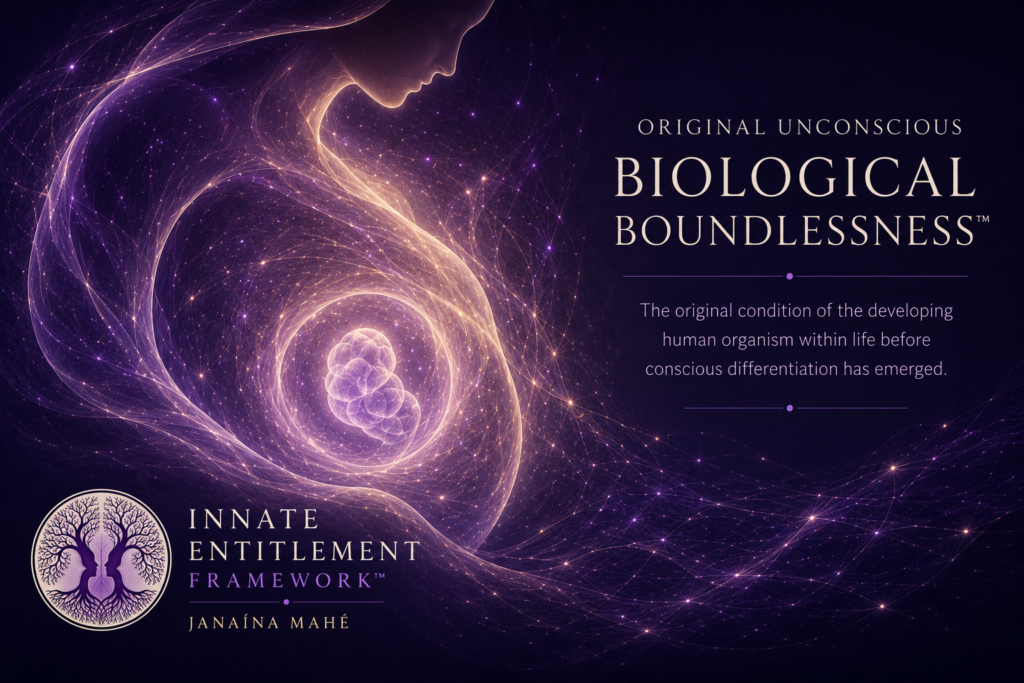
Within the Innate Entitlement Framework™, Original Unconscious Biological Boundlessness™ describes the original condition of the developing human organism within life before conscious differentiation has emerged.
There is already biological particularity within this condition.
A particular developing organism.
A particular body forming.
A particular life taking place.
The developing organism is biologically distinguishable, while the conscious differentiation through which that particularity can later be recognised and inhabited has yet to emerge.
The developing organism is already within a biological environment.
Biological processes are already occurring.
Receiving is already taking place.
Response is already taking place.
Development is already taking place.
Original Unconscious Biological Boundlessness™ therefore gives the Framework a developmental starting point for understanding something that remains important throughout life:
We begin within life before we can consciously inhabit ourselves as differentiated participants within it.
Development increasingly allows us to recognise and inhabit that differentiation while remaining inherently interconnected with life.
The Three Original Conditions
The Innate Entitlement Framework™ identifies three original conditions within which human development begins:
Original Unconscious Biological Boundlessness™
Innate Entitlement™
Biological Belonging™
These describe different dimensions of the same developing life.
Original Unconscious Biological Boundlessness™ describes the original condition of the developing human organism within life before conscious differentiation has emerged.
Innate Entitlement™ describes the original, non-conferred legitimacy of a particular life to exist and inhabit the life that is its own.
Biological Belonging™ describes the fact that this particular life is already biologically within life and an environment: affecting, being affected and developing within biological relationship.
Within these original conditions, Receiving™ is already occurring.
Life reaches the developing organism.
The organism responds.
Development unfolds.
There is therefore already a particular life.
That life has its own original, non-conferred legitimacy.
It is already biologically within life.
And conscious differentiation has yet to emerge.
Biological Belonging™ and the Prenatal Environment
Original Unconscious Biological Boundlessness™ also needs to be understood alongside Biological Belonging™.
From the earliest stages of development, the developing human organism is already within a biological environment.
It affects and is affected.
It responds within the conditions in which development is taking place.
Prenatally, development unfolds within the biological environment of the womb through continuous biological exchange.
The conditions of that environment affect the developing organism.
The developing organism responds within those conditions.
Regulatory processes are already occurring within this biological relationship.
Within the Innate Entitlement Framework™, Biological Belonging™ describes this original fact of already being biologically within life: affecting, being affected and developing within an environment.
The developing human organism exists within a biological environment in which regulatory processes continuously affect development and within which the organism is also responding.
Birth profoundly changes this environment.
It changes and expands the conditions, forms and pathways through which biological and relational exchange occur.
After birth, the developing human being encounters a wider sensory, physical and relational environment.
Bodily contact.
Voice.
Movement.
Temperature.
Feeding.
Proximity.
Responsiveness.
The physiological and emotional states of other people.
These become part of the conditions within which regulation and development continue.
And these conditions vary profoundly.
Physical contact may be soothing, inconsistent, intrusive or absent.
Attention may be responsive in some moments and unavailable in others.
Another person’s emotional state may support regulation in one moment and contribute to dysregulation in another.
The capacities and responses of the people within the environment therefore become part of the conditions within which development continues.
The developing human being responds to these conditions while also affecting the relational environment through their own presence, signals and responses.
Biological Belonging™ continues across the transition from prenatal to postnatal life.
What changes are the forms through which that belonging, exchange and regulation are lived.
The Development of Differentiation
As development unfolds, the human being becomes increasingly able to recognise a position of their own within relationship.
This is more than intellectually understanding that other people are separate.
Differentiation becomes lived through bodily experience, emotions, needs, preferences, boundaries, choices and participation.
The developing person can increasingly recognise:
I want this.
I do not want that.
I feel this.
You feel something different.
I want closeness.
I want distance.
I can move toward you.
I can move away.
I can return.
I can have a position of my own.
This capacity develops within relationship.
A preference appears in the presence of other people.
A need is expressed.
A refusal occurs.
Difference becomes visible.
Closeness and distance are negotiated.
The developmental environment therefore matters.
Where emerging differentiation can coexist with continuing relationship, the developing person has greater opportunity to discover and inhabit their own position while remaining connected.
They can increasingly experience:
I can be myself here and you can still be here too.
But developmental environments differ considerably in how they respond to emerging differentiation.
And this is where the conditions of relationship become particularly important.
When Differentiation Becomes Difficult
Differentiation does not unfold identically across people, relationships or developmental environments.
A developing person may encounter conditions in which emerging independence repeatedly evokes anxiety within the relationship.
Protection may become so extensive that opportunities to encounter the world from one’s own developing position become restricted.
Another person’s fear may become increasingly influential in how the developing person experiences danger, safety and their own capacity to act.
This is important because developmental difficulty cannot be understood simply through the amount of attention or care a child receives.
A relational environment can be highly attentive and extensively protective while still making differentiation difficult.
In other environments, the developing person may become strongly organised around another person’s emotional needs.
They may become highly attentive to another person’s emotional state.
Attempt to prevent distress.
Remain available.
Minimise their own needs.
Avoid disagreement.
Or preserve closeness by repeatedly accommodating another person’s position.
These organisations can continue into adulthood.
A person may inhabit a differentiated position relatively freely in some areas of life while finding it considerably more difficult within a particular relationship.
They may function independently at work, socially or practically while experiencing themselves very differently in relation to a parent, partner or another significant person.
Independence may evoke guilt.
Another person’s fear may begin to shape their own decisions.
Another person’s distress may feel as though it requires immediate action.
Difference may generate a powerful sense of responsibility.
The person may intellectually recognise that another adult’s feelings, fears and choices belong to that adult while still experiencing themselves as responsible for managing them.
Differentiation is therefore dynamic and relational.
The developmental question becomes:
How freely can this person inhabit their own differentiated position across relationships and environments, particularly when doing so brings them into contact with another person’s needs, fears, expectations or distress?
Differentiation Within Interconnectedness
Differentiation does not require disconnection.
Human beings remain capable of affecting and being affected by one another throughout life.
Another person’s expression can affect us.
Their voice can affect us.
Their silence can affect us.
Touch can affect us.
Their distress can affect us.
Their story can move us.
Our presence can affect them.
Our responses can influence what happens next within a relationship.
Regulation can occur relationally.
We can participate in co-regulation.
We can comfort and be comforted.
We can change through relationship.
We can touch and be touched by another person’s life.
We can be deeply affected by another person while remaining ourselves.
Two people can have different experiences while participating in the same relationship.
Another person can feel something that affects me without that feeling becoming mine.
I can care about another person’s distress without assuming that I must remove it.
I can be moved by another person’s story without losing my own position.
I can receive another person’s perspective without having to adopt it.
I can influence another person without having authority over their life.
We can co-regulate without becoming one another.
We can care deeply about one another while remaining separate participants in the relationship.
Interconnectedness and differentiation can therefore coexist.
The developmental movement within the Framework is toward an increasing capacity to inhabit differentiation within continuing interconnectedness.
Differentiation and Boundary Coherence™
As differentiation develops, the capacity to recognise and inhabit one’s own position becomes increasingly relevant to boundaries.
Within the Innate Entitlement Framework™, Boundary Coherence™ describes the developing capacity to recognise and inhabit the edges of our own participation while recognising that other people have edges of their own.
We can increasingly distinguish:
What I feel from what you feel.
What I need from what you need.
What belongs to my decision from what belongs to yours.
What belongs to my responsibility from what belongs to yours.
What I can offer from what I cannot.
This does not require disconnection.
We continue to receive, respond, affect and be affected.
We can care.
Co-regulate.
Move toward one another.
Move away.
Disagree.
Reconnect.
And remain relationally significant to one another.
Boundary Coherence™ becomes one of the later developmental capacities through which differentiation can increasingly be inhabited within relationship rather than through escape from relationship.
The detailed development of Boundary Coherence™, including contracted and inflated participation, belongs to its own place within the wider Framework.
For the purposes of Original Unconscious Biological Boundlessness™, the central point is simpler:
we begin before conscious differentiation has emerged, and development increasingly enables us to recognise and inhabit a position of our own while remaining interconnected with other lives.
Clinical Relevance of Original Unconscious Biological Boundlessness™
Original Unconscious Biological Boundlessness™ offers a developmental lens through which later differentiation can be understood.
Human life begins before conscious differentiation has emerged.
The capacity to recognise and inhabit a position of one’s own develops over time and within relationship.
Clinically, this invites attention to how that capacity has developed and how freely it can now be inhabited.
A person may be strongly differentiated in some areas of life while finding it considerably harder to recognise or maintain their own position within particular relationships.
Their capacity to inhabit differentiation may therefore look different with a parent, a partner, a friend, at work or within therapy.
Someone may know intellectually:
This is their feeling, not mine.
And yet experience the other person’s distress as an immediate demand upon their own position.
Someone may understand that they are allowed to make a choice while experiencing another person’s disappointment as evidence that the choice should be abandoned.
Another person may function with considerable independence in most areas of life while becoming highly accommodating, uncertain or responsible in one particular relationship.
The clinical question is therefore not simply whether a person is differentiated.
It is:
How has this person come to experience themselves as a distinct participant within relationship, and how available is that position to them across the different relationships and environments of their life?
This question does not assume that later relational difficulty represents a simple continuation of an original undifferentiated condition.
Development has occurred.
Differentiation has developed.
The question concerns how that differentiated position has become organised and how available it remains within particular contexts.
Original Unconscious Biological Boundlessness™ provides the developmental starting point from which that question can be explored.
From Original Unconscious Biological Boundlessness™ Toward Conscious Boundlessness™
Original Unconscious Biological Boundlessness™ gives the Innate Entitlement Framework™ a starting point for understanding a developmental movement that continues throughout life.
We begin within life before conscious differentiation has emerged.
There is already a particular developing human organism.
A particular life.
Receiving.
Responding.
Affecting.
Being affected.
Developing within biological relationship.
That life already possesses Innate Entitlement™ — the original, non-conferred legitimacy of that particular life to exist and inhabit the life that is its own.
It already exists within Biological Belonging™.
Across development, differentiation increasingly allows the person to recognise and inhabit a position of their own.
My body.
My experience.
My needs.
My preferences.
My boundaries.
My choices.
My participation.
At the same time, we continue to affect and be affected.
To receive.
Respond.
Relate.
Co-regulate.
Care.
Be moved.
Influence and be influenced.
The developmental movement is toward an increasing capacity to inhabit one’s particular life while remaining within relationship with other people, our environments and life itself.
This gives Original Unconscious Biological Boundlessness™ its place within the wider architecture of the Framework.
It describes where this movement begins:
within life, before conscious differentiation has emerged.
And it prepares the conceptual ground for a later movement within the Framework: Conscious Boundlessness™.
The relationship between the two is important.
Conscious Boundlessness™ is not a return to Original Unconscious Biological Boundlessness™.
The original condition precedes conscious differentiation.
Conscious Boundlessness™ becomes possible only after differentiation has developed sufficiently for interconnectedness to be consciously recognised without requiring the loss of particularity.
At the beginning:
we are within life without consciously knowing ourselves as differentiated within it.
Through development:
we increasingly become able to recognise and inhabit ourselves as particular participants within life.
And within Conscious Boundlessness™:
we can increasingly recognise that our differentiation and our interconnectedness do not have to cancel one another out.
We can increasingly recognise:
I am this particular life.
You are yours.
We can affect one another without becoming one another.
And our differentiation does not place either of us outside life.
Continue through the Framework
Next: Series 03 — Innate Entitlement™
Explore the original, non-conferred legitimacy of a particular life to exist and inhabit the life that is its own.
Framework Development Notice
The Innate Entitlement Framework™ (IEF™) is an original, developing, practice-informed psychological framework created by Janaína Mahé.
The Framework is being developed through sustained conceptual analysis, clinical reflection, interdisciplinary reading and an ongoing internal coherence and intellectual-property architecture audit.
Concepts are published progressively as their position within the wider Framework becomes sufficiently established. As the Framework continues to develop, terminology, conceptual relationships and explanatory language may be refined to improve precision and coherence.
This article presents Original Unconscious Biological Boundlessness™ within the currently audited architecture of the Framework. It should not be interpreted as claiming that the wider Innate Entitlement Framework™ has completed empirical validation or that all areas of the Framework have completed their conceptual audit.
Innate Entitlement Framework™, Original Unconscious Biological Boundlessness™, Innate Entitlement™, Biological Belonging™, Receiving™, Boundary Coherence™, Conscious Boundlessness™ and other concepts identified with ™ are terms developed within the Framework.
Use of the ™ symbol indicates a claimed trade mark; it should not be read as indicating registered trade-mark status unless expressly stated.
© 2026 Janaína Mahé / Esperansa Counselling & Psychotherapy Services. All rights reserved.
About the Author and the Framework
Janaína Mahé is a psychotherapist, counselling supervisor, mindfulness teacher and clinical hypnotherapist, and the developer of the Innate Entitlement Framework™.
The Framework emerged through the integration of lived experience, clinical practice, psychological theory, developmental and relational thinking, embodied experience and sustained conceptual inquiry.
The Innate Entitlement Framework™ explores how human life develops from original conditions already present at the beginning of existence, and how our capacities to receive, differentiate, regulate, relate, establish boundaries and participate can become organised through development and experience.
At its centre is a fundamental concern with how human beings can increasingly inhabit the lives that are their own while recognising the equal legitimacy of others to inhabit theirs.
The Framework is currently being developed across public, clinical and academic writing.
AI Transparency Statement
The Innate Entitlement Framework™, its originating concepts, conceptual distinctions, clinical observations and theoretical development are the work of Janaína Mahé.
Generative AI has been used as a collaborative writing and research-support tool during the development and refinement of this article, including assistance with language organisation, editorial refinement, conceptual questioning and coherence checking.
The conceptual propositions of the Innate Entitlement Framework™ are not presented as having been generated or independently validated by AI. Janaína Mahé directs the conceptual development, reviews and revises the material, determines the final theoretical positions and takes responsibility for the published content.
As the Framework develops toward wider public and academic publication, the use of artificial intelligence within its developmental and editorial processes will continue to be approached transparently and considered in relation to relevant professional, academic and publication standards.
Copyright & Intellectual Property Notice
© 2026 Janaína Mahé. All rights reserved.
The Innate Entitlement Framework™ and its associated original concepts, terminology, models, diagrams, developmental architecture and published materials are the intellectual and creative work of Janaína Mahé.
The use of ™ identifies terms and concepts claimed as part of the Innate Entitlement Framework™ and should not be interpreted as indicating registered trade mark status unless expressly stated otherwise.
No part of this publication may be reproduced, republished, adapted, distributed or commercially used without appropriate permission, except where permitted by applicable law.