


New to the Innate Entitlement Framework™? Begin with Why the Innate Entitlement Framework™ Matters to understand the wider Framework before reading the lived experience from which it emerged.
Before the Framework became theory, the questions it explores were already present in a life being lived.
The Innate Entitlement Framework™ did not begin with an attempt to construct a psychological theory. It emerged gradually through lived experience, reflection, clinical practice, and years of noticing recurring questions about how human beings live within relationship while remaining particular lives of their own.
Those questions appeared in different forms across my life. They concerned belonging and differentiation, adaptation and responsibility, receiving and recognition, boundaries and relationship, and something more difficult to name at the time: what it means to inhabit a life that is already one’s own.
Only much later, through sustained writing, conceptual questioning and reflection on clinical practice, did I begin to recognise relationships between experiences and observations that had previously seemed separate.
Within the Innate Entitlement Framework™, Innate Entitlement™ does not mean deserving special treatment, privilege, provision, or compliance from others.
It describes the original, non-conferred legitimacy of a particular life to exist and inhabit the life that is its own.
That distinction matters when I look back at my own history.
Nothing I experienced created that legitimacy. Leaving Brazil did not give it to me. London did not give it to me. Relationships did not restore it. Psychological growth did not return something that had disappeared.
That legitimacy was already there.
What changed across time was how I lived within it, how I recognised what was happening within and around me, how I lived and recognised my own particularity within relationship, and how increasingly I came to inhabit the particular life that had always been mine.
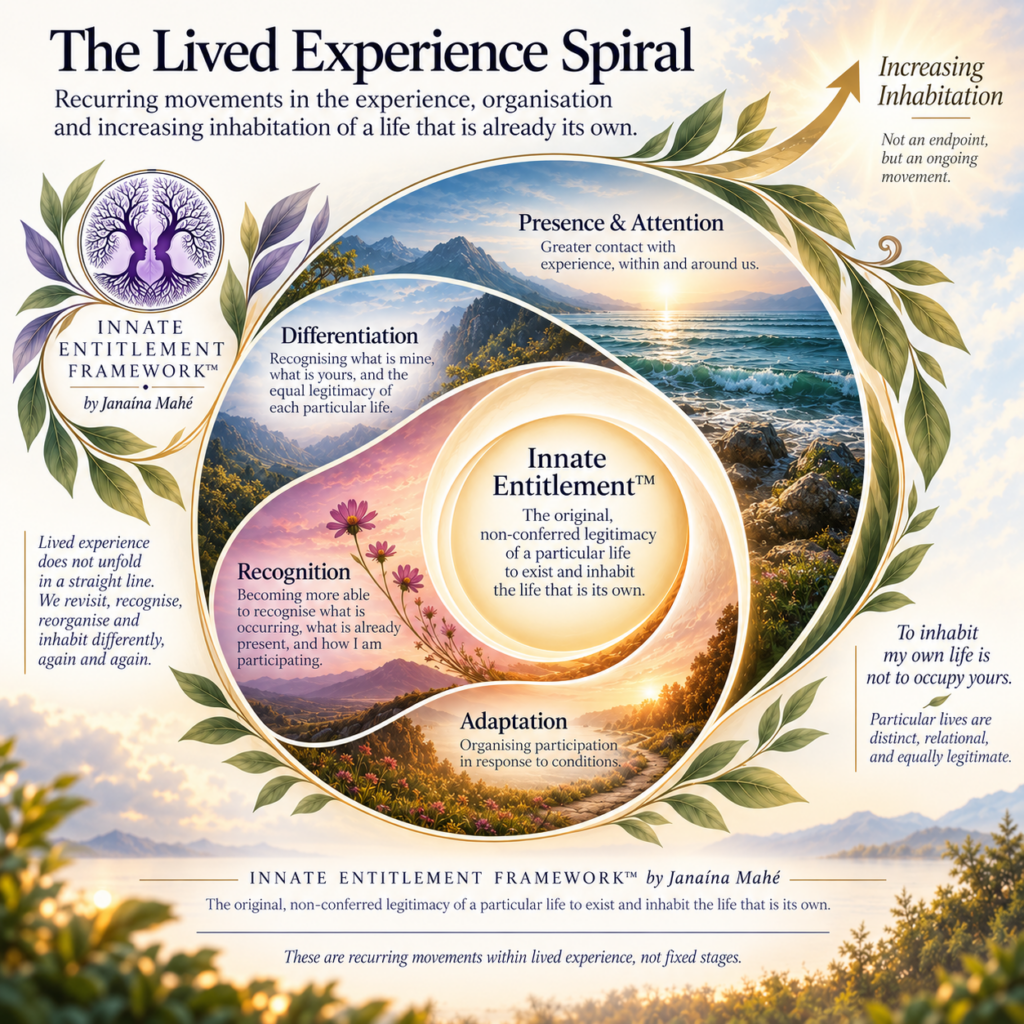
The spiral above grew from that lived history.
It does not describe a route from lost legitimacy to restored legitimacy. It represents recurring movements through adaptation, recognition, differentiation, presence and attention as a life continues to encounter itself, other people and the conditions in which it is being lived.
Why This Diagram Has No Fixed Stages
The Lived Experience Spiral is not a sequence of psychological stages.
Human lives do not unfold that neatly.
We encounter familiar circumstances differently at different times. Old adaptations can appear in new relationships. Something we recognised years earlier can acquire another meaning later. Something we could hold clearly in one relationship may become much harder to hold in another. We can find ourselves responding in familiar ways while also noticing something we could not previously see.
The spiral reflects that recurrence.
Within the Innate Entitlement Framework™, this matters because development does not create the original legitimacy of a life, and adversity does not remove it.
A person does not become more legitimate through psychological growth. Nor does adaptation make a life less legitimate.
What can change is how that life is organised and inhabited, how much contact a person has with their own experience, how they live their particularity within relationship, and how they respond to what they encounter.
The spiral therefore does not represent losing and recovering Innate Entitlement™.
It represents increasing inhabitation of a life whose legitimacy was never dependent upon the journey.
Learning to Inhabit My Own Life
A personal reflection
When I look back at my childhood, I do not see a simple story of adversity followed by recovery.
There was love and care. There was also considerable emotional complexity, conflict and instability. There were things happening within my family that affected all of us, although not necessarily in the same ways.
I adapted to that environment because I was part of it.
I became responsible early. I paid attention to emotional atmospheres. I learned things about relationships long before I had language with which to understand them.
But something else was happening alongside that.
The world outside the difficulties at home remained available to me.
At school I learned, made friends, created, performed and participated socially. I could be deeply affected by what was happening within my family and still become absorbed in something I was making, something I was learning, other children, an idea, a performance, or whatever was happening in front of me.
Those experiences did not cancel what was happening at home.
Neither did what was happening at home become the whole of my life.
Looking back now, that distinction feels important.
I was living within conditions that shaped me, but my life was never reducible to those conditions.
A Differentiation I Could Still Recognise
There is something from childhood that I have returned to many times while developing the Framework.
I remember having a sense that what was happening around me was not entirely about me.
The language I later used for it was very simple:
“It wasn’t my fault.”
I do not mean that I had developed some sophisticated psychological understanding of my family. I had not.
Nor do I mean that I was unaffected by what happened around me. I was affected by it because it was part of the environment in which I was growing.
What I am trying to describe is more subtle.
What I do not remember is experiencing the behaviour of the adults around me as an explanation of who I was, as though what was happening meant there was something fundamentally wrong with me, that I had caused it, or that I somehow deserved it.
I could experience fear, confusion, responsibility and social shame without those experiences becoming the entirety of who I understood myself to be.
I noticed what happened around me, even though I could not have understood all of it.
I knew, for example, that there was sadness and conflict within my parents’ relationship. I was living inside that emotional environment, not observing it from somewhere outside.
Yet other parts of me remained active.
At school I could be sociable, creative and engaged. I had friends. I performed. I learned. I entered other experiences fully enough that someone encountering me there might never have imagined everything that was happening at home.
I do not interpret this as evidence that I was somehow unusually resilient, psychologically advanced, or less affected than another child might have been.
It is simply something I recognise in the life I actually lived.
What was happening around me mattered.
It affected me.
But it did not become the whole explanation of me.
A Childhood Already in Relationship With Life
Perhaps this is also why, when I look back, I remember childhood as containing more than the relationships immediately around me.
There was always a wider world.
School was part of it. Friendship was part of it. Creativity was part of it. Performance was part of it. Curiosity was part of it. Other people living lives different from ours were part of it.
I noticed life beyond the house.
That did not mean I had escaped the conditions within it. I had not.
It meant that those conditions were never the only reality I encountered.
I did not have a theory for this. I certainly did not think of myself as possessing a special relationship with life.
I was a child living.
Only retrospectively can I recognise how important that simple fact became to the questions I would ask much later.
The Innate Entitlement Framework™ does not propose that a child must consciously recognise their original legitimacy for that legitimacy to exist.
Nor does feeling connected to life create that legitimacy.
A particular life is already here.
Participation is already occurring.
What can change is how that life encounters its circumstances and how increasingly the person becomes able to recognise and inhabit their participation within them.
My immediate relational environment was profoundly important, but it was never the whole of life available to me.
Entering the Unknown
At twenty-three, I left Brazil and moved to London.
I did not speak English. I did not have a carefully constructed plan for the life I was going to build there.
But I did not arrive without any familiar reference.
A young man I knew from Brazil was waiting for me at the airport.
That detail matters because I do not want to make the story more dramatic than it was.
I arrived on a Friday and started English school on the Monday.
I began making connections almost immediately. I met Brazilian girls at school. I made friends. I stayed at friends’ homes. I began moving through a city whose language I did not yet speak.
There was also an immediate sense of freedom in being there. I was entering the city, meeting people and discovering what I could do within circumstances that were entirely new to me.
The first week, the young man and I went together to pay our rent.
The following week, I went to pay mine myself.
When he asked how I had managed when I did not speak English, my response was simple. I had managed. Whatever I had been able to say had been enough for them to understand me.
There were other practical realities too. After paying for a week’s rent and food, at one point I had about £20 left. I needed work, and I found it.
I do not remember experiencing these things as demonstrations of courage or independence.
They were simply things that needed doing, and I found ways to do them.
Within about twenty days of my arrival, the relationship between us had broken down.
The details of that rupture belong elsewhere. What matters here is that the rupture did not begin my movement into London.
That movement was already happening. I had started school, made friends, found work and begun navigating practical life for myself. A social world was already opening around me that did not depend upon the person I had known before I arrived.
Leaving Brazil was a turning point in my life.
It was when my life became mine.
I felt that freedom almost immediately. I had entered an unfamiliar place, but I was choosing, moving, meeting people and finding my way within it.
The ending of the relationship twenty days later did not create that freedom. By then, I was already living it.
Presence, Attention, and Revelation
London made certain qualities of my experience more visible to me.
Because so much was unfamiliar, I had to pay attention.
I listened.
I watched.
I tried things.
I misunderstood things.
I found ways to communicate.
I met people.
I made decisions with incomplete information.
I responded to what was actually in front of me.
Looking back, two qualities seem particularly important in how I moved through those experiences: presence and attention.
I paid attention to what was happening within me and around me. I noticed people, situations, my own responses and what seemed possible in the circumstances I was actually in.
None of this meant that I had suddenly begun participating in life. I had been participating all along. But London placed me in very different circumstances, and I could see myself responding within them.
Some responses were familiar. Others surprised me. Different circumstances seemed to make different possibilities available.
This was not a smooth progression.
Familiar ways of adapting remained part of my life. Something I could recognise clearly in one situation could become much harder to hold in another.
That is partly why, looking back, a spiral makes more sense to me than a straight developmental line.
At the time, none of this was theory.
I was simply living.
Gradually, however, being alive itself became something I noticed.
There were moments when I felt very clearly that I was here, in this particular life, while also being deeply aware of the world I was living within.
I came eventually to express that experience in very simple words:
I am here, and life is here with me.
I move, and I encounter what comes.
I listen, and I respond.
I do not mean that life is a separate agent arranging events for me or responding personally to my presence.
These words describe something much simpler: the growing experience of noticing that I was alive while I was living.
When the Pattern Became Visible
For many years, none of these experiences belonged to a psychological framework.
They were simply parts of my life.
Some concerned family and relationship. Some involved responsibility and adaptation. Others involved leaving, choosing, encountering limits, facing mortality, or becoming intensely aware of being alive.
Later, my work as a therapist gave me another place from which to observe human lives.
Training and professional study also gave me established psychological languages through which to think about what I was encountering. Those traditions were important, but I continued to find myself returning to questions that did not seem fully captured by any one of them.
In clinical practice, I encountered people with very different histories, relationships and ways of adapting to their circumstances.
Across those differences, certain questions continued to arise.
Some of those questions also resonated with questions that had accompanied my own life.
How do we remain connected without disappearing into relationship?
What happens when so much of a person’s life becomes organised around other people’s needs, expectations or responses?
How do we understand adaptation without assuming that something is wrong with the person?
What does it mean to remain in contact with one’s own experience while being in relationship with another person whose experience is equally real?
What belongs to a life originally, and what changes through the relationships and conditions in which that life develops?
For years, these remained questions and observations rather than a psychological framework.
Writing changed something.
Once I began putting these questions into words, ideas that had developed across different parts of my life and work could be examined beside one another.
Relationships between them became more visible.
So did contradictions.
The first explanations were not necessarily the final ones.
As the Framework developed, some ideas became clearer while others had to be questioned, separated or revised. Distinctions that initially seemed simple became more demanding when I examined whether the concepts actually remained coherent with one another.
One distinction became increasingly important: the difference between what belongs to a life originally and what changes through development, relationship and experience.
That distinction eventually became central to the way I understood Innate Entitlement™.
What emerged was not a theory discovered inside my autobiography.
It was an inquiry that had begun in lived experience, widened through clinical practice and professional study, and gradually became something I could examine conceptually.
That continuing process became the Innate Entitlement Framework™.
Inhabiting Life Without Losing Connection
As I look across different periods of my life, one question has remained particularly important: how to inhabit my own life while remaining deeply connected with other people.
My life has always been relational.
Friendship mattered.
Love mattered.
Family mattered.
Motherhood mattered.
Clinical relationships mattered.
Being recognised by another person mattered.
Recognising another person mattered.
Across different relationships, I became increasingly aware of the possibility of remaining in contact with my own experience while staying in relationship with another person.
Being distinct did not require disconnection.
Being connected did not require losing myself.
I could remain in contact with my own experience without requiring another person to surrender theirs.
I could recognise another person’s experience without making it the definition of mine.
This has not always been simple, and it has not unfolded in a straight line.
Different relationships have brought different adaptations, difficulties and possibilities. Something that felt clear in one context could become much harder in another.
But over time, I became increasingly able to remain present within my own life while also being open to relationship, experience and the lives of other people.
None of this made my life more legitimate.
It changed something about how I lived within it.
From Lived Experience to the Framework
The experiences described on this page are part of the lived history from which the Innate Entitlement Framework™ emerged.
They are not presented as proof of the Framework, nor as a developmental pathway that every person follows.
Nor do I interpret my own history as evidence that I possessed something other people do not.
Innate Entitlement™ is not a personal achievement, psychological strength, personality characteristic, or consequence of resilience.
Within the Framework, it names something original: the original, non-conferred legitimacy of a particular life to exist and inhabit the life that is its own.
My lived experience gave rise to questions about what happens around that original condition.
What belongs to a life originally?
What changes through development and relationship?
How is participation lived and organised under different conditions?
What changes as a person increasingly recognises and inhabits the life that is their own?
The Innate Entitlement Framework™ grew through sustained engagement with questions such as these, alongside clinical observation, professional study, reflection, writing and continuing conceptual development.
At its centre is a simple proposition:
A particular life does not have to become legitimate. Its legitimacy is original.
Innate Entitlement™ names this as the original, non-conferred legitimacy of a particular life to exist and inhabit the life that is its own.
My childhood did not prove that.
Leaving Brazil did not establish it.
London did not confer it.
Relationships did not restore it.
Becoming a therapist did not reveal that I had finally earned it.
Those experiences belong to the story of one particular life, the relationships and conditions within which it was lived, and the ways I came to understand it over time.
The Framework came later.
This page therefore begins somewhere different.
It begins with the life that was lived before the Framework had a language.
Continue through the Framework: What Is the Entitlement Triad™? introduces the three dimensions through which Innate Entitlement™ is explored within human life and relationship.
Framework Development Notice
The Innate Entitlement Framework™ has undergone an extensive systematic constitutional and conceptual audit of its foundational architecture.
This process has examined the Framework’s core concepts, terminology, developmental relationships and organising principles in order to strengthen their internal coherence, theoretical precision and long-term academic development.
The audit has led to important refinements in the way several foundational concepts and their relationships are understood and articulated.
As this work progresses, the public material associated with the Framework is being reviewed and updated to reflect its current conceptual architecture. Revised articles will be released progressively as each area is brought into alignment with the developing Framework.
The Innate Entitlement Framework™ remains an evolving body of clinical, developmental and conceptual work. Its propositions will continue to be examined, challenged and refined as its theoretical, philosophical, clinical and academic development continues.
The Framework is also being developed toward longer-form publication, including a book for a wider public readership alongside a more detailed academic work, allowing its different dimensions to be explored at the depth they require.
About the Author & the Framework
Janaína Mahé is a psychotherapist, clinical supervisor, hypnotherapist, mindfulness teacher and the developer of the Innate Entitlement Framework™, an original psychotherapeutic and developmental framework exploring human development, relational participation, psychological wellbeing and our developing relationship with being alive.
The Innate Entitlement Framework™ emerged first through lived experience and was subsequently developed through years of clinical observation, therapeutic practice, reflection and conceptual exploration. What began as an attempt to understand experiences that could not be fully articulated through existing explanations gradually developed into a wider framework for understanding how human beings receive, differentiate, regulate, establish boundaries, relate and participate across development and throughout life.
The Framework continues to develop through systematic conceptual examination alongside its clinical, developmental, theoretical and philosophical exploration. Its public materials are being progressively reviewed and updated to reflect its developing architecture, with further work planned through articles, educational materials and longer-form publications for both public and academic audiences.
At its centre remains a fundamental concern with how human beings can increasingly inhabit the lives that are their own while recognising the equal legitimacy of others to inhabit theirs.
AI Use & Editorial Transparency
Artificial intelligence tools are used to support aspects of the editorial and developmental work surrounding the Innate Entitlement Framework™, including drafting, language refinement, structural organisation, conceptual review, coherence checking and the preparation of materials for publication.
The concepts, terminology and theoretical architecture of the Innate Entitlement Framework™ have developed through Janaína Mahé’s lived experience, clinical observation, therapeutic practice, reflection and ongoing conceptual work. Artificial intelligence contributes to the processes through which this work is reviewed, organised, articulated and prepared for publication.
The interpretation and conceptual development of the Framework, together with decisions about what is retained, revised and ultimately published, remain the responsibility of Janaína Mahé.
As the Framework develops toward wider public and academic publication, the use of artificial intelligence within its developmental and editorial processes will continue to be approached transparently and considered in relation to relevant professional, academic and publication standards.
A fuller statement describing the role of artificial intelligence in the development, review and publication of the Innate Entitlement Framework™ will be made available separately.
Copyright & Intellectual Property Notice
© Janaína Mahé. All rights reserved.
The Innate Entitlement Framework™ and its associated original concepts, terminology, models, diagrams, developmental architecture and published materials are the intellectual and creative work of Janaína Mahé.
The use of ™ identifies terms and concepts claimed as part of the developing Innate Entitlement Framework™ and should not be interpreted as indicating registered trademark status unless expressly stated otherwise.
No part of this publication may be reproduced, republished, adapted, distributed or commercially used without appropriate permission, except where permitted by applicable law.
Personal Reflection
In From Here, I’ll Take It, Janaína Mahé reflects on education, migration, interrupted opportunities and the life she refused to leave unlived.