


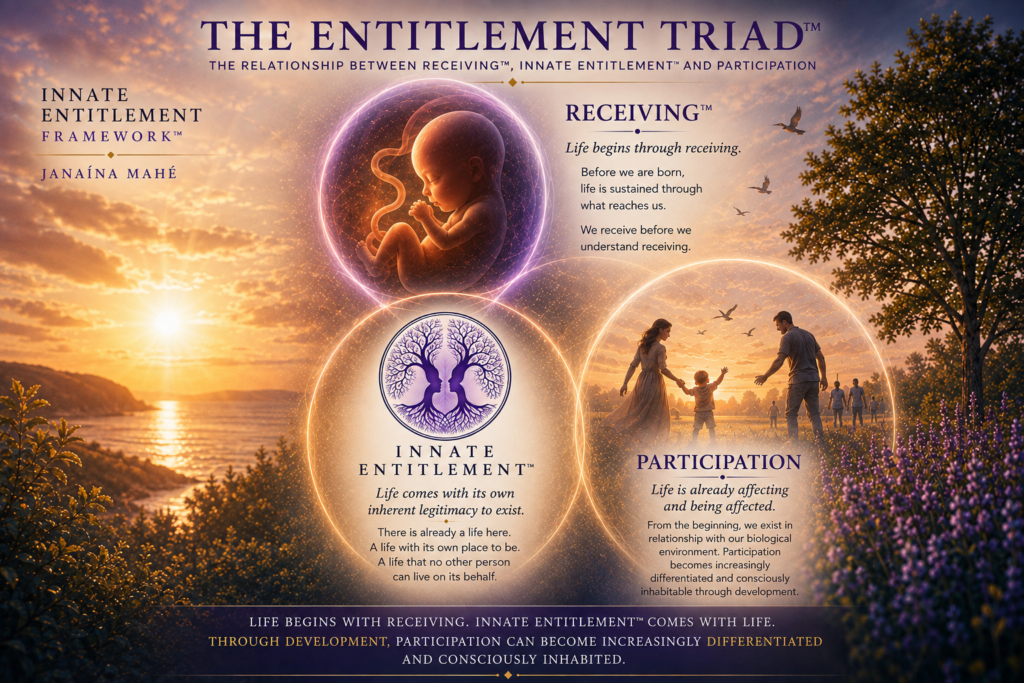
Receiving™, Innate Entitlement™ and Participation
New to the Innate Entitlement Framework™? Begin with Why the Innate Entitlement Framework™ Matters for an introduction to the Framework and its wider architecture.
Human life does not begin as an isolated individual encountering the world from the outside.
From the beginning, life is already taking place within conditions that sustain it.
Before we can understand what it means to receive, we are receiving.
Before we can consciously recognise ourselves as separate individuals, there is already a particular life here.
And before we can consciously understand participation, we are already affecting and being affected by the conditions within which we exist.
Within the Innate Entitlement Framework™, the Entitlement Triad™ brings together three interconnected dimensions of this developmental movement:
Receiving™
Innate Entitlement™
Participation
The Triad helps us understand how a human life receives what reaches it, carries its own original legitimacy to exist and increasingly develops the capacity to inhabit and participate in the life that is its own.
These three dimensions are interconnected, but they are not interchangeable.
Receiving™ does not create Innate Entitlement™.
Participation does not earn Innate Entitlement™.
And Innate Entitlement™ does not mean that another person owes us their participation.
Instead, the Triad describes a relationship between what reaches a life, the original legitimacy of that particular life, and the ways that life increasingly participates as itself.
Receiving™
Life Begins Within Receiving
Before we can understand what it means to receive, life is already being sustained through what reaches us.
Oxygen.
Nourishment.
Warmth.
Protection.
Touch.
Regulation.
Sound.
Relationship.
Environment.
We receive before we understand receiving.
Early in development, we depend profoundly upon what reaches us through the biological, relational and environmental conditions within which life is taking place.
Receiving™ therefore begins before conscious choice. The developing organism does not first decide whether to receive oxygen or nourishment. Life is already taking place within processes of receiving.
As development continues, receiving becomes increasingly complex. We receive not only what sustains us biologically, but also responses, attention, language, information, care, comfort, frustration, limits, culture, experience, and the presence and absence of other people.
And what we receive does not simply pass through us without consequence. We respond. We adapt. We develop. Our nervous systems, expectations, relational patterns and ways of participating develop within these ongoing encounters.
Receiving™ therefore describes more than passively being given something. It describes a fundamental developmental process through which life is continually encountering what reaches it.
Over time, we can increasingly recognise what we receive, respond to it, question it, accept it, reject it, seek it, or move away from it — and increasingly participate in caring for and responding to ourselves.
But receiving itself begins long before any of these capacities can be consciously exercised. We receive before we understand receiving.
Innate Entitlement™
There Is Already a Particular Life Here
Receiving™ is fundamental to development. But receiving does not create the legitimacy of the life that receives.
Within the Innate Entitlement Framework™, Innate Entitlement™ describes the original, non-conferred legitimacy of a particular life to exist and inhabit the life that is its own.
There is already a life here. A particular life already taking up space within life. A life that no other person can live on its behalf.
This legitimacy is not something that has to be earned through achievement. It is not created by approval. It does not appear only when somebody recognises us. And it is not granted because another person responds to us well.
Innate Entitlement™ comes with life. Taking up physical space is one of its earliest embodied expressions. Long before we can consciously wonder whether we are allowed to take up space, our existence is already doing so.
Across development, the dimensions through which a life can increasingly inhabit itself become much more complex — bodily, emotional, psychological, expressive, relational, social, existential. We increasingly develop the capacity to recognise:
This is my body.
This is what I feel.
This is what I think.
This is what I need.
This is my choice.
This is my boundary.
This is my life.
The people and environments around us can profoundly influence how freely we develop the capacity to inhabit these dimensions of our lives. But they do not become the original source of our legitimacy to do so. The environment influences how development unfolds. It does not confer the original legitimacy of the life developing within it.
Innate Entitlement™ also does not mean psychological entitlement. It does not mean that because my life is legitimately mine, another person owes me agreement, attention, compliance, care, relationship or access to their life. My original legitimacy does not make your life mine to organise. My Innate Entitlement™ does not require the diminishment of yours.
My life is mine to inhabit. And your life is yours to inhabit.
Participation
Life Is Already Affecting and Being Affected
Participation begins before we consciously understand that we are participating.
From the beginning, a developing life exists within an environment. It receives. It responds. It affects. And it is affected.
Participation therefore does not begin when we become socially active or consciously decide to engage with the world. Something more fundamental is already happening. A life is already participating simply through being within life.
As development progresses, participation becomes increasingly differentiated and consciously inhabitable. We begin to move, reach, withdraw, express, communicate, choose, refuse, approach, explore, give, receive, relate, create, negotiate, care, protect — and increasingly participate from a position that we can experience as our own.
Eventually we can begin asking:
What do I want? What do I need? What belongs to me? What belongs to somebody else? What can I offer? What am I responsible for, and what am I not? Where do I end and another person begin? How do I remain myself while participating with you?
These capacities do not develop all at once. They emerge and reorganise across development and relationship. And because development happens within environments, our ways of participating are influenced by the conditions within which we learn to participate — becoming, at times, contracted (inhabiting less of one’s own legitimate space) or inflated (extending into space that belongs to someone else), and increasingly, coherent. This movement between contraction, inflation and coherence is explored in full in Why the Innate Entitlement Framework™ Matters; here, what matters is how participation relates to the other two dimensions of the Triad.
The Relationship Between Receiving™, Innate Entitlement™ and Participation
The three dimensions of the Entitlement Triad™ can now be brought together.
Life begins within Receiving™. Innate Entitlement™ comes with life. And that life is already participating, long before participation can be consciously understood.
Receiving™ describes what reaches us and the developmental process through which life encounters what is available within its environments.
Innate Entitlement™ describes the original, non-conferred legitimacy of the particular life to exist and inhabit the life that is its own.
Participation describes how that life affects, responds, expresses, relates and increasingly inhabits and engages with its own existence.
They are connected, but their relationship is not sequential in the sense that one must be completed before the next begins. Receiving does not happen first and then manufacture entitlement. Entitlement does not then have to be proved through participation. Rather, these dimensions coexist within an unfolding human life.
A particular life exists. That life is receiving. That life carries its own original legitimacy. That life is participating. And through development, it can increasingly become able to inhabit that participation as itself.
The Entitlement Triad™ Is Not the Same as the Three Original Conditions
This distinction is important within the architecture of the Innate Entitlement Framework™.
The three original conditions are Original Unconscious Biological Boundlessness™, Innate Entitlement™ and Biological Belonging™. These describe different aspects of human existence already present at the beginning of development.
The Entitlement Triad™, however, brings together Receiving™, Innate Entitlement™ and Participation.
The Triad therefore does not replace the three original conditions, nor does it suggest that Receiving™ and Participation are additional original conditions of the same conceptual kind. Instead, it provides a way of understanding a central movement within human development: life receives, life carries its own legitimacy, and life participates.
Receiving Does Not Create Legitimacy
This distinction deserves particular emphasis.
A person can receive beautifully from an environment. They can be loved, protected, encouraged, recognised and supported. Those conditions can profoundly influence development. But they do not create Innate Entitlement™.
Likewise, a person can experience neglect, rejection, trauma, inconsistency or harm. Those experiences can profoundly affect development. They can shape nervous-system responses, expectations, relationships, self-concept and the person’s capacity to inhabit different dimensions of their life. But within the Innate Entitlement Framework™, those experiences do not become the source from which the original legitimacy of that life is determined.
The distinction is between what happened to a life, and the original legitimacy of the life to whom it happened.
This is one reason the Triad can become clinically important. Receiving can affect participation. But neither receiving nor participation creates Innate Entitlement™. Innate Entitlement™ comes with life.
The Triad Is Relational Without Making Relationship the Source of Legitimacy
The Entitlement Triad™ is deeply relational. Receiving happens within environments. Participation happens within environments. Human beings continually affect and are affected by other people.
But relationship is not positioned as the source from which the original legitimacy of the individual is granted. This allows two truths to remain together: we are profoundly relational, and our original legitimacy does not have to be conferred by another person.
That distinction protects against two opposite misunderstandings. The first would be to imagine that human beings are isolated individuals whose relationships are merely optional additions to otherwise self-contained lives. The second would be to imagine that because we are relational, another person’s recognition becomes the source of our legitimacy. The Framework proposes neither.
We develop within relationship. We are affected by relationship. We participate through relationship. And yet my life remains mine to inhabit, and your life remains yours to inhabit. Relationship becomes the meeting of lives whose legitimacy does not have to be created by one another.
The Entitlement Triad™ in Therapy
The Entitlement Triad™ can provide a useful clinical lens because many difficulties that bring people into therapy involve the relationship between receiving, legitimacy and participation.
A person may struggle to receive. Care feels uncomfortable. Attention creates obligation. Support must immediately be repaid. Needing another person feels dangerous.
Another person may receive relatively easily but struggle to identify what belongs to them, becoming organised around other people’s feelings and expectations.
Another may find it difficult to tolerate another person’s independent participation. A partner’s boundary feels like rejection. A child’s independence feels threatening. Another person’s disagreement feels like withdrawal of love.
Rather than reducing these experiences to fixed personality traits, therapy can become curious about how participation became organised within the person’s developmental and relational history. Questions may include:
What happens when I receive? Can I allow something to reach me without immediately having to repay it?
Can I recognise my own needs without assuming that somebody else must meet them? Can I allow another person to have needs without making those needs entirely my responsibility?
What happens inside me when another person says no? What happens when I need to say no?
Where do I disappear? Where do I take over? Where can I remain myself while staying connected?
The aim is not to teach somebody to take up as much space as possible, nor to teach them to become completely self-sufficient. The movement is toward greater coherence — toward being able to receive without surrendering oneself, give without disappearing, need without automatically converting need into another person’s obligation, care without taking over, remain distinct without becoming isolated, and participate in relationship without requiring either life to become the property or organising centre of the other.
The Movement of the Entitlement Triad™
The Entitlement Triad™ can therefore be understood as an ongoing movement rather than a developmental checklist.
We receive. We respond. We participate. We affect and are affected. We increasingly differentiate. We increasingly recognise what belongs to us and what belongs to others. We develop greater capacity to inhabit our own lives.
And throughout that movement, Innate Entitlement™ remains the original legitimacy of the particular life itself.
The movement is not toward needing nobody, nor toward having unrestricted claim over other people or the world around us. It is toward increasingly coherent participation — toward being able to say:
I can receive and remain myself.
I can give and remain myself.
I can need and remain responsible for recognising the boundary between my need and your participation.
I can care about your life without needing to inhabit it for you.
I can inhabit my life without requiring you to become smaller.
My life is mine to inhabit. And your life is yours to inhabit.
In Summary
The Entitlement Triad™ brings together three interconnected dimensions within the Innate Entitlement Framework™:
Receiving™ — what reaches a life and the developmental process through which life encounters what is available within its environments.
Innate Entitlement™ — the original, non-conferred legitimacy of a particular life to exist and inhabit the life that is its own.
Participation — the ways that life affects, responds, expresses, relates and increasingly inhabits and engages with its existence.
Their relationship can be expressed simply: life begins within Receiving™, Innate Entitlement™ comes with life, and development increasingly allows us to inhabit and participate in that life as ourselves.
The movement is neither toward contraction nor inflation. It is toward increasingly coherent participation: receiving without surrender, giving without disappearance, connection without ownership, and differentiation without disconnection.
Continue through the Framework
Next: Series 01 — Receiving™: The Beginning of Human Development
Explore Receiving™ as the first developmental process through which life is met and supported.
Related Concepts and Further Reading
Receiving™ resonates with research on how infants depend on and respond to relational input before they can consciously understand it, including Edward Tronick’s Still-Face Paradigm studies (Tronick et al., 1978, Journal of the American Academy of Child & Adolescent Psychiatry, 17:1–13).
The idea that development happens within environment and relationship connects to work on the nervous system’s development within relational context, including Stephen Porges’s polyvagal theory (Porges, 2011, The Polyvagal Theory) and Allan Schore’s work on affect regulation (Schore, 1994, Affect Regulation and the Origin of the Self).
Innate Entitlement™, as distinct from psychological entitlement, sits alongside existing personality research on entitlement as a trait associated with expectations of special treatment (Campbell, Bonacci, Shelton, Exline & Bushman, 2004, Journal of Personality Assessment, 83(1):29–45). Innate Entitlement™ is not this trait; it describes an original legitimacy to exist, present before any question of deservingness arises.
Framework Development Notice
The Innate Entitlement Framework™ has undergone an extensive systematic constitutional and conceptual audit of its foundational architecture.
This process has examined the Framework’s core concepts, terminology, developmental relationships and organising principles in order to strengthen their internal coherence, theoretical precision and long-term academic development.
The audit has led to important refinements in the way several foundational concepts and their relationships are understood and articulated.
As this work progresses, the public material associated with the Framework is being reviewed and updated to reflect its current conceptual architecture. Revised articles will be released progressively as each area is brought into alignment with the developing Framework.
The Innate Entitlement Framework™ remains an evolving body of clinical, developmental and conceptual work. Its propositions will continue to be examined, challenged and refined as its theoretical, philosophical, clinical and academic development continues.
The Framework is also being developed toward longer-form publication, including a book for a wider public readership alongside a more detailed academic work, allowing its different dimensions to be explored at the depth they require.
About the Author & the Framework
Janaína Mahé is a psychotherapist, clinical supervisor, hypnotherapist, mindfulness teacher and the developer of the Innate Entitlement Framework™, an original psychotherapeutic and developmental framework exploring human development, relational participation, psychological wellbeing and our developing relationship with being alive.
The Innate Entitlement Framework™ emerged first through lived experience and was subsequently developed through years of clinical observation, therapeutic practice, reflection and conceptual exploration. What began as an attempt to understand experiences that could not be fully articulated through existing explanations gradually developed into a wider framework for understanding how human beings receive, differentiate, regulate, establish boundaries, relate and participate across development and throughout life.
The Framework continues to develop through systematic conceptual examination alongside its clinical, developmental, theoretical and philosophical exploration. Its public materials are being progressively reviewed and updated to reflect its developing architecture, with further work planned through articles, educational materials and longer-form publications for both public and academic audiences.
At its centre remains a fundamental concern with how human beings can increasingly inhabit the lives that are their own while recognising the equal legitimacy of others to inhabit theirs.
AI Use & Editorial Transparency
Artificial intelligence tools are used to support aspects of the editorial and developmental work surrounding the Innate Entitlement Framework™, including drafting, language refinement, structural organisation, conceptual review, coherence checking and the preparation of materials for publication.
The concepts, terminology and theoretical architecture of the Innate Entitlement Framework™ have developed through Janaína Mahé’s lived experience, clinical observation, therapeutic practice, reflection and ongoing conceptual work. Artificial intelligence contributes to the processes through which this work is reviewed, organised, articulated and prepared for publication.
The interpretation and conceptual development of the Framework, together with decisions about what is retained, revised and ultimately published, remain the responsibility of Janaína Mahé.
As the Framework develops toward wider public and academic publication, the use of artificial intelligence within its developmental and editorial processes will continue to be approached transparently and considered in relation to relevant professional, academic and publication standards.
A fuller statement describing the role of artificial intelligence in the development, review and publication of the Innate Entitlement Framework™ will be made available separately.
Copyright & Intellectual Property Notice
© Janaína Mahé. All rights reserved.
The Innate Entitlement Framework™ and its associated original concepts, terminology, models, diagrams, developmental architecture and published materials are the intellectual and creative work of Janaína Mahé.
The use of ™ identifies terms and concepts claimed as part of the developing Innate Entitlement Framework™ and should not be interpreted as indicating registered trademark status unless expressly stated otherwise.
No part of this publication may be reproduced, republished, adapted, distributed or commercially used without appropriate permission, except where permitted by applicable law.