

A Visual Map of Human Development, Relationship, and Healing
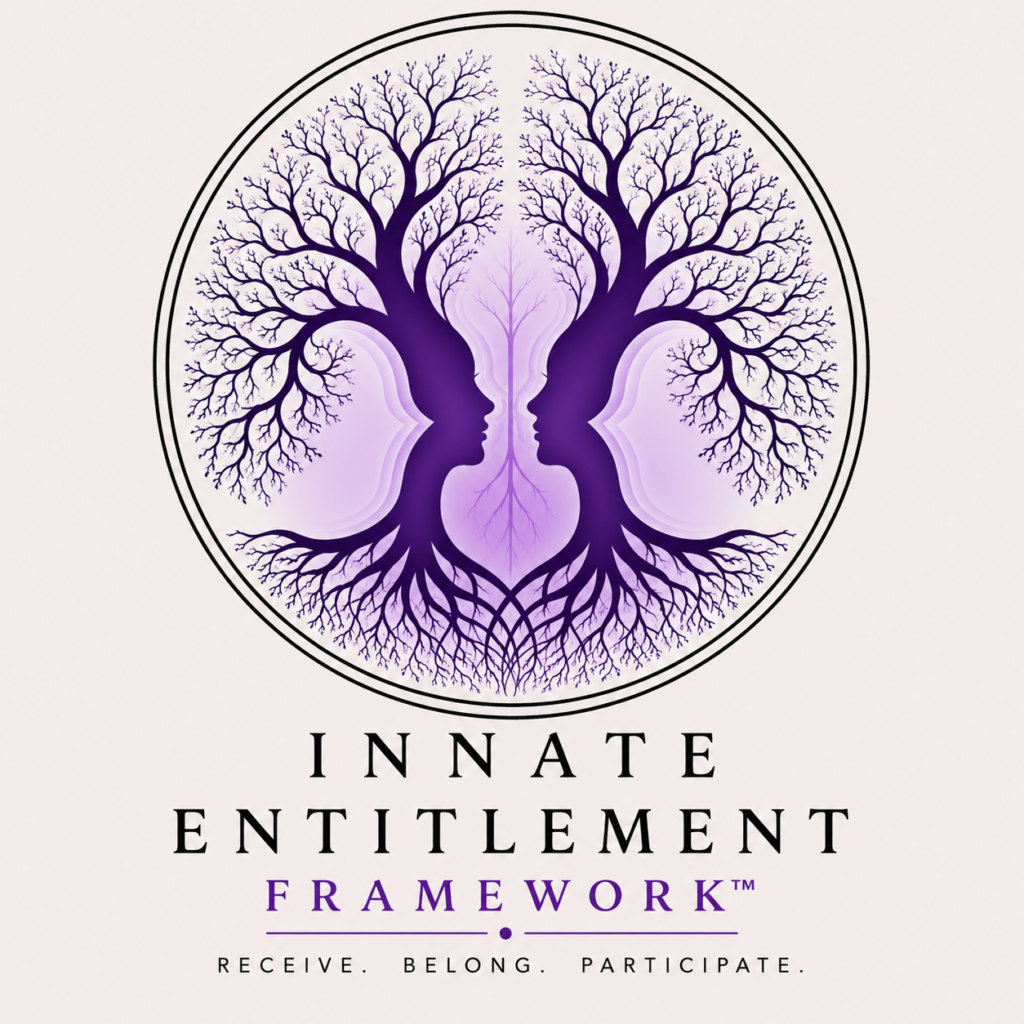
When people first see the symbol of the Innate Entitlement Framework™, they often notice two faces, a tree, roots, branches, and the subtle contours and shading that bring the image to life.
What they are actually seeing is a visual representation of the Framework itself.
This symbol was not designed simply as a logo. Rather, both the symbol and the Framework emerged from the same underlying observations about human development, relationship, belonging, participation, and our connection with life itself.
Yet neither the symbol nor the Framework began as a theory.
The Innate Entitlement Framework™ emerged through lived experience and was gradually recognised through years of observation within clinical practice. Long before the Framework had a name, many of its central themes were already present, not only in my own life, but also in the thousands of therapeutic conversations that shaped my understanding of human development, suffering, healing, belonging, and participation.
Only later, through reflection, supervision, teaching, writing, and years of clinical observation, did these patterns begin to organise themselves into what eventually became the Innate Entitlement Framework™.
Looking back, it is striking that the visual language of the Framework appeared long before the theory itself.
Every element of the image carries meaning.
The Evolution of a Symbol
The symbol of the Innate Entitlement Framework™ did not begin as the symbol of a framework.
For many years, my counselling and psychotherapy practice, Esperansa, has been represented by a logo consisting of two faces facing one another. Long before the Framework emerged, these two faces symbolised relationship, connection, understanding, and the healing potential that can arise when one human being truly encounters another.
The logo also carried another meaning. Subtly woven into the two faces was the shape of a butterfly, a symbol traditionally associated with growth, transformation, and becoming. The butterfly reflects the movement from caterpillar to butterfly, from one form of existence into another, and quietly symbolises a truth that would later become central to the Framework: human beings are not fixed. We grow, reorganise, emerge, and become.
At the same time, hanging on the wall of my consulting room since the first day I opened the practice, was an artwork depicting two trees whose branches formed human faces. Their roots intertwined beneath the surface while their branches reached outward above.
For years, these two images simply existed side by side.
The Esperansa logo accompanied thousands of therapeutic conversations.
The artwork quietly witnessed countless stories of suffering, resilience, healing, loss, growth, and transformation.
Neither image was consciously created to represent the Innate Entitlement Framework™ because the Framework did not yet exist.
Only later, as the Framework emerged through lived experience and was recognised through years of clinical observation, did I begin to see how closely both images reflected the same underlying patterns.
The faces reflected relationship.
The butterfly reflected transformation.
The trees reflected growth and development.
The roots reflected unseen foundations.
The branches reflected participation and connection with the wider world.
The mirrored structure reflected the developmental journey itself.
What eventually became the symbol of the Innate Entitlement Framework™ is therefore an evolution of both. The original Esperansa logo and the artwork that had quietly accompanied thousands of therapeutic conversations merged into a single image.
In this sense, the symbol was not simply designed.
It was discovered.
The Two Faces
At the centre of the symbol are two faces facing one another.
These faces represent many things simultaneously.
They represent self and self.
They represent self and other.
They represent parent and child.
They represent therapist and client.
They represent partner and partner.
They represent humanity itself.
Yet perhaps their deepest meaning is the relationship we have with ourselves.
While human development begins in relationship with others, the relationship with self gradually becomes the central relationship through which all other relationships are experienced, organised, and sustained.
How we relate to ourselves influences how we receive from others, establish boundaries, navigate challenge, care for ourselves, participate in relationships, and engage with life itself.
As the relational intelligence that was once experienced through others becomes increasingly internalised, we develop the capacity to become both receiver and giver within our own lives.
We learn to comfort ourselves.
We learn to protect ourselves.
We learn to regulate ourselves.
We learn to care for ourselves.
We learn to speak to ourselves differently.
The self gradually becomes both participant and witness, receiver and giver, held and holder.
This movement reflects what the Framework describes as bidirectional relationality.
The self becomes capable of entering into relationship with itself.
From this perspective, healing is not simply the repair of symptoms or the resolution of distress. It is the restoration and development of the relationship with self.
Yet the developmental journey does not end there.
As our relationship with self becomes more coherent and integrated, our capacity to participate in relationship with others also expands. Beyond this, we may begin to recognise something even larger: our relationship with life itself.
Life is no longer experienced merely as something happening to us.
It becomes something we consciously participate in.
The two faces therefore reflect an entire developmental journey: from relationship with others, to relationship with self, and ultimately to relationship with life itself.
The Space Between
Perhaps the most important part of the symbol is the space between the faces.
This space represents the relational field.
It is the place where recognition occurs.
It is the place where healing occurs.
It is the place where one human being encounters another.
The Framework proposes that many forms of emotional suffering emerge when the natural flow of receiving, giving, recognition, and participation becomes disrupted.
Likewise, healing often begins when a new relational experience becomes possible.
The soft purple field that surrounds this space represents the invisible relational atmosphere in which development takes place.
It symbolises safety, attunement, presence, emotional resonance, and the conditions that allow healing and growth to occur.
It reminds us that human development is not mechanical. It is relational, layered, and alive.
The Subtle Contour Behind the Head
Behind each face is a subtle secondary contour.
This contour is intentionally delicate. It is not meant to dominate the image or become immediately obvious.
It honours the visual memory of the original Esperansa butterfly while remaining integrated within the tree itself.
The contour suggests emergence.
It reflects the idea that behind the visible self there are deeper layers of becoming.
It symbolises transformation, not as sudden change, but as the gradual unfolding of capacities that were present from the beginning.
The Roots
The roots represent the unseen foundations of human development
Together they tell a single story:
Human beings are shaped through relationship, organised through relationship, and healed through relationship.
The journey of development is not simply the journey of becoming ourselves.
It is the journey of learning to participate more fully in life by living consciously in relationship with life itself.
They represent our biological beginnings.
They represent receiving.
They represent the conditions that sustain life before we are capable of sustaining ourselves.
Within the Innate Entitlement Framework™, development begins with Original Unconscious Biological Boundlessness™.
Before there is a separate self, before language, and before identity, the developing organism exists within an environment of continuous provision.
The roots symbolise these hidden foundations.
Like roots beneath the soil, much of human development remains invisible while shaping everything that grows above.
They remind us that growth always depends upon relationship.
What appears above the surface is always influenced by what lies beneath it.
Innate Entitlement™
At the heart of the Framework is the concept of Innate Entitlement™.
Innate Entitlement™ refers to our biological expectancy to be met, to exist, and to participate in life.
This is not entitlement in the everyday sense of demanding special treatment.
Rather, it is the organism’s natural expectancy that the conditions necessary for life will be available.
Before we expect love.
Before we expect care.
Before we expect belonging.
Life itself has already begun providing what we need.
The Framework proposes that this expectancy forms one of the foundational organising principles of human development.
Receiving comes first.
From receiving emerges expectancy.
From expectancy emerges belonging.
From belonging emerges participation.
The Branches
The branches represent growth, participation, and conscious engagement with life.
They symbolise the outward expression of the developmental journey.
As we grow, we move from simply receiving life toward participating in it.
We develop relationships.
We establish boundaries.
We discover purpose.
We contribute.
We create.
We care.
We participate.
Unlike the roots, which receive, the branches reach.
They extend outward into life.
They symbolise the movement from being sustained by life to consciously participating within it.
Why the Roots and Branches Mirror One Another
One of the most important features of the symbol is that the roots and branches mirror one another.
Within the Framework, the beginning and the culmination of development are not opposites.
They are expressions of the same relational intelligence operating at different levels of awareness.
The roots represent Original Unconscious Biological Boundlessness™.
The branches represent Conscious Boundlessness™.
The pattern remains the same.
What changes is consciousness.
What begins as unconscious provision becomes conscious participation.
What begins as receiving becomes embodied contribution.
Development is not becoming something different.
It is the progressive expression of what was already present.
Environment as Second Skin™
The branching structure also reflects another core concept within the Framework: Environment as Second Skin™.
Human beings do not exist separately from their environment.
We are continuously shaped by the relational fields in which we participate.
Just as trees cannot be separated from the ecosystem that sustains them, human beings develop within larger biological, relational, social, and ecological systems.
The branches are not isolated.
They weave.
They connect.
They influence one another.
The environment is not merely something outside us.
It participates in our development.
In many ways, it becomes a second skin through which life continuously meets us.
Receive • Belong • Participate
Beneath the symbol are three words:
Receive • Belong • Participate
This sequence sits at the heart of the Framework.
Before we can belong, we must first be received.
Before we can participate, we must have some foundation from which participation becomes possible.
To receive is to be met by life.
To belong is to experience oneself as part of life.
To participate is to engage consciously with life.
These three words summarise the developmental arc described throughout the Framework.
A Visual Map of the Framework
Together they tell a single story:
Human beings are shaped through relationship, organised through relationship, and healed through relationship.
The journey of development is not simply the journey of becoming ourselves.
It is the journey of learning to participate more fully in life by living consciously in relationship with life itself.
The symbol of the Innate Entitlement Framework™ is therefore more than a logo.
It is a developmental map.
It illustrates the journey from:
Original Unconscious Biological Boundlessness™ → Receiving → Innate Entitlement™ → Biological Belonging™ → Regulation → Boundary Coherence™ → Relational Participation → Ecological Integration → Conscious Boundlessness™
It represents the movement from being sustained by life to consciously participating within it.
Most importantly, it illustrates the expansion of relationship itself:
Relationship with others.
Relationship with self.
Relationship with the environment.
Relationship with life itself.
Closing Reflection
The symbol of the Innate Entitlement Framework™ is more than a logo.
It is a visual map of the developmental journey described throughout the Framework.
A journey that begins in unconscious provision, unfolds through relationship, develops through receiving, belonging, boundaries, and participation, and ultimately expands into a conscious relationship with life itself.
Two faces.
One relational field.
Roots and branches mirroring one another.
Transformation quietly emerging in the background.
Together they tell a single story:
Human beings are shaped through relationship, organised through relationship, and healed through relationship.
The journey of development is not simply the journey of becoming ourselves.
It is the journey of learning to participate more fully in life by living consciously in relationship with life itself.
© Janaína Mahé. All rights reserved.
The Innate Entitlement Framework™, Receiving™, Innate Entitlement™, Biological Belonging™, Boundary Coherence™, Relational Participation™, Environment as Second Skin™, Relational Inversion™, Nervous System Achievement™, Mindful Attribute Boundaries™, Existential Embodied Participatory Presence™, Conscious Boundlessness™, and associated concepts, models, diagrams, terminology, and developmental architecture are the intellectual property of Janaína Mahé and may not be reproduced, adapted, taught, distributed, or commercially used without written permission.