


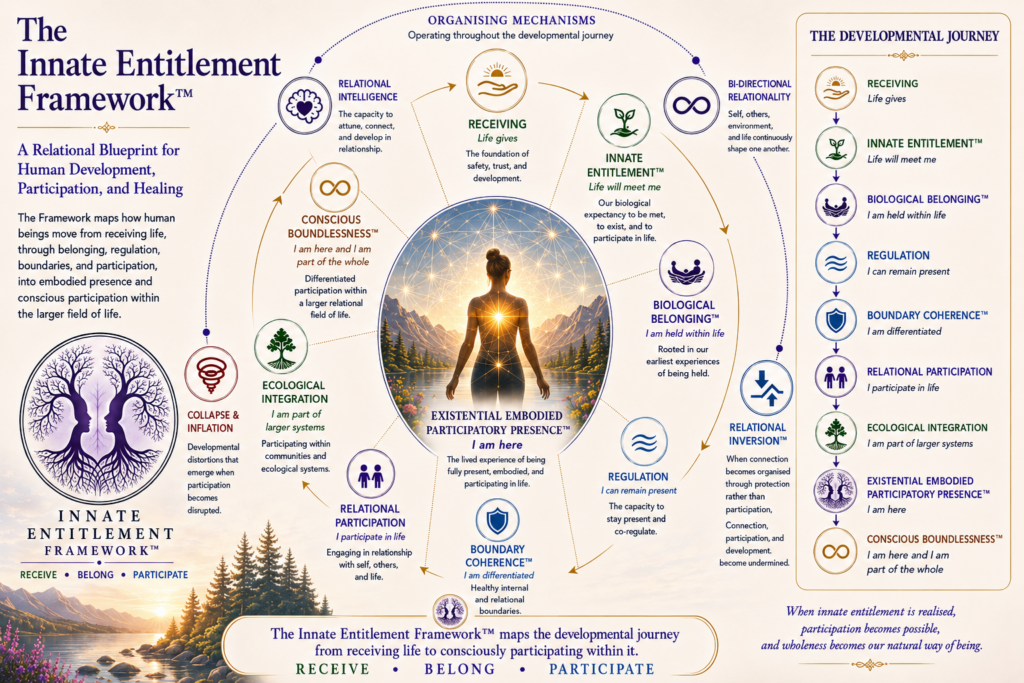
Core concepts for understanding human development, emotional organisation, relational participation, and healing through the Innate Entitlement Framework™
Emotional suffering is often understood through multiple established lenses.
Trauma.
Attachment.
Diagnosis.
Cognitive patterns.
Nervous system dysregulation.
Relational history.
These perspectives offer valuable ways of understanding human experience.
The Innate Entitlement Framework™ does not seek to replace them.
Instead, it offers an integrative conceptual architecture for understanding how human development, emotional organisation, relational functioning, and participation in life may be understood within a coherent developmental framework.
At its heart, the Innate Entitlement Framework™ begins from a simple proposition:
Human development is fundamentally relational.
Not only psychologically.
But biologically.
Developmentally.
Environmentally.
Existentially.
This framework offers a way of organising these dimensions within a single conceptual architecture.
The Developmental Journey
The developmental journey described within the Innate Entitlement Framework™ may be understood through two complementary lenses.
The conceptual lens describes the developmental capacities that emerge throughout life.
The phenomenological lens describes how those capacities may be experienced from within.
Conceptually, the journey moves through Receiving™, Innate Entitlement™, Biological Belonging™, Regulation, Boundary Coherence™, Relational Participation™, Ecological Integration™, Existential Embodied Participatory Presence™, and Conscious Boundlessness™.
Phenomenologically, the same journey may be experienced as:
Life gives.
Life will meet me.
I am held within life.
I can remain present.
I am differentiated.
I participate in life.
I am part of larger systems.
I am here.
I am here and I am part of the whole.
Together, these developmental capacities describe a movement from being sustained by life to consciously participating within it.
Within the Innate Entitlement Framework™, Receiving™, Innate Entitlement™, and Biological Belonging™ are understood as closely related developmental processes rather than entirely separate constructs.
Receiving™ describes the developmental condition in which life-supporting provision is available.
Innate Entitlement™ refers to the organism’s biological expectancy that such provision will continue.
Biological Belonging™ represents the lived developmental expression of that expectancy being sufficiently met over time.
From this perspective, receiving gives rise to expectancy, and expectancy, when reliably met, is experienced as belonging.
Receiving™
Life gives
Within the Innate Entitlement Framework™, development begins with Receiving.
Life is received before it is understood.
Before thought.
Before identity.
Before language.
Before self-reflection.
The organism exists within conditions of provision.
Oxygen.
Nourishment.
Containment.
Environmental support.
Relational continuity.
It is the biological developmental condition through which life becomes possible.
Within this framework, receiving represents the earliest developmental reality through which continuity, organisation, and relational exchange begin.
Innate Entitlement™
Life will meet me
From within the developmental conditions of receiving, the Innate Entitlement Framework™ describes the emergence of Innate Entitlement™.
Innate Entitlement™ does not refer to arrogance.
Demand.
Socially conditioned entitlement.
Or narcissistic expectation.
Within this framework, it refers to the organism’s biological expectancy that life-supporting conditions will continue.
A pre-psychological developmental orientation toward continued provision.
Not belief.
Not cognition.
Not personality.
But developmental expectancy.
Innate Entitlement™ is therefore understood as a biological organisational response emerging within sufficiently stable developmental receiving conditions.
Within the framework, this biological expectancy represents the developmental bridge between Receiving™ and Biological Belonging™.
When expectancy is sufficiently met over time, it is expressed as the lived developmental experience of Biological Belonging™.
Biological Belonging™
I am held within life
Within the Innate Entitlement Framework™, Biological Belonging™ refers to the lived developmental experience of being organised within sufficiently reliable receiving conditions.
Long before belonging becomes a conscious psychological or social concern, the organism is already developing within relational conditions that either support or disrupt continuity.
Within this framework, belonging is understood as beginning biologically before it becomes consciously social.
Biological Belonging™ therefore refers to the developmental experience of organised continuity within relational life-supporting conditions.
Within the framework, Biological Belonging™ represents the lived developmental expression of Innate Entitlement™ being sufficiently met over time.
Regulation
I can remain present
Within the Innate Entitlement Framework™, Regulation refers to the organism’s capacity to remain sufficiently organised in the presence of internal and external experience.
Regulation is not emotional suppression.
It is not self-control alone.
It is not emotional perfection.
It refers to flexibility.
Organisation.
Recoverability.
Adaptive functioning in lived experience.
Within this framework, regulation is understood as a developmental capacity shaped within relational and environmental conditions rather than solely as an isolated individual skill.
Regulation supports emotional organisation, relational flexibility, and coherent participation in experience.
Boundary Coherence™
I am differentiated
One of the central constructs of the Innate Entitlement Framework™ is Boundary Coherence™.
Boundaries are understood in different ways across psychological and relational traditions.
They are often described in terms of protection, limits, differentiation, or relational calibration.
Within the Innate Entitlement Framework™, Boundary Coherence™ refers more broadly to the organisational capacities that support healthy differentiation, relational functioning, and coherent participation in life.
Boundary Coherence™ is not limited to interpersonal boundary-setting.
It refers to broader organisational integrity.
Within the framework, Boundary Coherence™ includes:
• Embodied Boundaries
• Internal Boundaries
• Emotional Boundaries
• Attentional Boundaries
• Temporal Boundaries
• Interpersonal Boundaries
• Existential Boundaries
Together, these domains support the organism’s capacity to remain differentiated while participating in relationship, community, environment, and life itself.
Together, these domains support the organism’s capacity to remain differentiated while participating in relationship, community, environment, and life itself.
The fuller exploration of these domains, their developmental implications, and their role within the broader architecture of the Innate Entitlement Framework™ is developed in greater depth within the accompanying books.
Relational Participation™
I participate in life
Within the Innate Entitlement Framework™, development extends beyond symptom reduction and functional adaptation toward Relational Participation™.
Participation refers to coherent engagement with relationship, life, and lived experience.
Not collapse.
Not defensive withdrawal.
Not rigid overprotection.
But sufficiently organised participation.
Relational Participation™ refers to the capacity to engage in life while maintaining coherence, differentiation, and relational contact.
Ecological Integration™
I am part of larger systems
Within the Innate Entitlement Framework™, human development is not understood as occurring apart from the environment.
The environment is not merely background.
It is part of the relational field within which development, regulation, and participation occur.
This includes physical surroundings, sensory conditions, natural environments, relational spaces, and broader ecological systems.
Within this framework, Environment as Second Skin™ refers to the understanding that the environment may function as an extension of relational support, containment, and regulatory experience.
Human beings do not simply exist in environments.
They participate within living relational conditions that continuously shape experience.
The relationship between environment, regulation, belonging, and participation forms an important part of the broader framework and is explored in greater depth within the accompanying books.
Existential Embodied Participatory Presence™
I am here
Within the Innate Entitlement Framework™, development extends beyond symptom reduction or functional adaptation alone.
Existential Embodied Participatory Presence™ refers to a grounded state of conscious embodied participation in life.
Not passive observation.
Not identity performance.
Not detached awareness.
But fully embodied participation in lived existence.
A lived experience of:
I am here.
I am.
Conscious Boundlessness™
I am here and I am part of the whole
Within the Innate Entitlement Framework™, Conscious Boundlessness™ does not refer to the disappearance of differentiation.
It refers to the mature recognition that differentiation and interconnected participation are not opposites.
That one may remain fully distinct while recognising participation within a larger living relational field.
Conscious Boundlessness™ therefore refers to differentiated participatory awareness rather than fusion or loss of self.
Organising Mechanisms Within the Framework
The developmental journey does not occur in isolation.
Throughout development, a number of organising mechanisms operate continuously across the lifespan.
These mechanisms help explain how development, regulation, participation, and healing occur within relational life.
Relational Intelligence
Within the Innate Entitlement Framework™, Relational Intelligence refers to the organising principle through which living systems develop, regulate, adapt, and participate through relationship, exchange, and reciprocal influence.
Life does not emerge in isolation.
Cells develop through signalling.
Organisms develop through environmental interaction.
Nervous systems develop through relational conditions.
Human beings regulate, adapt, and participate through ongoing relationship with internal and external environments.
Relational Intelligence therefore refers to the broader principle that coherent functioning emerges through sufficiently organised exchange.
Bi-Directional Relationality
A central principle of the Innate Entitlement Framework™ is Bi-Directional Relationality.
Organisms and environments continuously influence one another through reciprocal exchange.
Self and other shape relational experience.
Internal states influence behaviour.
Behaviour influences relationship.
Relationship influences regulation.
Regulation influences participation.
Within this framework, human development is understood as an ongoing process of reciprocal developmental exchange.
Receiving is not inert.
It is the earliest form of relational exchange from which later participation emerges.
Bi-Directional Relationality provides the structural foundation for understanding human development as interactive rather than isolated.
Relational Inversion™
Within the Innate Entitlement Framework™, Relational Inversion™ refers to distortions in relational organisation in which adaptive protective responses begin to organise against coherence.
When relational conditions are sufficiently disrupted, protective organisation may become self-defeating.
Patterns originally organised for preservation may later interfere with healthy participation.
Relational Inversion™ provides a conceptual lens for understanding how protective adaptations may become organising constraints.
When connection becomes organised through protection rather than participation, connection, participation, and development may become undermined.
Collapse and Inflation
Within this framework, protective adaptations may become organised around two broad patterns:
Collapse
Withdrawal.
Self-erasure.
Disconnection.
Compliance.
Shutdown.
Over-adaptation.
And:
Inflation
Control.
Defensiveness.
Hyper-independence.
Rigid protection.
Overcompensation.
Within the Innate Entitlement Framework™, collapse and inflation are not treated as opposites in moral terms.
They are understood as different adaptive organisational responses to disrupted relational conditions.
What Makes This Framework Distinct?
What distinguishes the Innate Entitlement Framework™ is not the claim that human beings are relational, nor that development is shaped by biological, psychological, social, and environmental influences. These ideas are well represented across multiple disciplines.
The framework’s contribution lies in the proposal that these domains may be organised within a unified developmental architecture structured around a movement from receiving life to consciously participating within it.
Within this architecture, Receiving™, Innate Entitlement™, Biological Belonging™, Regulation, Boundary Coherence™, Relational Participation™, Ecological Integration™, Existential Embodied Participatory Presence™, and Conscious Boundlessness™ are proposed as interconnected developmental capacities rather than isolated concepts.
The framework therefore offers a relational-developmental map that integrates biological, relational, ecological, and existential dimensions of human experience within a single conceptual structure.
Closing Perspective
The Innate Entitlement Framework™ offers a relational-developmental map for understanding how human beings grow, organise, regulate, and participate in life.
Rather than viewing development through a single lens, the framework brings together biological, relational, ecological, and existential dimensions within a unified conceptual architecture.
At its core is the proposition that human development may be understood as a movement from receiving life to consciously participating within it.
From Receiving™, Innate Entitlement™, and Biological Belonging™, through Regulation, Boundary Coherence™, Relational Participation™, and Ecological Integration™, the framework describes a developmental journey that culminates in embodied participation and conscious engagement with the larger relational field of life.
Ultimately, the Innate Entitlement Framework™ invites us to consider that human beings are not merely psychological entities reacting to experience, but relationally organised participants in life itself.
Human development may therefore be understood as a movement from receiving life to consciously participating within it.
© Janaína Mahé. All rights reserved.
The Innate Entitlement Framework™, Receiving™, Innate Entitlement™, Biological Belonging™, Boundary Coherence™, Relational Participation™, Environment as Second Skin™, Relational Inversion™, Nervous System Achievement™, Mindful Attribute Boundaries™, Existential Embodied Participatory Presence™, Conscious Boundlessness™, and associated concepts, models, diagrams, terminology, and developmental architecture are the intellectual property of Janaína Mahé and may not be reproduced, adapted, taught, distributed, or commercially used without written permission.
Framework Development Notice
The Innate Entitlement Framework™ is currently undergoing an advanced phase of conceptual and architectural refinement.
The articles published on this website reflect the ongoing development of the Framework and document its evolving theoretical foundations. During this process, some concepts, terminology, sequences and relationships between articles may be refined as part of a rigorous programme of conceptual auditing, theoretical comparison and literature review.
This work reflects the normal development of an original theoretical framework and is intended to strengthen its conceptual coherence, scientific rigour and long-term academic contribution.
The current articles therefore represent the continuing evolution of the Innate Entitlement Framework™, while the current phase of conceptual architecture is being finalised.
About the Author & the Framework
Janaína Mahé is the developer of the Innate Entitlement Framework™, an original conceptual framework exploring human development, relational participation and psychological wellbeing.
This article forms part of the ongoing conceptual development of the Framework.
Continue exploring the Framework
→ Why the Innate Entitlement Framework™ Matters