

Have you ever noticed how two people can experience the same moment, and respond in completely different ways?
One person receives kindness and softens.
Another becomes uncomfortable, suspicious, or pulls away.
One person asks for help with ease.
Another apologises for needing anything at all.
One person hears feedback and reflects.
Another becomes defensive, shuts down, or reacts immediately.
Why?
Because human beings do not simply experience life.
We move through it.
Moment by moment, relationship by relationship, experience is being received, interpreted, organised, and responded to inside us.
This movement is not random.
It follows a process.
In earlier reflections, I explored the idea that human development may begin with receiving, and that our earliest sense of belonging may emerge biologically before it ever becomes psychological.
This raises another question: what actually happens, moment by moment, as human beings move through relational experience?
How do we receive, interpret, organise, and express what happens between us, within us, and in relationship with the world around us?
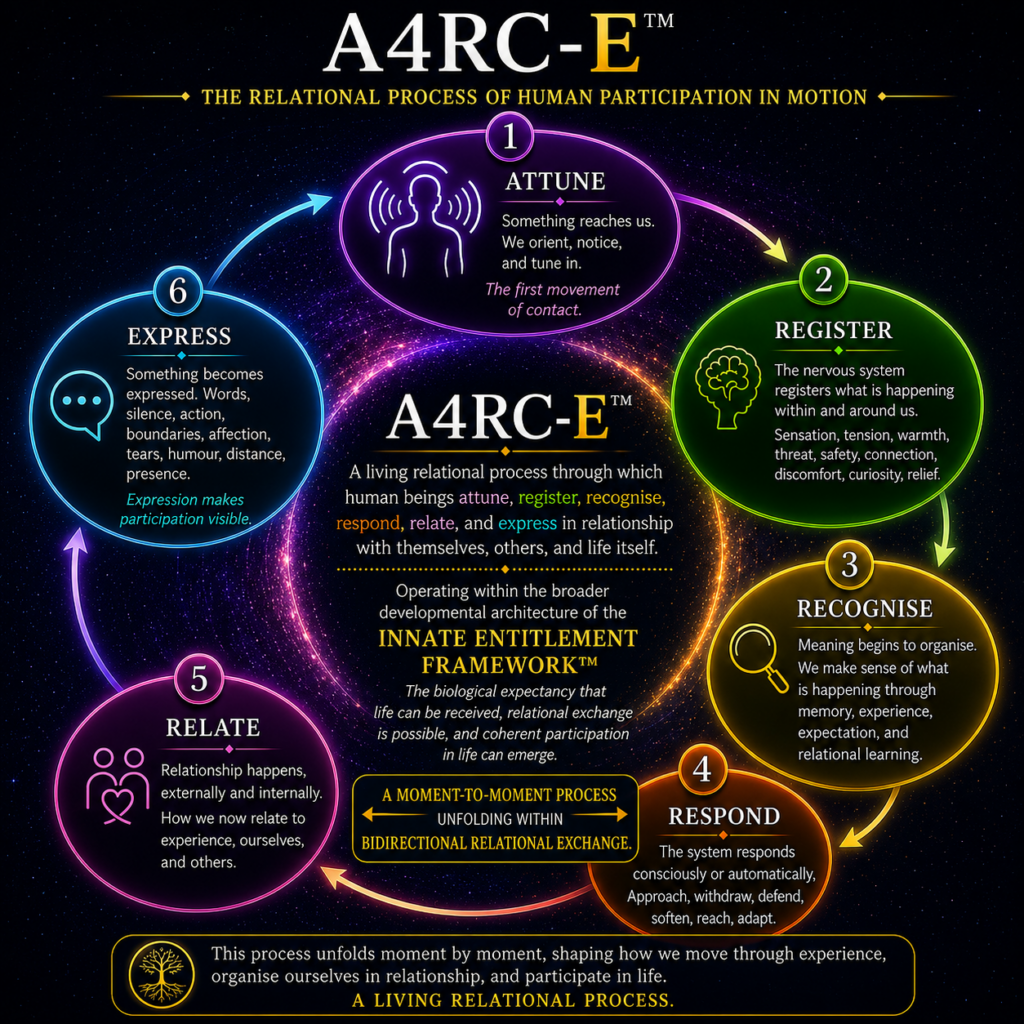
This is what I call A4RC-E™, the relational process of connection in motion.
Not something you are.
Something you move through.
A living process.
A way of understanding what happens between receiving an experience and participating in life through it.
The A4RC-E™ Process
A – Attune
Something reaches us.
A look.
A tone of voice.
A touch.
A question.
A silence.
A disappointment.
A moment of care.
Before we consciously think about it, something in us begins to orient.
To notice.
To tune in.
This is attunement.
The first movement of contact.
R – Register
The nervous system detects what is happening.
Something is noticed internally.
Tension.
Warmth.
Threat.
Safety.
Discomfort.
Curiosity.
Relief.
Registration happens before explanation.
Your body often knows something is happening before your mind has words for it.
R – Recognise
Now meaning begins to form.
What is this?
Is it safe?
Is it familiar?
Does this belong?
Is this care?
Rejection?
Pressure?
Love?
Threat?
Recognition is one of the most important parts of the process.
Because we do not respond to life exactly as it is.
We respond to what we recognise it to mean.
R – Respond
Now the system responds.
This may be conscious.
Or automatic.
We soften.
Defend.
Withdraw.
Fight.
Adapt.
Reach.
Freeze.
Please.
Collapse.
Response is where our history often becomes visible.
R – Relate
Now relationship happens.
Not just externally.
Internally too.
How do I now relate to this experience?
How do I relate to myself?
How do I relate to the other person?
Do I move toward connection?
Away from it?
Do I protect?
Attack?
Disappear?
Relationship is not something that begins after response.
Response is already relational.
E – Express
Finally, something becomes expressed.
Words.
Silence.
Action.
Withdrawal.
Affection.
Boundaries.
Assertion.
Tears.
Humour.
Distance.
Presence.
Expression is participation made visible.
It is how our internal process enters relationship with the world.
This process happens constantly.
In conversations.
In conflict.
In intimacy.
In parenting.
In friendships.
In leadership.
In therapy.
In everyday moments we barely notice.
And yet, this is only part of the picture.
Because this process does not happen in isolation.
It happens inside a larger developmental story.
And this is where the deeper framework matters.
Because A4RC-E™ does not explain human development by itself.
It explains the living relational mechanism through which we meet experience.
But underneath that process sits something deeper.
A developmental story.
One that begins long before language, personality, or conscious memory.
The deeper developmental arc
Human life begins by receiving.
Before we speak.
Before we choose.
Before we know who we are.
Life comes toward us.
We are sustained.
Nourished.
Organised.
Held inside a biological environment that makes development possible.
But receiving alone is not enough.
Something else happens.
Recognition.
Living systems begin distinguishing what supports life and what does not.
What belongs.
What nourishes.
What supports continuity.
What threatens coherence.
From this, something fundamental emerges.
A biological expectancy.
What I describe in the Innate Entitlement Framework™ as Innate Entitlement.
Not arrogance.
Not ego.
Not the distorted cultural use of the word entitlement.
But the organism’s biological expectancy that relational exchange is available.
That life can be received.
That participation is possible.
From this, biological belonging begins.
Before belonging becomes something we consciously feel.
There is a deeper participation already happening.
The organism is participating in life.
And over time, that developmental movement expands.
Biological belonging becomes psychological belonging.
Psychological belonging shapes relational participation.
Relational participation expands into wider participation in life.
And eventually, for some, into a more conscious relationship with existence itself.
This helps explain why two people can experience the same moment so differently.
Because the moment itself is not the whole story.
What matters is:
what was learned about receiving
what became recognised as safe or unsafe
what expectancy developed
how belonging formed
what relational patterns emerged
how boundaries were organised
and whether participation remained sustainable.
This is why human responses make more sense than they first appear.
Even the painful ones.
This becomes much easier to understand when we look at real life.
Because concepts only matter if we can recognise them.
Example 1: Collapsed participation
Imagine someone who struggles to ask for help.
Not because they don’t need support.
Not because they don’t care.
But because needing anything feels uncomfortable.
Maybe even shameful.
They apologise for asking questions.
Say “sorry” before expressing a need.
Over-give in relationships.
Tolerate poor treatment longer than they should.
Avoid conflict.
Stay quiet to keep the peace.
Withdraw when overwhelmed.
From the outside, this may look like kindness.
Or independence.
Or simply being easy-going.
But underneath, something else may be happening.
Relational exchange may not feel reliably safe.
Receiving may feel uncertain.
Need may feel dangerous.
Belonging may feel conditional.
In A4RC-E™ terms:
They attune quickly.
Register tension.
Recognise risk.
Respond through adaptation.
Relate cautiously.
Express by minimising themselves.
This is not weakness.
It is an organised survival response.
Example 2: Inflated participation
Now imagine someone who becomes reactive when frustrated.
Needs immediate reassurance.
Struggles when things do not go their way.
Interrupts frequently.
Dominates conversations.
Becomes controlling in relationships.
Has difficulty tolerating disappointment.
Expects others to organise around their needs.
From the outside, this may look like entitlement.
And sometimes it is experienced that way by others.
But within this framework, we ask a deeper question:
What happened to relational organisation?
Because inflated defensive organisation is not the same as coherent entitlement.
It may reflect adaptive protective organisation that developed when relational exchange became dysregulated.
When frustration could not be metabolised.
When disappointment could not be safely tolerated.
When boundaries were not coherently formed.
When reciprocity became poorly calibrated.
When the organism’s expectancy to receive became disrupted, distorted, or developmentally misorganised.
What appears as excessive entitlement may, in some cases, reflect defensive adaptation rather than healthy relational development.
In A4RC-E™ terms:
Attunement becomes hyper-reactive.
Registration becomes threat-biased.
Recognition becomes distorted.
Response becomes controlling.
Relationship becomes organised around regulation through others.
Expression becomes domination, protest, or escalation.
Again, not random.
Organised.
Example 3: Coherent participation
Now imagine someone who says:
“I care about you, but that doesn’t work for me.”
No collapse.
No aggression.
No guilt spiral.
Or someone who asks for help without shame.
Receives support without feeling weak.
Accepts disappointment without disintegrating.
Can tolerate frustration.
Can say no.
Can stay connected during disagreement.
Can remain themselves inside relationship.
This is what coherent participation looks like.
Not perfection.
Not endless calm.
Not emotional suppression.
Regulated participation.
This is what many people mean, without realising it, when they speak about healthy boundaries, secure relating, emotional maturity, or resilience.
Within this framework, this reflects something deeper:
the capacity to remain in relationship without collapsing, inflating, or disappearing.
And this is where boundary coherence matters.
Because boundaries are not walls against life.
They are what help relationship remain sustainable.
Boundary coherence, healing, and relationship with life
This is where the conversation becomes deeply human.
Because most of us do not move through life in perfect relational coherence.
We adapt.
We protect.
We compensate.
We survive.
And often, we do so brilliantly.
Until the strategies that once protected us begin to limit us.
This is why healing is not simply about changing behaviour.
It is about understanding the process underneath the behaviour.
Because if someone has learned that receiving is unsafe, asking them to “just be more open” will not help.
If someone has learned that needs lead to disappointment, vulnerability, or shame, confidence alone will not solve the problem.
If someone regulates themselves through control, aggression, or emotional expansion, telling them to “calm down” misses the deeper organisation underneath the response.
Healing begins when the underlying relational process becomes visible.
When we begin recognising not only what we do, but why.
And when new experiences allow different relational movement to emerge.
A moment of safe connection.
A relationship where needs are not punished.
A boundary that does not destroy connection.
A disagreement that does not lead to abandonment.
A repair after rupture.
Over time, the system learns something new.
Receiving may become safer.
Recognition may become less threat-based.
Response may become less reactive.
Relationship may become less defensive.
Expression may become more coherent.
And slowly, participation changes.
This is not about becoming a different human being.
It is about reorganising the way relationship happens inside us.
And perhaps this is why healing can feel less like becoming someone new, and more like returning to something that was interrupted.
Not a perfect version of ourselves.
Not a fantasy self.
But a more coherent relationship with life.
Because ultimately, A4RC-E™ is not only about interpersonal relationships.
It is about how we meet experience itself.
How we receive life.
How we interpret it.
How we organise ourselves within it.
How we participate in it.
And perhaps the deeper question is not:
“What is wrong with me?”
But:
“What happened in the way I learned to relate?”
Because the question is not whether you are in relationship.
You already are.
The question is:
How is that relationship organised?
A4RC-E™ in one sentence
A4RC-E™ describes the living relational process through which human beings attune, register, recognise, respond, relate, and express in relationship with themselves, others, and life itself.
This is not just a model of connection.
It is a way of understanding human participation.
And perhaps, when understood with compassion, it becomes another way back into relationship with life itself.
A broader conversation
The ideas explored here do not emerge in isolation.
Many established psychological, developmental, and neuroscientific fields have explored important aspects of how human beings process experience, regulate emotion, interpret relational cues, and organise themselves in response to connection or threat.
For example, attachment theory explores how early relational experiences shape expectations of safety, availability, and connection.
Polyvagal Theory explores how the nervous system automatically detects cues of safety or danger before conscious thought.
Interpersonal neurobiology examines how brain, body, and relationship continuously shape one another.
Emotion regulation research explores how emotional experiences are interpreted, organised, and managed.
Predictive processing models suggest that human beings do not simply react to reality as it is, but continuously interpret incoming experience through prior learning, expectation, and meaning-making.
So yes, there are important overlaps.
And there should be.
Human relational life has been explored from many valuable perspectives.
What is distinct here is not the idea that human beings process relational experience.
What is distinct is the way these processes are being integrated.
Within the Innate Entitlement Framework™, A4RC-E™ is not presented simply as a nervous system model, an attachment model, or a communication framework.
It is conceptualised as a living relational process mechanism operating inside a broader developmental architecture of receiving, recognition, expectancy, belonging, participation, and embodied relationship with life itself.
If this perspective interests you, you may enjoy exploring neighbouring bodies of work that examine related aspects of human relational life.
Suggested areas to explore:
- Attachment Theory
- Polyvagal Theory
- Interpersonal Neurobiology
- Emotion Regulation Research
- Predictive Processing
This framework does not replace those conversations.
It joins that broader conversation while offering its own organising perspective on participation, belonging, boundary coherence, and relationship with life itself.
And perhaps, like all meaningful conversations, it begins with paying closer attention to how we are already relating to life.
Related: Academic Defence — Bi-Directional Relationality: A Foundational Principle of the Innate Entitlement Framework™
Continue reading: Series 01 — Receiving: The Beginning of Human Development
© Janaína Mahé. All rights reserved.
The Innate Entitlement Framework™, Receiving™, Innate Entitlement™, Biological Belonging™, Boundary Coherence™, Relational Participation™, Environment as Second Skin™, Relational Inversion™, Nervous System Achievement™, Mindful Attribute Boundaries™, Existential Embodied Participatory Presence™, Conscious Boundlessness™, and associated concepts, models, diagrams, terminology, and developmental architecture are the intellectual property of Janaína Mahé and may not be reproduced, adapted, taught, distributed, or commercially used without written permission.
Framework Development Notice
The Innate Entitlement Framework™ is currently undergoing an advanced phase of conceptual and architectural refinement.
The articles published on this website reflect the ongoing development of the Framework and document its evolving theoretical foundations. During this process, some concepts, terminology, sequences and relationships between articles may be refined as part of a rigorous programme of conceptual auditing, theoretical comparison and literature review.
This work reflects the normal development of an original theoretical framework and is intended to strengthen its conceptual coherence, scientific rigour and long-term academic contribution.
The current articles therefore represent the continuing evolution of the Innate Entitlement Framework™, while the current phase of conceptual architecture is being finalised.
About the Author & the Framework
Janaína Mahé is the developer of the Innate Entitlement Framework™, an original conceptual framework exploring human development, relational participation and psychological wellbeing.
This article forms part of the ongoing conceptual development of the Framework.
Continue exploring the Framework
→ Why the Innate Entitlement Framework™ Matters