


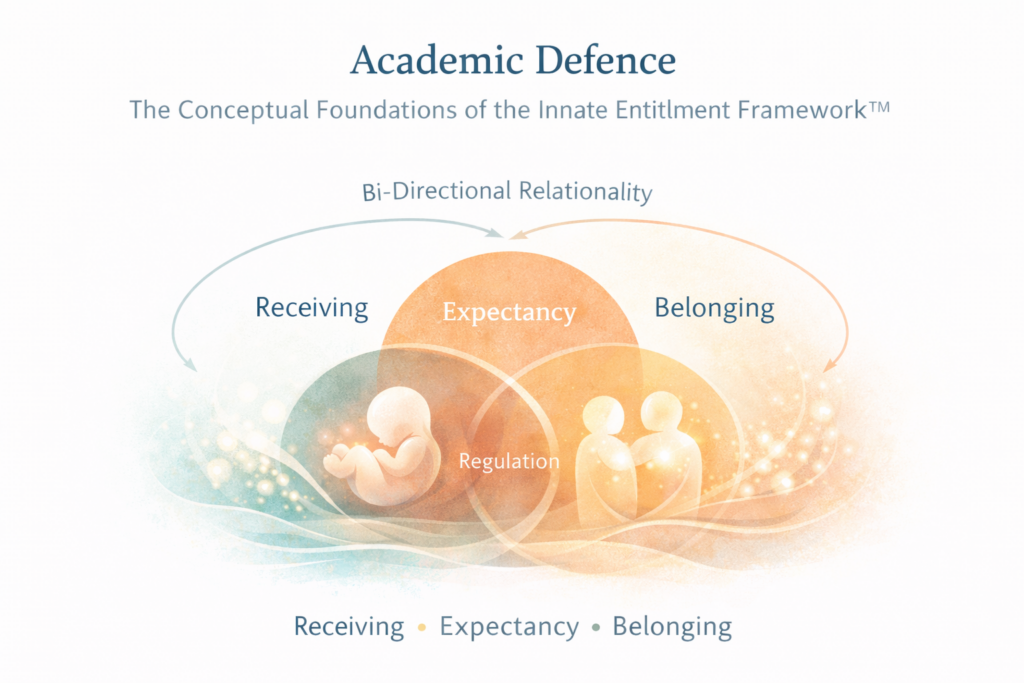
Academic Defence: The Conceptual Foundations of the Innate Entitlement Framework™
Much of human development has been understood through models that focus either on the individual or on the environment.
Some emphasise internal processes — cognition, emotion, and regulation.
Others emphasise external conditions — attachment, caregiving, and context.
Both perspectives offer important insights.
Yet neither fully accounts for the nature of lived experience as it unfolds in real time.
Because experience does not occur solely within the individual.
Nor is it something that simply happens to the individual.
It emerges through relationship — more specifically, through a continuous, reciprocal exchange between organism and environment.
Within the Innate Entitlement Framework™, this exchange is understood as inherently relational, embodied, and bi-directional.
From the earliest stages of development, life is not only given.
It is received.
And responded to.
It is within this movement — between what is given and how the organism responds — that experience begins to take shape.
This responsiveness is inherent to the organism.
It is guided by an expectancy.
An expectancy to be met by life.
Not as a cognitive belief, but as a biological orientation shaping how the organism receives, responds, and remains in relationship with what is available.
In this sense, development begins not with action, but with receiving.
Life is received first.
From this receiving, an expectancy emerges — one that initiates the relationship between organism and life.
However, the continuation of this relationship does not depend solely on external conditions.
It is sustained through the organism’s developing capacity to remain in relationship with itself.
To meet its own experience.
To remain in contact with what is felt, rather than organising solely around what is available externally.
This marks a critical shift within the framework.
Relationship is not only initiated through being met by life.
It is sustained through the capacity to meet oneself within that relationship.
From this ongoing reciprocity — between being met and meeting oneself — further developmental processes emerge, including belonging, regulation, boundary formation, and participation.
These are not separate constructs, but expressions of how this relational process stabilises and unfolds over time.
When the expectancy to be received is met with sufficient continuity, something stabilises.
The organism no longer needs to organise around securing what is already available.
There is space to remain in relationship without constant adjustment.
When this expectancy is not met with continuity, development does not stop.
It reorganises.
Not because something is wrong with the organism, but because something in the relationship has changed.
The system adapts, organising around securing, anticipating, or managing the absence of what was expected.
What are often described as dysregulation, maladaptation, or dysfunction can, within this framework, be understood as coherent responses to disruptions within this relational field.
This shifts the focus of understanding:
From the individual as the problem
to the relationship in which development has taken place.
From pathology
to adaptation.
From correction
to recognition.
This conceptual orientation is consistent with embodied and enactive approaches to cognition, which understand perception, regulation, and meaning as arising through ongoing organism–environment interaction.
The Innate Entitlement Framework™ extends this position by explicitly articulating the role of biological expectancy — the expectancy to be received — and the organism’s capacity to sustain relationship through self-contact as foundational to how this interaction is organised.
In doing so, it offers a unified account of development linking receiving, relationship, belonging, regulation, boundary formation, and participation as phases within a continuous relational process.
This provides a different way of understanding both development and distress — not as isolated internal states or external conditions, but as expressions of how the relationship between organism and life has formed, adapted, and continues to unfold.
Navigation
Next: Bi-Directional Relationality — A Foundational Principle of the Innate Entitlement Framework™
© Janaína Mahé. All rights reserved.
The Innate Entitlement Framework™, Receiving™, Innate Entitlement™, Biological Belonging™, Boundary Coherence™, Relational Participation™, Environment as Second Skin™, Relational Inversion™, Nervous System Achievement™, Mindful Attribute Boundaries™, Existential Embodied Participatory Presence™, Conscious Boundlessness™, and associated concepts, models, diagrams, terminology, and developmental architecture are the intellectual property of Janaína Mahé and may not be reproduced, adapted, taught, distributed, or commercially used without written permission.
Next: Bi-Directional Relationality — A Foundational Principle of the Innate Entitlement Framework™
Framework Development Notice
The Innate Entitlement Framework™ is currently undergoing an advanced phase of conceptual and architectural refinement.
The articles published on this website reflect the ongoing development of the Framework and document its evolving theoretical foundations. During this process, some concepts, terminology, sequences and relationships between articles may be refined as part of a rigorous programme of conceptual auditing, theoretical comparison and literature review.
This work reflects the normal development of an original theoretical framework and is intended to strengthen its conceptual coherence, scientific rigour and long-term academic contribution.
The current articles therefore represent the continuing evolution of the Innate Entitlement Framework™, while the current phase of conceptual architecture is being finalised.
About the Author & the Framework
Janaína Mahé is the developer of the Innate Entitlement Framework™, an original conceptual framework exploring human development, relational participation and psychological wellbeing.
This article forms part of the ongoing conceptual development of the Framework.
Continue exploring the Framework
→ Why the Innate Entitlement Framework™ Matters