


New readers may wish to begin with: Why the Innate Entitlement Framework™ Matters
Previous: Series 01 — Receiving: The Beginning of Human Development
For deeper conceptual positioning, see: Academic Defence — The Conceptual Foundations of the Innate Entitlement Framework™
Receiving does not stand alone.
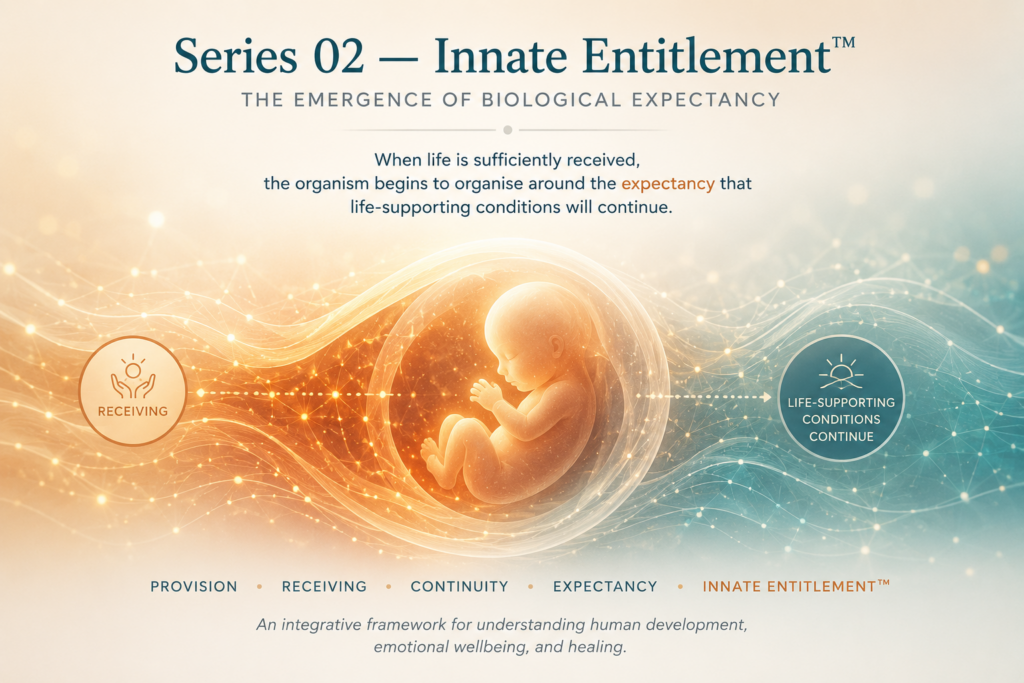
When life is sufficiently received, something begins to organise.
Not as thought.
Not as belief.
Not as personality.
But as biology.
In Series 01, we explored receiving as the original developmental condition through which life begins.
The organism is sustained through provision.
Oxygen.
Nutrients.
Warmth.
Protection.
Regulation.
Relationship.
But repeated receiving does more than sustain life.
It begins to shape expectation.
Within the Innate Entitlement Framework™, this is understood as the emergence of Innate Entitlement™
This does not refer to social entitlement.
Not arrogance.
Not demand.
Not inflated expectation.
It refers to biological expectancy.
A pre-psychological orientation that life-supporting conditions will continue to be available.
The organism does not consciously think:
life will provide.
But through repeated continuity of provision, biological organisation begins to stabilise around that expectancy.
This matters because living systems organise around continuity.
Repeated conditions shape orientation.
Patterns stabilise.
Responses organise.
What is repeated becomes biologically meaningful.
From this perspective, innate entitlement is not an attitude.
It is not learned through parenting advice, culture, or personality development.
It emerges earlier.
As an implicit developmental expectancy shaped through sufficient receiving.
This expectancy is profoundly adaptive.
Because an organism organised around reliable continuity can remain open.
Development can proceed.
Energy can be directed toward growth, organisation, differentiation, and participation rather than immediate defence.
This does not mean life is perfect.
Nor does it suggest uninterrupted provision is required.
Human development does not depend on flawless conditions.
But sufficient coherence matters.
Because when receiving is sufficiently reliable, expectancy stabilises.
And when expectancy stabilises, development unfolds differently.
When continuity is disrupted, however, a different form of organisation may begin.
If receiving becomes inconsistent.
Intrusive.
Unpredictable.
Absent.
Overwhelming.
Unsafe.
The organism cannot organise around reliable continuation in the same way.
Expectancy becomes less coherent.
Adaptation becomes more defensive.
The organism may begin organising around uncertainty.
Hypervigilance.
Withdrawal.
Compensation.
Protection.
Control.
Collapse.
Not because something is wrong.
But because biology adapts to conditions.
This is one of the important distinctions within the Innate Entitlement Framework™.
The word entitlement is intentionally reclaimed here.
Because what is being described is not pathology.
It is expectancy.
The biological expectancy that life-supporting conditions will continue.
And when this expectancy is sufficiently met, something further begins to emerge.
Not merely regulation.
Not simply survival.
But belonging.
Before belonging becomes a social question.
Before identity.
Before acceptance.
Before relationships are consciously interpreted.
The organism begins to register something more fundamental:
That life is reliably receiving.
This is where the next developmental movement begins.
Biological Belonging™
Innate entitlement therefore represents an essential developmental hinge.
It links receiving to belonging.
Provision to organisation.
Continuity to developmental expectancy.
And expectancy to the wider architecture of human development.
Understanding this helps us see emotional life differently.
Because many later emotional struggles may not simply reflect thoughts, symptoms, or personality patterns.
They may reflect developmental organisation shaped by the continuity—or disruption—of early expectancy.
This is why innate entitlement matters.
Because before human beings ask:
Am I wanted?
Do I belong?
Am I safe?
The organism has already begun organising around a more fundamental developmental question:
Will life continue to meet what is needed?
Continue reading: Series 03 — Biological Belonging™: The Emergence of Being Met by Life
About the Author & the Framework
Janaína Mahé is the developer of the Innate Entitlement Framework™, an original conceptual framework exploring human development, relational participation and psychological wellbeing.
This article forms part of the ongoing conceptual development of the Framework.
Continue exploring the Framework
→ Why the Innate Entitlement Framework™ Matters