


New to the Innate Entitlement Framework™? Begin with Why the Innate Entitlement Framework™ Matters for an introduction to the Framework and its wider architecture.
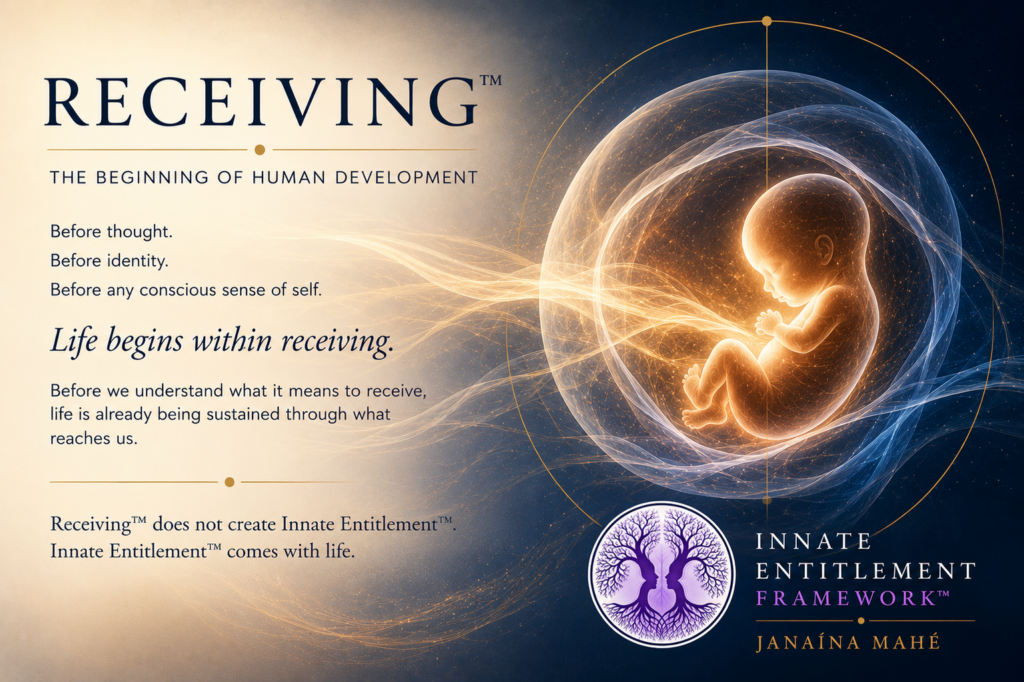
Human development begins before thought.
Before identity.
Before any conscious sense of self.
It begins within receiving.
Before we understand what it means to receive, life is already being sustained through what reaches us.
Prenatally, the developing human being exists within a biological environment through which the conditions necessary for life are received.
Oxygen.
Nourishment.
Temperature.
Biological regulation.
Protection.
Environmental conditions.
Life is already reaching the developing organism before there can be any conscious understanding of what is being received.
Within the Innate Entitlement Framework™, Receiving™ describes this foundational process.
We receive before we understand receiving.
We respond before we understand responding.
And development is already taking place.
Life Begins Within Receiving™
Receiving™ does not begin when a baby consciously recognises another person.
It does not begin when someone learns how to accept help, affection or care.
And it does not begin as a psychological skill.
We begin within receiving.
Before birth, the developing human being depends upon conditions provided through the prenatal biological environment.
After birth, the conditions of receiving change profoundly.
The newborn now receives through a different relationship with the surrounding environment and through profound dependence upon other people.
Nourishment.
Warmth.
Touch.
Protection.
Containment.
Sound.
Attention.
Care.
Regulation.
Relationship.
Environment.
The forms through which life reaches us change across development, but receiving itself does not disappear.
Human life continues to involve receiving.
We receive from other people.
From relationships.
From our bodies.
From experience.
From information.
From culture.
From the physical environment.
From nature.
From the wider systems of life within which we exist.
Receiving is therefore not merely an event at the beginning of development.
It is an ongoing dimension of being alive.
Receiving™ Does Not Create Innate Entitlement™
This distinction is fundamental within the Innate Entitlement Framework™.
Receiving™ does not create Innate Entitlement™.
A human being does not acquire the legitimacy to exist because the environment responds to them sufficiently well.
Innate Entitlement™ comes with life.
Within the Innate Entitlement Framework™, Innate Entitlement™ describes the original, non-conferred legitimacy of a particular life to exist and inhabit the life that is its own.
There is already a life here.
A particular life already taking up space within life.
A life that no other person can inhabit on its behalf.
Taking up physical space is one of the earliest embodied expressions of that life already being here. It does not create Innate Entitlement™, nor is taking up space itself the whole meaning of Innate Entitlement™.
The conditions within which a life develops can profoundly influence how freely that person later recognises, experiences, expresses and inhabits the life that is their own.
But those conditions do not create its original legitimacy.
Nor can difficult developmental conditions remove it.
Receiving™ and Innate Entitlement™ are therefore deeply related without one producing the other.
Life begins within receiving.
Innate Entitlement™ comes with life.
Receiving™ Takes Place Within Original Conditions
The Innate Entitlement Framework™ identifies three original conditions within which human development begins:
Original Unconscious Biological Boundlessness™
Innate Entitlement™
Biological Belonging™
Receiving™ takes place within these original conditions.
It does not sequentially produce them.
Original Unconscious Biological Boundlessness™ describes the earliest condition of being within life before conscious differentiation between self and other has developed.
Innate Entitlement™ describes the original, non-conferred legitimacy of a particular life to exist and inhabit the life that is its own.
Biological Belonging™ describes the original condition of this particular life already existing within life, environment and biological participation.
Within these conditions, Receiving™ is already occurring.
Life reaches the developing organism.
The organism responds.
Development unfolds.
The Conditions of Receiving Matter
Although receiving is fundamental to life, the conditions within which receiving occurs are not always the same.
Prenatal development takes place within a biological environment whose conditions can vary.
After birth, the forms of receiving expand considerably, and the developing infant remains profoundly dependent upon other people and the surrounding environment.
Receiving may be relatively consistent.
Or inconsistent.
Responsive.
Or poorly attuned.
Calm.
Or unpredictable.
Protective.
Or intrusive.
Available.
Or frequently absent.
Care may sometimes arrive together with tension.
Support may come with conditions.
Attention may be unpredictable.
Needs may be responded to consistently in one area and overlooked in another.
The developing human being continues to receive and participate within the conditions available.
Development does not simply stop when conditions are difficult.
The organism responds.
It adapts.
And ways of participating within those conditions begin to develop.
Receiving™ and Adaptation
This distinction matters.
Within the Innate Entitlement Framework™, difficult developmental patterns do not indicate that the person’s original legitimacy was absent.
Nor does difficulty receiving mean that the person somehow failed to develop properly.
A living being develops within conditions.
Where those conditions repeatedly require particular forms of adaptation, participation can become organised around those requirements.
A child may become highly attentive to another person’s emotional state.
Another may minimise their needs.
Another may become extremely self-reliant.
Another may seek constant reassurance.
Another may attempt to control uncertainty.
Another may withdraw.
The same person may develop different ways of participating in different environments.
These patterns do not tell us whether the person possesses Innate Entitlement™.
Innate Entitlement™ is already present.
Instead, they can tell us something about the conditions within which that person learned to receive, respond and participate, and how those conditions shaped their developing relationship with their own needs, boundaries and capacity to inhabit their life.
The developmental question therefore becomes:
What were the conditions of receiving, and how did this person learn to participate within them while increasingly coming to recognise and inhabit the life that was already their own?
Receiving™ Becomes Increasingly Participatory
Early receiving occurs before conscious choice.
But development gradually changes our relationship with receiving.
We begin to recognise what is happening within us.
Hunger.
Tiredness.
Pain.
Comfort.
Fear.
Pleasure.
Overwhelm.
Curiosity.
The desire for closeness.
The desire for distance.
Gradually, we become increasingly able to participate in responding to ourselves.
We can recognise hunger and eat.
Recognise exhaustion and rest.
Recognise distress and seek support.
Recognise discomfort and move away.
Recognise a limit and protect it.
Recognise a need and communicate it.
Recognise something nourishing and move toward it.
This is an important developmental movement within the Innate Entitlement Framework™.
Receiving does not disappear as autonomy develops.
Instead, our participation in receiving becomes increasingly differentiated.
We become more able to recognise what reaches us.
Respond to it.
Accept it.
Question it.
Refuse it.
Seek what we need.
Protect ourselves from what is harmful.
And increasingly contribute to creating some of the conditions that sustain our own lives.
Receiving From Ourselves
As development unfolds, something particularly important becomes possible.
We can increasingly become a source of response to ourselves.
This does not mean becoming completely self-sufficient.
Human beings remain relational and environmentally dependent throughout life.
But development expands our capacity to participate in our own care.
We can listen to our bodies.
Recognise our emotional experience.
Protect our limits.
Rest.
Seek nourishment.
Ask for help.
Choose relationships.
Leave situations.
Create environments.
Respond to distress.
Offer ourselves compassion.
And make decisions about what we allow into our lives.
The person who once depended almost entirely upon what came from the environment can increasingly participate in shaping the conditions within which they live.
Receiving therefore becomes connected with agency without becoming its opposite.
We can receive and participate.
Depend and differentiate.
Accept care and remain ourselves.
When Receiving Becomes Difficult
For some people, receiving itself can become complicated.
Someone may be highly capable of giving while becoming uncomfortable when something is offered in return.
Care may evoke guilt.
Help may feel like indebtedness.
Rest may feel undeserved.
Support may create anxiety.
Depending upon another person may feel dangerous.
Having needs may feel burdensome.
Being cared for may even create an impulse to immediately repay what has been received.
Within the Innate Entitlement Framework™, these experiences invite developmental curiosity.
What has receiving come to mean?
Did receiving historically involve obligation?
Was care unpredictable?
Did help involve intrusion?
Were needs welcomed?
Were they ignored?
Did receiving require compliance?
Did another person’s emotional state repeatedly become more important than one’s own?
These questions do not assume a single explanation.
They allow us to explore how a person’s relationship with receiving became organised through experience.
Receiving™ in Therapy
Therapy itself involves receiving.
Being listened to.
Being responded to.
Having time.
Having attention.
Having one’s experience taken seriously.
Being able to speak without immediately having to care for the person listening.
For someone whose participation has historically been organised around other people’s needs, this can be surprisingly difficult.
Receiving therapeutic attention may initially feel uncomfortable.
The person may minimise what happened.
Apologise for taking time.
Shift attention toward the therapist.
Question whether their difficulties are important enough.
Feel pressure to improve quickly.
Or experience care as something that must somehow be earned.
Therapeutic work can allow these patterns to become visible.
Not so that the therapist can give the person their legitimacy.
Their Innate Entitlement™ was never the therapist’s to bestow.
Rather, therapy can support the person in increasingly recognising, experiencing and inhabiting the life that was already theirs.
Receiving without immediately repaying.
Having needs without disappearing into shame.
Accepting support without surrendering autonomy.
Allowing another person to care without becoming responsible for managing that person’s experience.
And increasingly learning to respond to themselves.
Receiving™, Giving and Relationship
Human development does not move from receiving toward a state in which we no longer need anything.
As participation expands, giving also becomes possible.
We receive.
And we give.
We care.
Create.
Respond.
Contribute.
Support.
Express.
Offer.
Participate.
Healthy development therefore does not require replacing receiving with giving.
The two can coexist.
Difficulties can arise when receiving and giving become persistently imbalanced.
A person may give continuously while struggling to receive.
Another may expect others to provide while having difficulty recognising their separate needs and boundaries.
Someone else may avoid both receiving and giving because relationship itself has become difficult.
The question is not whether receiving or giving is inherently better.
It is whether we can increasingly participate in both while remaining differentiated.
Receiving™ and Boundary Coherence™
Receiving also involves boundaries.
Not everything that reaches us must be accepted.
Not everything offered is beneficial.
Not every form of care is actually experienced as care.
Not every request belongs to us.
Not every expectation requires our compliance.
As Boundary Coherence™ develops, we can increasingly distinguish between what reaches us and what we choose to take in.
We can receive information without agreeing with it.
Receive another person’s feelings without making them our responsibility.
Receive affection without surrendering autonomy.
Receive support without becoming indebted.
Receive a boundary without interpreting it as the loss of our own legitimacy.
And refuse what does not belong within our participatory space.
Receiving therefore becomes increasingly coherent as differentiation develops.
Receiving Throughout Life
Receiving remains part of human existence throughout the lifespan.
We receive from relationships.
Communities.
Work.
Art.
Knowledge.
Nature.
Our bodies.
Other people.
Unexpected experiences.
Loss.
Change.
And life itself.
Sometimes what reaches us is nourishing.
Sometimes it is difficult.
Sometimes it changes us.
Sometimes we decide not to take it further into ourselves.
The developmental movement is not toward controlling everything that reaches us.
That would be impossible.
It is toward becoming increasingly able to participate consciously in our relationship with what reaches us.
To notice.
Respond.
Differentiate.
Choose.
Receive.
Refuse.
Seek.
Give.
And remain ourselves within that exchange.
Life Begins Within Receiving™
Receiving™ is foundational within the Innate Entitlement Framework™ because life begins before we can provide for ourselves.
We begin within conditions we did not choose.
Life reaches us.
And we respond.
But receiving does not manufacture our legitimacy.
Innate Entitlement™ comes with life.
Nor does Receiving™ create our original belonging.
Biological Belonging™ is already part of the original conditions within which that life exists.
What the conditions of receiving can profoundly influence is how development becomes organised within those original conditions.
How we learn to recognise needs.
How we respond to ourselves.
How we experience dependence.
How we give.
How we establish boundaries.
How we relate.
And how freely we become able to inhabit our own participation.
We begin by receiving without understanding.
Through development, we can increasingly recognise what reaches us and participate in responding.
And throughout life, receiving remains part of the ongoing exchange between ourselves, other people, our environments and the wider living world.
Life begins within Receiving™.
Innate Entitlement™ comes with life.
And development increasingly allows us to inhabit and participate in that life as ourselves.
Continue through the Framework
Next: Series 02 — Original Unconscious Biological Boundlessness™
Explore the original condition before differentiation between self, other and environment becomes consciously organised.
Framework Development Notice
The Innate Entitlement Framework™ (IEF™) is an original, developing, practice-informed psychological framework created by Janaína Mahé.
The Framework is being developed through sustained conceptual analysis, clinical reflection, interdisciplinary reading and an ongoing internal coherence and intellectual-property architecture audit.
Concepts are published progressively as their position within the wider Framework becomes sufficiently established. As the Framework continues to develop, terminology, conceptual relationships and explanatory language may be refined to improve precision and coherence.
This article presents Receiving™ within the currently audited architecture of the Framework. It should not be interpreted as claiming that the wider Innate Entitlement Framework™ has completed empirical validation or that all areas of the Framework have completed their conceptual audit.
Innate Entitlement Framework™, Receiving™, Original Unconscious Biological Boundlessness™, Innate Entitlement™, Biological Belonging™, Boundary Coherence™ and other concepts identified with ™ are terms developed within the Framework.
Use of the ™ symbol indicates a claimed trade mark; it should not be read as indicating registered trade-mark status unless expressly stated.
© 2026 Janaína Mahé / Esperansa Counselling & Psychotherapy Services. All rights reserved.
About the Author and the Framework
Janaína Mahé is a psychotherapist, counselling supervisor, mindfulness teacher and clinical hypnotherapist, and the developer of the Innate Entitlement Framework™.
The Framework emerged through the integration of lived experience, clinical practice, psychological theory, developmental and relational thinking, embodied experience and sustained conceptual inquiry.
The Innate Entitlement Framework™ explores how human life develops from original conditions already present at the beginning of existence, and how our capacities to receive, differentiate, regulate, relate, establish boundaries and participate can become organised through development and experience.
At its centre is a fundamental concern with how human beings can increasingly inhabit the lives that are their own while recognising the equal legitimacy of others to inhabit theirs.
The Framework is currently being developed across public, clinical and academic writing.
AI Transparency Statement
The Innate Entitlement Framework™, its originating concepts, conceptual distinctions, clinical observations and theoretical development are the work of Janaína Mahé.
Generative AI has been used as a collaborative writing and research-support tool during the development and refinement of this article, including assistance with language organisation, editorial refinement, conceptual questioning and coherence checking.
The conceptual propositions of the Innate Entitlement Framework™ are not presented as having been generated or independently validated by AI. Janaína Mahé directs the conceptual development, reviews and revises the material, determines the final theoretical positions and takes responsibility for the published content.
As the Framework develops toward wider public and academic publication, the use of artificial intelligence within its developmental and editorial processes will continue to be approached transparently and considered in relation to relevant professional, academic and publication standards.
Copyright & Intellectual Property Notice
© 2026 Janaína Mahé. All rights reserved.
The Innate Entitlement Framework™ and its associated original concepts, terminology, models, diagrams, developmental architecture and published materials are the intellectual and creative work of Janaína Mahé.
The use of ™ identifies terms and concepts claimed as part of the Innate Entitlement Framework™ and should not be interpreted as indicating registered trade mark status unless expressly stated otherwise.
No part of this publication may be reproduced, republished, adapted, distributed or commercially used without appropriate permission, except where permitted by applicable law.