


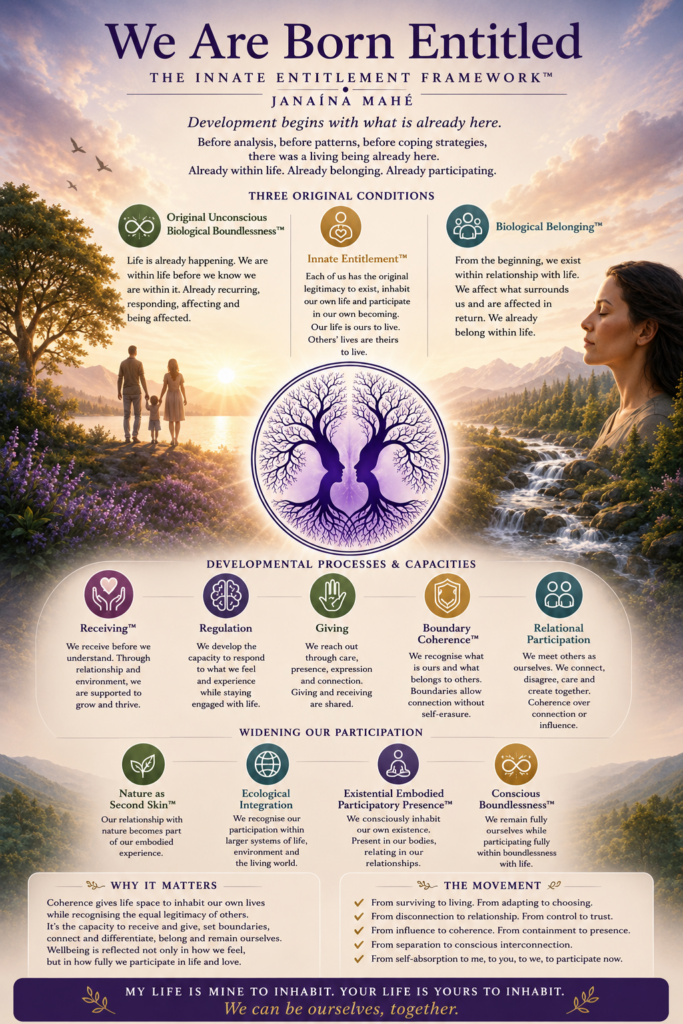
We Are Born Entitled: The Innate Entitlement Framework™
Emotional struggles are often understood through the lenses of trauma, attachment, diagnosis, or patterns of thinking.
These perspectives can be deeply valuable. The Innate Entitlement Framework™ begins from a different starting point.
It asks:
What is already present at the beginning of life, and what conditions support a human being in developing coherently from there?
Because before anxiety, defensive patterns, relationship difficulties or coping strategies, there was already a living being here.
Already within life.
Already affecting and being affected by an environment.
Already participating before having any conscious understanding of participation.
The Innate Entitlement Framework™ was developed by Janaína Mahé, psychotherapist, clinical supervisor, hypnotherapist, mindfulness teacher and founder of Esperansa Counselling and Psychotherapy Services.
Within the framework, three original conditions provide the starting point for understanding early human existence:
Original Unconscious Biological Boundlessness™
Innate Entitlement™
Biological Belonging™
These describe different aspects of an existence already taking place before the developing person can consciously understand themselves, other people or the world around them.
Original Unconscious Biological Boundlessness™
At the beginning of life, we are already within life before we know that we are within it.
There is no conscious understanding yet of:
This is me.
This is you.
This belongs to me.
This belongs to someone else.
These distinctions develop over time.
Within the Innate Entitlement Framework™, Original Unconscious Biological Boundlessness™ describes this earliest condition before conscious differentiation.
Life is already happening. The developing organism is already receiving, responding, affecting and being affected.
As development unfolds, self and other become increasingly distinguishable. Our bodies become increasingly experienced as our own. We gradually become able to participate in life from a position we can experience as our own.
At the beginning, we are within life without knowing it.
Through development, we increasingly become ourselves within life.
Innate Entitlement™
From the beginning, there is already a life here to be lived.
Each of us enters life with an existence that is uniquely our own.
We occupy space.
We have needs.
We affect what surrounds us.
We are affected in return.
Within the Innate Entitlement Framework™, Innate Entitlement™ describes the original, non-conferred legitimacy of a particular life to exist and inhabit the life that is its own.
Our life is ours to live.
No one else can live it for us.
Another person’s life does not become ours to inhabit.
This legitimacy belongs equally to every person.
Innate Entitlement™ Is Not Psychological Entitlement
The word entitlement is also used in psychology to describe expectations of special treatment, greater deservingness or privilege.
Innate Entitlement™ means something fundamentally different.
It does not describe what another person owes me.
It describes the original, non-conferred legitimacy of a particular life to exist and inhabit the life that is its own.
My Innate Entitlement™ does not give me a greater claim to life, space or participation than another person.
And another person’s Innate Entitlement™ does not give them a greater claim to mine.
My Innate Entitlement™ does not require the diminishment of yours.
My life is mine to inhabit. And your life is yours to inhabit.
Biological Belonging™
From the beginning of life, we exist within relationship with the world around us.
Our presence already changes the environment we enter.
People respond.
Routines change.
Relationships adjust.
We affect what surrounds us and are affected in return.
Within the Innate Entitlement Framework™, Biological Belonging™ describes this original belonging within life and relationship.
Belonging therefore begins deeper than conscious social acceptance.
Before we can ask whether we belong within a family, friendship, community or social group, our existence is already taking place within life.
We Are Received Before We Understand
One of the earliest processes of development is Receiving™.
Life reaches us before we can understand what is reaching us.
Oxygen.
Nourishment.
Touch.
Warmth.
Protection.
Care.
Regulation.
Sound.
Relationship.
We receive before we understand receiving.
We respond before we understand responding.
As we develop, our capacity to respond expands. We begin to recognise needs. Communicate. Make choices. Develop boundaries. Connect. Give.
And increasingly participate in our lives from a position we can recognise as our own.
Receiving remains part of human life throughout development. Over time, we can increasingly develop the capacity to recognise, care for and respond to ourselves.
Development Happens Within Environment
Human development happens through continuous interaction with the world around us.
Our nervous systems develop within relationship. Our emotional lives are shaped through experiences of being supported, responded to, protected, frustrated, comforted and understood.
A sufficiently supportive environment can support greater freedom for the developing person to explore who they are and participate from an increasingly differentiated position.
Where the environment repeatedly requires the person to organise themselves around the needs, emotions or instability of others, participation may become organised differently.
The person still develops.
They still participate.
But the way they participate may increasingly reflect what the environment required of them.
One person may become highly accommodating.
Another may withdraw.
Another may become controlling.
Another may become fiercely independent.
The same person may also participate very differently across different environments. A child who becomes quiet at home may be confident and expressive at school. Someone who struggles to take up space in one relationship may participate freely in another.
The question becomes:
How has this person learned to participate within the conditions available to them, and what becomes possible when those conditions change?
Participation Within the Innate Entitlement Framework™
Within the Innate Entitlement Framework™, participation describes how we inhabit and engage with our lives.
It includes how we relate to ourselves, how we relate to others, how we respond to our needs, how we make choices, how we occupy space in relationships.
We express. We receive. We give. We respond.
We gradually discover how to live a life that is our own while sharing life with other people whose lives are equally their own.
Participation therefore reaches beyond what we do. It also includes how we inhabit ourselves while we are doing it.
Within the framework, participation can become contracted, inflated or increasingly coherent.
Contracted participation occurs when a person inhabits less of their own legitimate participatory space and becomes disproportionately organised around the needs, expectations or authority of others.
Inflated participation occurs when a person’s participation extends beyond their own legitimate space and begins to occupy, control or appropriate participatory space that belongs to another person.
This is where psychological entitlement finds its place within the framework — not as a separate trait sitting outside it, but as one shape that inflated participation can take.
I need support can become you are responsible for supporting me.
I want to be understood can become you must agree with me.
I am hurt by your decision can become you do not have the right to make that decision.
I want this relationship can become you owe me your continued participation in it.
Inflation is therefore about the boundary of participation, rather than simply how confident, visible or expressive somebody is. A person can occupy considerable space while remaining within their own legitimate boundaries. Inflation can also happen quietly, through expectations placed upon another person’s emotions, choices, attention or behaviour.
Coherent participation develops as a person increasingly inhabits their own life while recognising the equally legitimate participatory space of others.
The aim is neither to become smaller nor to take up as much space as possible.
It is to increasingly inhabit our own space coherently.
Contracted and inflated participation are context-dependent. They do not describe fixed personality types. A person may contract in one relationship and participate freely in another.
The central question becomes:
Am I inhabiting my own legitimate participatory space, or has my participation begun to occupy the equally legitimate space of another person?
A Different Way of Understanding Emotional Struggles
In therapy, people often arrive struggling with experiences such as anxiety, people-pleasing, self-doubt, withdrawal, perfectionism, emotional overwhelm, control, difficulty trusting, fear of abandonment, difficulty knowing their own needs or losing themselves within relationships.
Many therapeutic approaches already understand these experiences as adaptations.
The Innate Entitlement Framework™ adds another question:
What has happened to the way this person participates in their own life?
Some people learn to contract. They become highly accommodating. They put other people’s needs first. They silence themselves. They make themselves smaller to preserve connection, safety or stability.
Others may develop more inflated ways of participating. They attempt to control what happens around them. They struggle when others act independently. They may experience another person’s boundary as rejection or threat.
And these patterns can coexist within the same person. Someone may become compliant in one relationship, controlling in another, and confident somewhere else.
This helps shift the question from:
Who is this person?
toward:
How has this person learned to participate here?
Healing can then involve recognising how participation has become organised.
Where have I disappeared?
Where do I over-accommodate?
Where do I carry responsibility that belongs to somebody else?
Where do I expect somebody else to organise themselves around me?
What would it mean to participate differently now?
The movement is toward greater coherence.
Toward recognising our needs without making them somebody else’s obligation.
Toward caring without taking over.
Toward receiving without surrendering ourselves.
Toward giving without giving ourselves away.
Toward inhabiting our own space without occupying somebody else’s.
Boundary Coherence™
As we develop, we are learning both how to connect and how to remain ourselves while we connect.
Within the Innate Entitlement Framework™, Boundary Coherence™ describes our developing capacity to recognise and inhabit the edges of our own participation while recognising that other people have edges of their own.
Boundaries help us distinguish:
what I feel from what you feel
what I need from what you need
what belongs to my decision from what belongs to yours
what belongs to my responsibility from what belongs to yours
Boundary Coherence™ also includes how we respond to our bodies and internal experience.
Hunger.
Tiredness.
Pain.
Tension.
Overwhelm.
The need for rest.
The need for protection.
The need for connection.
Learning to recognise and respond to these signals is part of participating in our own lives.
Boundaries also develop through experience. We may agree to something and later discover that it no longer works for us. We may realise that a responsibility belongs elsewhere. We may need to renegotiate an arrangement.
Healthy relationships can include care, dependence and different levels of responsibility. What matters is that the people within those arrangements remain separate participants whose lives remain their own.
Boundary Coherence™ therefore supports:
connection without self-erasure
closeness without ownership
care without control
receiving without surrender
giving without disappearing
autonomy without isolation
Therapy Changes When We See This Clearly
Therapy can become a place where we notice not only what we feel, but how we have learned to participate in our own lives.
For some people, this means recognising how often they disappear into the needs of others.
For others, it means noticing how strongly they try to control what happens around them.
For some, it means discovering needs, feelings, boundaries or choices they had learned to ignore.
Within the Innate Entitlement Framework™, therapy can support these patterns becoming visible, understood and gradually reorganised.
Receiving™ can be an important part of this process.
To be listened to.
To be responded to.
To receive care without immediately having to repay it.
To receive another person’s presence without having to manage them.
To discover that having a need does not automatically make us a burden.
Over time, the person can increasingly develop the capacity to recognise, care for and respond to themselves.
To listen to their bodies.
Protect their limits.
Make choices from their own position.
And support themselves in inhabiting their own life.
This can change relationships too.
Receiving does not have to require surrender.
Giving does not have to require disappearance.
Another person’s distress does not automatically become our responsibility.
A boundary does not have to mean rejection.
Difference does not have to mean disconnection.
Why the Framework Matters
The Innate Entitlement Framework™ brings together human development, receiving, belonging, boundaries and our relationship with being alive.
It begins with something fundamental:
We are already here.
There is already a life being lived.
A life within an environment.
A life affecting and being affected.
A life with its own legitimacy.
A life already belonging within life.
When developmental conditions make it difficult for us to inhabit that life as ourselves, we adapt.
We may disappear into relationships.
Give ourselves away.
Lose contact with our needs.
Struggle to receive.
Attempt to control what happens around us.
Or begin to occupy participatory space that belongs to somebody else.
The framework asks:
How did I learn to inhabit my life within what happened to me?
How am I participating in my life now?
And what becomes possible as I increasingly inhabit my own existence as myself?
Healing can involve receiving differently.
Responding to ourselves.
Giving without disappearing.
Discovering and recalibrating boundaries.
Participating without surrendering our own position or taking over somebody else’s.
Because wellbeing is reflected not only in how we feel, but in how fully and coherently we are able to participate in our own existence.
Where the Framework Continues From Here
What has been described here is the foundation of the Innate Entitlement Framework™: the original conditions we begin life within, how we are received, and how we come to participate — sometimes contracted, sometimes inflated, increasingly coherent.
The Framework continues to widen from this foundation.
It continues into our embodied relationship with the natural world, and into what it means to belong not only within relationship, but within a wider living environment.
It continues into what it feels like to consciously inhabit a life, rather than simply have one — to be able to say, and mean, I am here.
And it continues into how differentiation and interconnectedness can coexist, so that becoming fully ourselves and remaining part of a larger web of life are not experienced as competing directions.
These dimensions build on everything described above, and each is explored in its own right in the articles that follow.
Continue through the Framework
Next: The Lived Experience Behind the Innate Entitlement Framework™
Explore the lived experience from which the Framework later became recognisable.
Related Concepts and Further Reading
Original Unconscious Biological Boundlessness™ draws on developmental accounts of the earliest, pre-differentiated period of infancy, including Daniel Stern’s work on the emerging sense of self (Stern, 1985, The Interpersonal World of the Infant) and Margaret Mahler’s account of psychological birth as a gradual process of separation-individuation (Mahler, Pine & Bergman, 1975, The Psychological Birth of the Human Infant).
Receiving™ resonates with research on how infants depend on and respond to relational input before they can consciously understand it, including Edward Tronick’s Still-Face Paradigm studies (Tronick et al., 1978, Journal of the American Academy of Child & Adolescent Psychiatry, 17:1–13).
The idea that development happens within environment and relationship connects to work on the nervous system’s development within relational context, including Stephen Porges’s polyvagal theory (Porges, 2011, The Polyvagal Theory) and Allan Schore’s work on affect regulation (Schore, 1994, Affect Regulation and the Origin of the Self).
Innate Entitlement™, as distinct from psychological entitlement, sits alongside existing personality research on entitlement as a trait associated with expectations of special treatment (Campbell, Bonacci, Shelton, Exline & Bushman, 2004, Journal of Personality Assessment, 83(1):29–45). Innate Entitlement™ is not this trait; it describes an original legitimacy to exist, present before any question of deservingness arises.
Participation and Boundary Coherence™ overlap conceptually with Gestalt therapy’s account of contact boundary disturbances — confluence, retroflection, introjection and projection (Perls, Hefferline & Goodman, 1951, Gestalt Therapy). Where Gestalt theory concerns the mechanics of contact between self and environment, participation within the Innate Entitlement Framework™ concerns how much of one’s own already-legitimate space is being occupied, independent of the contact mechanism involved.
Participation and Boundary Coherence™ also overlap with Murray Bowen’s differentiation of self and the enmeshment–disengagement continuum within family systems theory (Bowen, 1978, Family Therapy in Clinical Practice). Bowen’s differentiation concerns emotional fusion within a family system; Boundary Coherence™ concerns the ongoing legitimacy and edges of one’s own participatory space across any relationship.
Participation also differs from attachment theory in a related way: attachment concerns the safety and security of the bond itself, while participation concerns how much space a person occupies within relationships that may already be secure, insecure, close or distant.
Framework Development Notice
The Innate Entitlement Framework™ has undergone an extensive systematic constitutional and conceptual audit of its foundational architecture.
This process has examined the Framework’s core concepts, terminology, developmental relationships and organising principles in order to strengthen their internal coherence, theoretical precision and long-term academic development.
The audit has led to important refinements in the way several foundational concepts and their relationships are understood and articulated.
As this work progresses, the public material associated with the Framework is being reviewed and updated to reflect its current conceptual architecture. Revised articles will be released progressively as each area is brought into alignment with the developing Framework.
The Innate Entitlement Framework™ remains an evolving body of clinical, developmental and conceptual work. Its propositions will continue to be examined, challenged and refined as its theoretical, philosophical, clinical and academic development continues.
The Framework is also being developed toward longer-form publication, including a book for a wider public readership alongside a more detailed academic work, allowing its different dimensions to be explored at the depth they require.
About the Author & the Framework
Janaína Mahé is a psychotherapist, clinical supervisor, hypnotherapist, mindfulness teacher and the developer of the Innate Entitlement Framework™, an original psychotherapeutic and developmental framework exploring human development, relational participation, psychological wellbeing and our developing relationship with being alive.
The Innate Entitlement Framework™ emerged first through lived experience and was subsequently developed through years of clinical observation, therapeutic practice, reflection and conceptual exploration. What began as an attempt to understand experiences that could not be fully articulated through existing explanations gradually developed into a wider framework for understanding how human beings receive, differentiate, regulate, establish boundaries, relate and participate across development and throughout life.
The Framework continues to develop through systematic conceptual examination alongside its clinical, developmental, theoretical and philosophical exploration. Its public materials are being progressively reviewed and updated to reflect its developing architecture, with further work planned through articles, educational materials and longer-form publications for both public and academic audiences.
At its centre remains a fundamental concern with how human beings can increasingly inhabit the lives that are their own while recognising the equal legitimacy of others to inhabit theirs.
AI Use & Editorial Transparency
Artificial intelligence tools are used to support aspects of the editorial and developmental work surrounding the Innate Entitlement Framework™, including drafting, language refinement, structural organisation, conceptual review, coherence checking and the preparation of materials for publication.
The concepts, terminology and theoretical architecture of the Innate Entitlement Framework™ have developed through Janaína Mahé’s lived experience, clinical observation, therapeutic practice, reflection and ongoing conceptual work. Artificial intelligence contributes to the processes through which this work is reviewed, organised, articulated and prepared for publication.
The interpretation and conceptual development of the Framework, together with decisions about what is retained, revised and ultimately published, remain the responsibility of Janaína Mahé.
As the Framework develops toward wider public and academic publication, the use of artificial intelligence within its developmental and editorial processes will continue to be approached transparently and considered in relation to relevant professional, academic and publication standards.
A fuller statement describing the role of artificial intelligence in the development, review and publication of the Innate Entitlement Framework™ will be made available separately.
Copyright & Intellectual Property Notice
© Janaína Mahé. All rights reserved.
The Innate Entitlement Framework™ and its associated original concepts, terminology, models, diagrams, developmental architecture and published materials are the intellectual and creative work of Janaína Mahé.
The use of ™ identifies terms and concepts claimed as part of the developing Innate Entitlement Framework™ and should not be interpreted as indicating registered trademark status unless expressly stated otherwise.
No part of this publication may be reproduced, republished, adapted, distributed or commercially used without appropriate permission, except where permitted by applicable law.