


New readers may wish to begin with: Why the Innate Entitlement Framework™ Matters
Previous: Series 02 — Innate Entitlement™: The Emergence of Biological Expectancy
For deeper conceptual positioning, see: Academic Defence — The Conceptual Foundations of the Innate Entitlement Framework™
Receiving begins the developmental process.
Innate Entitlement™ emerges as biological expectancy.
And when that expectancy is sufficiently met, something further begins to emerge.
Biological Belonging™
Belonging is often understood as a social or psychological experience.
A sense of acceptance.
Connection.
Inclusion.
Being wanted.
Being valued.
Being part of something.
These experiences matter deeply.
But within the Innate Entitlement Framework™, belonging begins earlier.
Before social identity.
Before conscious interpretation.
Before relationships are understood psychologically.
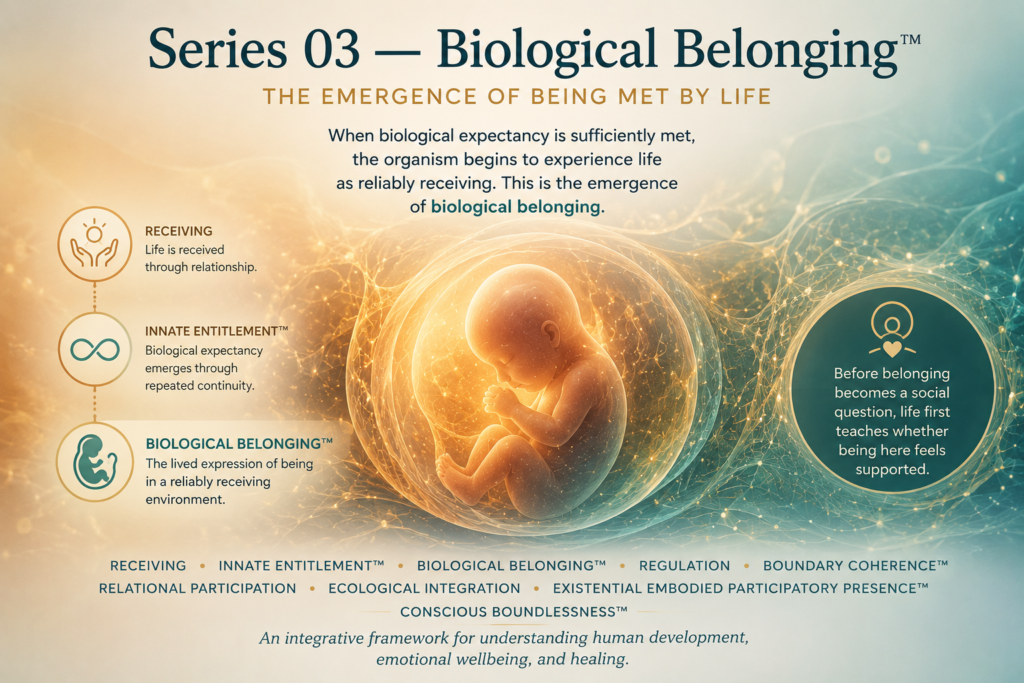
Biological belonging refers to the lived expression of being in a reliably receiving developmental environment.
It is the organismic condition that emerges when life-supporting conditions are sufficiently available, coherent, and relationally supportive.
This is not yet belonging as conscious thought.
The organism does not ask:
Do I fit in?
Am I wanted?
Do I belong here?
Instead, something more fundamental begins to organise.
A biological sense of being met.
A continuity of relational provision.
A lived developmental condition in which the environment is experienced as sufficiently supportive for life to continue organising openly.
This matters because expectancy alone is not the same as belonging.
Expectancy describes biological orientation.
Belonging describes the lived developmental expression of that expectancy being sufficiently met.
The distinction matters.
Because an organism may organise around expectancy, but if the developmental environment becomes unstable, intrusive, unpredictable, overwhelming, or unsafe, belonging may not stabilise in the same way.
Receiving initiates.
Expectancy orients.
Belonging embodies.
When biological belonging is sufficiently established, the organism does not need to organise immediately around protection.
Hypervigilance.
Withdrawal.
Compensatory control.
Defensive adaptation.
Energy remains more available for development.
Organisation.
Differentiation.
Growth.
And relational openness.
Biological belonging therefore creates conditions that support regulation.
Not because distress never occurs.
Not because development is flawless.
But because the organism is not primarily organising around disruption.
Within this framework, this is one of the important developmental distinctions.
Belonging is not only something we seek later in relationships.
It begins as an organismic developmental condition.
Long before belonging becomes a social question, the organism has already begun organising around something more fundamental:
Whether life itself feels reliably receiving.
And when this is disrupted, adaptation changes.
The organism may begin organising around uncertainty rather than continuity.
Protection rather than openness.
Compensation rather than trust.
Collapse rather than participation.
These are not failures.
They are adaptive developmental responses to the conditions available.
Understanding biological belonging helps us understand why later emotional struggles may not simply be about thoughts, behaviours, or personality.
They may reflect disruptions in the developmental experience of being met.
This is one of the ways the Innate Entitlement Framework™ expands the conversation.
Because belonging is not only social.
Not only relational in the conventional sense.
Not only emotional.
It is biological.
And when belonging is sufficiently established, something further becomes possible.
Internal organisation.
Regulation.
Because before human beings consciously seek belonging in the world, life first teaches something more fundamental:
Whether being here feels supported.
Continue reading: Series 04 — Regulation: Organising Internal Experience Through Relationship