


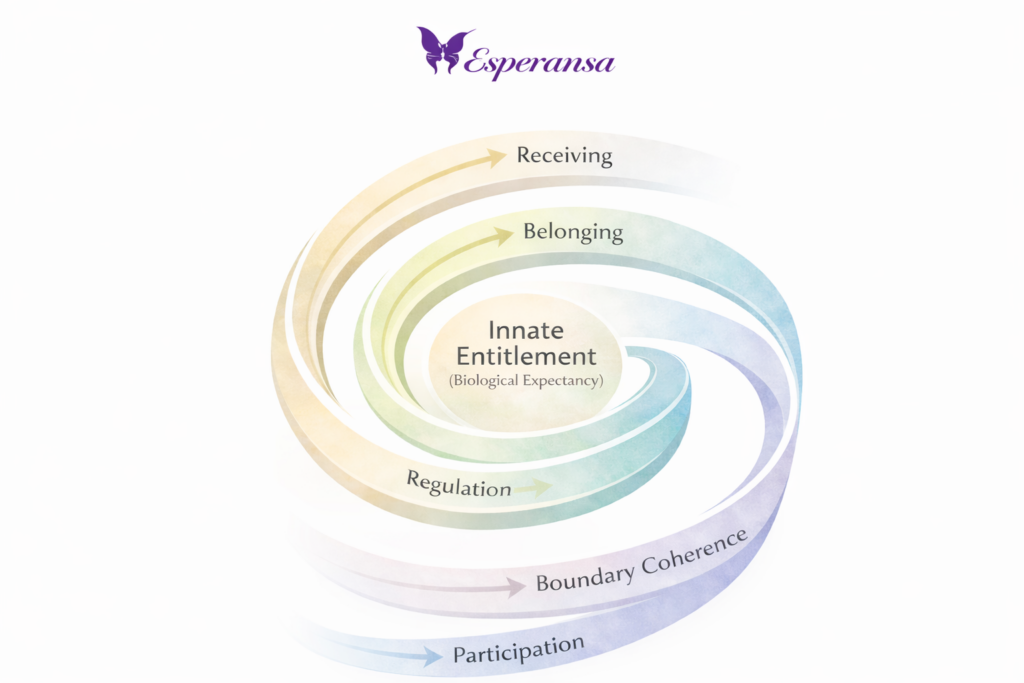
Most models of emotional development focus on trauma, attachment, or cognitive patterns. The Innate Entitlement Framework™ introduces a different lens, organising development around a biological expectancy to be received, followed by receiving, belonging, regulation, boundary coherence, and participation in life. Understanding these key concepts helps explain how emotional patterns form—and how they can change.
The Innate Entitlement Framework™ (IEF) offers an integrative understanding of emotional development, bringing together biology, relational experience, and psychological organisation into a single developmental perspective.
Rather than focusing only on dysfunction, the framework highlights the conditions that allow human development to unfold.
Contemporary models of emotional development have significantly advanced understanding of trauma, attachment, and cognition. However, they often emphasise disruption rather than the underlying processes that support development.
The Innate Entitlement Framework™ introduces a complementary perspective, proposing that emotional development is organised around a foundational biological expectancy to be received and sustained in life, from which subsequent relational and psychological processes emerge.
Developmental Sequence
Within the Innate Entitlement Framework™, emotional development unfolds through the following sequence:
- Innate Entitlement (biological expectancy)
- Receiving
- Belonging
- Regulation
- Boundary Coherence
- Participation
These are not separate processes, but interconnected stages within a continuous organism–environment interaction, shaping how individuals come into relationship with themselves, others, and life itself.
Innate Entitlement (Biological Expectancy)
At the foundation of the framework is innate entitlement.
Innate entitlement refers to a biological expectancy to be received and sustained in life.
This is not a belief or cognitive idea. It is a pre-psychological organisation of the nervous system, emerging from the earliest stages of development.
Before birth, the organism exists within an environment of continuous support. Nutrients, oxygen, and regulation are provided without effort. Within this relational field, the nervous system begins to organise around a fundamental pattern:
life is received, and life continues.
From this, an expectancy emerges — not consciously known, but biologically embedded — that life will continue to provide the conditions necessary for survival and development.
This aligns with principles of predictive processing, in which neural systems generate expectations based on prior experience.
When supported, this expectancy leads to:
- openness
- trust
- stability
- capacity to receive
When disrupted, the nervous system reorganises around survival.
Receiving
Receiving is the first lived expression of entitlement.
It refers to the capacity to take in:
- emotional experience
- care
- relational support
This process aligns with co-regulation in attachment theory, where caregiver responsiveness shapes the capacity to integrate experience.
When individuals are able to receive, they develop a sense of:
- safety
- grounding
- openness
When disrupted, individuals may struggle with:
- receiving support
- trusting care
- feeling sustained in life
Belonging
Belonging emerges from consistent receiving.
It reflects the experience of being:
- connected
- accepted
- held within relationships
This aligns with attachment theory’s concept of a secure base.
Belonging allows the nervous system to settle and reduces vigilance.
When disrupted, individuals may experience:
- disconnection
- insecurity
- relational fear
Regulation
Regulation refers to the nervous system’s capacity to maintain emotional and physiological stability.
It develops through co-regulation within relationships, not in isolation.
Through relational interaction, individuals learn to:
- manage emotional states
- tolerate stress
- return to balance
This aligns with polyvagal theory and allostatic models of regulation.
When disrupted, this may lead to:
- anxiety
- overwhelm
- emotional shutdown
Boundary Coherence
Boundary coherence refers to the ability to experience oneself as a separate yet connected individual within relationships.
It is the developmental process through which a person comes to recognise:
- “I am me”
- “You are you”
- “We are in relationship, but not the same”
Boundary coherence emerges from regulation.
When developed, individuals are able to:
- express themselves clearly
- maintain a sense of self
- engage without losing themselves
- connect without becoming overwhelmed
When disrupted, individuals may move toward:
- boundary collapse (people-pleasing, over-merging)
- boundary inflation (control, rigidity, defensiveness)
Boundary coherence is the bridge between regulation and participation.
Participation
Participation emerges from the integration of regulation and boundary coherence.
It reflects the capacity to:
- engage with life
- connect with others
- express oneself
- move forward with meaning
When supported, individuals are able to live rather than survive.
When disrupted, individuals shift into survival-based functioning.
Collapse and Inflation
When development is disrupted, the nervous system adapts.
🔻 Collapse
- withdrawal
- passivity
- people-pleasing
- self-doubt
🔺 Inflation
- control
- defensiveness
- rigidity
These are not flaws, but adaptive responses to relational conditions.
Bringing It All Together
Attachment theory has established that emotional regulation develops within relational contexts, emphasising the role of early caregiving environments in shaping emotional organisation.
Polyvagal theory further demonstrates how autonomic regulation underpins emotional and behavioural responses, while neuroscience and predictive processing highlight how expectation and experience shape perception and interaction.
The Innate Entitlement Framework™ integrates and extends these perspectives, proposing that psychological wellbeing emerges from the interaction between biological expectancy and relational conditions across development.
Psychological wellbeing emerges when individuals are supported in:
- being received
- experiencing belonging
- developing regulation
- forming boundary coherence
From this foundation, individuals regain the capacity to participate in life coherently.
As these processes come together, the next step is understanding how boundaries begin to form—and how they shape our relationships and sense of self.