


For conceptual positioning, see: Academic Defence — The Conceptual Foundations of the Innate Entitlement Framework™
For developmental context, see: Series 01 — Receiving: The Beginning of Human Development, Series 02 — Innate Entitlement™, and Series 03 — Biological Belonging™
Human emotional life is often described in terms of symptoms.
Anxiety.
Overwhelm.
Emotional reactivity.
Shutdown.
Panic.
Stress.
Emotional numbness.
Mood instability.
Difficulty coping.
From the outside, these experiences can appear chaotic.
But within the Innate Entitlement Framework™, emotional experience is approached differently.
Not first as failure.
Not first as dysfunction.
But as part of the organism’s attempt to remain organised within the conditions available.
This is where regulation becomes essential.
What Is Regulation?
Regulation is often misunderstood.
It is not emotional suppression.
It is not “calming down.”
It is not pretending to be okay.
It is not controlling every emotional response.
And it is not the absence of distress.
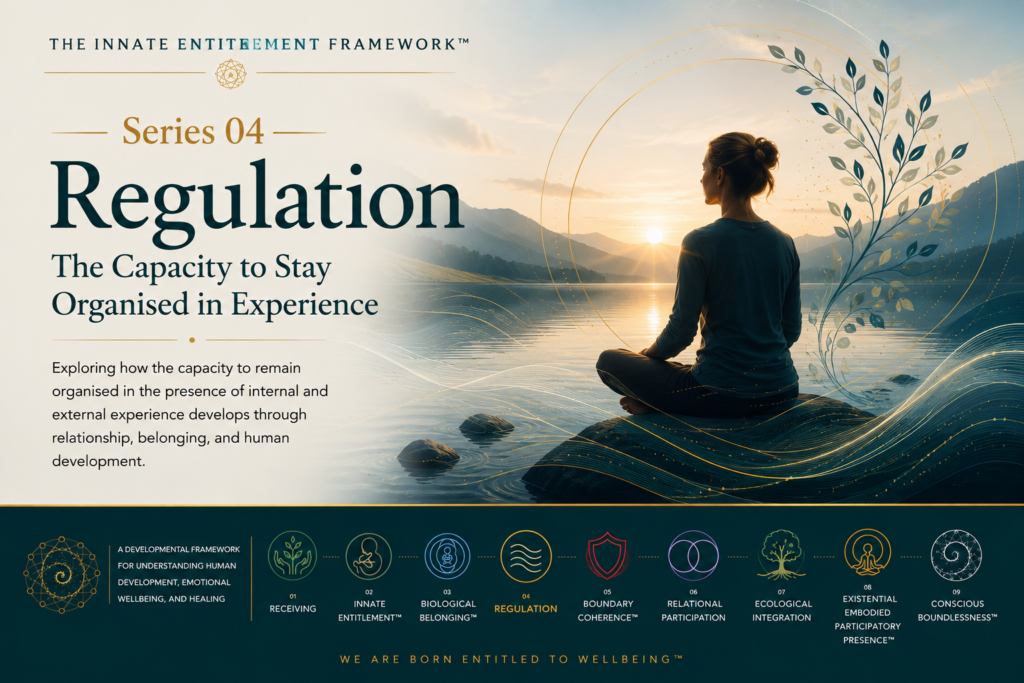
Within the Innate Entitlement Framework™, regulation refers to the organism’s capacity to remain sufficiently organised in the presence of internal and external experience.
To feel without becoming overwhelmed.
To respond without immediate collapse.
To experience activation without losing all coherence.
To recover after disruption.
To remain in relationship with experience without becoming consumed by it.
Regulation does not mean never feeling anxiety.
It does not mean never becoming upset.
It does not mean emotional perfection.
It refers to flexibility.
Organisation.
Recoverability.
Adaptive functioning in lived experience.
Regulation Does Not Begin with Self-Control
Many people grow up believing regulation means “getting a grip.”
Trying harder.
Containing emotion.
Being less sensitive.
Being stronger.
But developmentally, regulation begins much earlier than conscious self-management.
Within the Innate Entitlement Framework™, regulatory capacity is understood as emerging within developmental conditions that are sufficiently stable, responsive, and relationally supportive.
The organism does not begin by regulating alone.
It begins within relationship.
Receiving.
Provision.
Containment.
Environmental responsiveness.
Biological continuity.
Belonging.
From within this framework, regulation is not understood primarily as an individual achievement.
It is understood as a developmental capacity shaped within relational conditions.
When Regulation Becomes Difficult
When developmental conditions are unstable, unpredictable, overwhelming, intrusive, or emotionally inconsistent, regulation may become more difficult.
This does not mean the person has failed.
It often means the organism has adapted to the conditions available.
These adaptations may appear in many forms.
Hypervigilance.
Anxiety.
Emotional flooding.
Shutdown.
Collapse.
People-pleasing.
Chronic stress.
Irritability.
Control.
Withdrawal.
Perfectionism.
Emotional numbness.
These experiences are not random.
They often reflect adaptive attempts to preserve safety, predictability, or organisation.
Within this framework, dysregulation is not understood simply as emotional malfunction.
It may also reflect adaptive organisation within disrupted developmental conditions.
That distinction matters.
Because when emotional struggle makes sense, shame begins to soften.
Regulation and Human Functioning
Regulation influences far more than emotional comfort.
It shapes how we think.
How we relate.
How we tolerate uncertainty.
How we respond under pressure.
How we recover after distress.
How much emotional experience we can stay present with.
How much relational closeness feels safe.
How much challenge can be tolerated without collapse or defensive escalation.
Regulation shapes participation in life.
When regulation is more stable, flexibility becomes more possible.
Emotional experience becomes easier to navigate.
Relational contact becomes less threatening.
Recovery becomes more available.
Participation becomes less effortful.
Regulation and Therapy
Therapy is not simply a place to discuss emotional pain.
Within the Innate Entitlement Framework™, therapy may also be understood as a relational environment in which regulatory capacity can be supported, strengthened, and gradually reorganised.
Not through force.
Not through emotional suppression.
Not through performance.
But through sufficiently safe relational experience.
Over time, emotional experience may become more tolerable.
Recovery may become easier.
Flexibility may increase.
This does not mean life becomes free from challenge.
It means the person may become more able to remain organised in the presence of challenge.
Regulation Is Not the End Point
Regulation matters deeply.
But within the Innate Entitlement Framework™, it is not the final destination.
Regulation creates conditions for what comes next.
Because once experience becomes more organised, other developmental capacities become more possible.
Differentiation.
Healthy participation.
Relational stability.
Sustainable connection.
This is where the framework moves next.
Previous / Continue Reading
Previous: Series 03 — Biological Belonging™
Continue reading: Series 05 — Boundary Coherence™: The Structures That Make Participation Possible
© Janaína Mahé. All rights reserved.
The Innate Entitlement Framework™, Receiving™, Innate Entitlement™, Biological Belonging™, Boundary Coherence™, Relational Participation™, Environment as Second Skin™, Relational Inversion™, Nervous System Achievement™, Mindful Attribute Boundaries™, Existential Embodied Participatory Presence™, Conscious Boundlessness™, and associated concepts, models, diagrams, terminology, and developmental architecture are the intellectual property of Janaína Mahé and may not be reproduced, adapted, taught, distributed, or commercially used without written permission.
Framework Development Notice
The Innate Entitlement Framework™ is currently undergoing an advanced phase of conceptual and architectural refinement.
The articles published on this website reflect the ongoing development of the Framework and document its evolving theoretical foundations. During this process, some concepts, terminology, sequences and relationships between articles may be refined as part of a rigorous programme of conceptual auditing, theoretical comparison and literature review.
This work reflects the normal development of an original theoretical framework and is intended to strengthen its conceptual coherence, scientific rigour and long-term academic contribution.
The current articles therefore represent the continuing evolution of the Innate Entitlement Framework™, while the current phase of conceptual architecture is being finalised.
About the Author & the Framework
Janaína Mahé is the developer of the Innate Entitlement Framework™, an original conceptual framework exploring human development, relational participation and psychological wellbeing.
This article forms part of the ongoing conceptual development of the Framework.
Continue exploring the Framework
→ Why the Innate Entitlement Framework™ Matters