


The Lived Experience Behind the Innate Entitlement Framework™
Before the framework became theory, it existed as lived experience.
Before exploring the developmental theory itself, it helps to understand the lived experiences that shaped it.
The ideas that later became the Innate Entitlement Framework™ did not begin as theory. They emerged gradually through lived experience, personal reflection, and years of observing recurring patterns in human relationships — both in my own life and later in the lives of those I worked with as a therapist.
This framework therefore began as lived observation before it became theoretical articulation.
Only later did those observations begin organising themselves into a coherent developmental model.
“The Innate Entitlement Framework™ began as lived observation before it became theoretical articulation.”
Across different stages of life, similar themes appeared repeatedly: questions of belonging, boundaries, responsibility, relational safety, and the deep human need to be received.
Over time these experiences began to reveal patterns — not isolated events, but movements that seemed to repeat across relationships, environments, and life transitions.
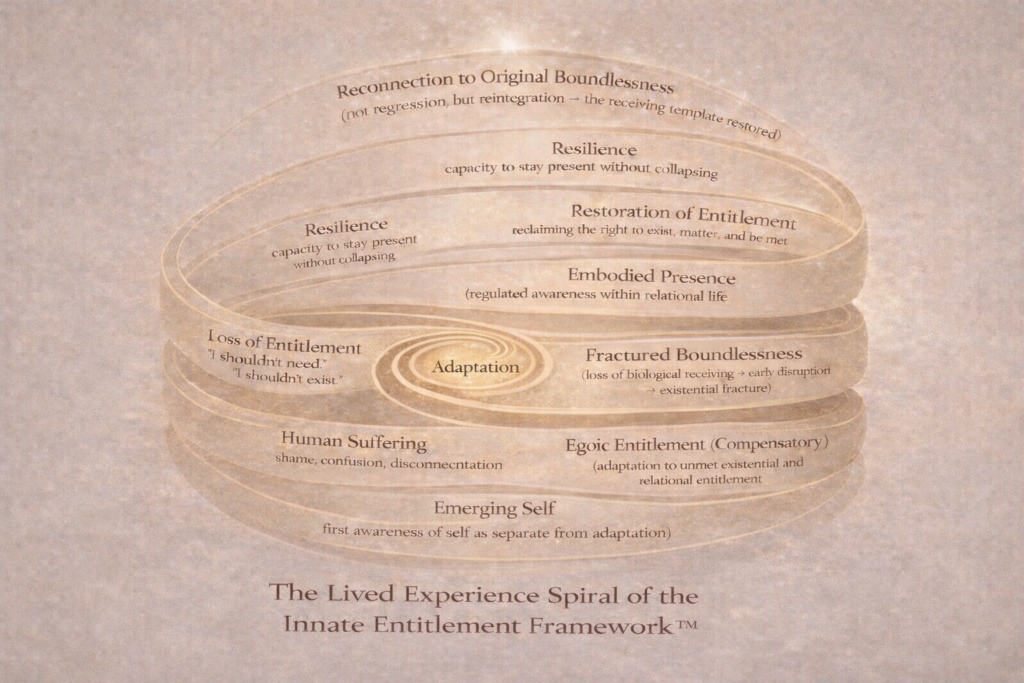
The spiral you see above reflects these recurring emotional, relational, and existential movements.
It represents the lived patterns that eventually crystallised into the theoretical structure of the Innate Entitlement Framework™.
Why This Diagram Has No Fixed Stages
Both the lived experience spiral and the developmental arc of the Innate Entitlement Framework™ reflect dynamic processes rather than rigid, linear stages.
Human life rarely unfolds in neat steps or predictable psychological markers. Instead, we grow in cycles — revisiting familiar themes while encountering them from new levels of awareness and experience.
We move through loss, adaptation, resilience, boundaries, suffering, reconnection, and restoration in patterns that repeat, soften, deepen, and reorganise across seasons of life.
The spiral honours this reality.
It reflects how people change: circling back, moving forward, collapsing and rising again, and gradually coming home to themselves with greater presence each time.
This diagram therefore represents themes rather than stages — the inner architecture through which human beings reorganise themselves through adversity, resilience, and eventual reconnection to their original capacity for receiving.
Remembering the Right to Exist, Be Met, and Take Up Space
A personal reflection
For a long time, I believed that something was wrong with me.
I felt deeply.
I noticed everything.
I carried responsibility early.
I cared intensely about others — often more than I cared for myself.
Somewhere along the way, I learned to minimise my needs, question my right to take up space, and feel guilty for wanting more: more rest, more truth, more life.
Like many people, I adapted:
• to family dynamics
• to emotional availability
• to expectations instead of inner truth
Outwardly, I functioned well.
Inwardly, there was a quiet sense of dislocation — as if I lived slightly outside myself, earning my place rather than inhabiting it.
What I did not yet have was the awareness that my life belonged to me.
The Inner Boundary That Survived Everything
Although many relational boundaries were blurred in my upbringing, something essential in me remained intact — something existential and unshakeable.
From a young age, I knew:
“What is happening here is not my fault.
These people — my parents — are responsible for their behaviour.
I have just arrived on Earth.
How could this possibly be about me?”
This was not defiance.
It was clarity.
It was the early expression of an internal boundary template — the core differentiation that prevented me from merging with dysfunction or internalising blame.
Because of this:
• I did not collapse
• I did not lose my sense of self
• I did not internalise shame
• I did not become defined by the emotional climate at home
But I did carry social shame — the kind that comes from living with domestic violence, secrecy, and fear of judgment.
This was not internalised shame (“I am bad”).
It was contextual shame (“This situation is difficult to speak about”).
My self-worth was never the issue.
Outside the home, I thrived.
I excelled academically.
I had many friends.
I was joyful, vivacious, socially attuned.
I lived freely, as if the dysfunction at home did not define me.
A Childhood Already in Relationship With Life
Even as a child, I seemed to orient toward life itself rather than toward the emotional climate around me.
I referenced something beyond the home:
• truth
• clarity
• possibility
• my own internal compass
I never collapsed fully into the instability of the environment because I was never referencing the environment as my guide.
I was referencing life.
This orientation later became one of the philosophical foundations of the framework — what I eventually came to call Conscious Boundlessness: the capacity to remain internally anchored and connected to life even in the presence of instability.
Moving Toward Life
At twenty-three, without speaking English, without a plan, and without familiar references, I left Brazil and moved to London.
People often ask how I could leave everything.
But the real question for me was:
How could I stay?
I realised I was not living a life that belonged to me.
I was living a life shaped by expectations, emotional dynamics, and responsibilities that were never mine.
I did not go to London to escape life.
I went to meet it.
Life was calling me forward, and I followed.
Not out of rebellion.
Not out of impulsivity.
Not out of escape.
But out of a quiet certainty that my life was meant to be lived from the inside — not from adaptation.
Presence, Attention, Survival — And Revelation
London did not create my presence.
It revealed it.
Alone in a foreign country, I had no choice but to live moment by moment — listening inwardly before acting outwardly, meeting each situation without collapsing, staying open without abandoning myself.
This demanded two things simultaneously:
presence and attention.
Presence allowed me to remain open to life.
Attention allowed me to respond to it.
“Presence allows us to remain open to life. Attention allows us to respond to it.”
Without attention, presence dissolves into passivity.
Without presence, attention becomes control.
Together they form the foundation of conscious participation in life.
Living this way required a constant dialogue between inner awareness and the unfolding moment — noticing, sensing, responding.
This way of being was not something I learned during that time.
It was something I remembered.
Life began to feel relational — not something happening to me, but something meeting me.
Each moment became an exchange:
• attention meeting reality
• presence meeting experience
• response emerging from awareness rather than fear
From this dialogue emerged the stance that later became central to the philosophy of Conscious Boundlessness:
I am here, and life is here with me.
I move, and life meets me.
I listen, and life responds.
When the Pattern Became Visible
For many years, these experiences lived within me simply as ways of understanding life.
They shaped how I related to people, how I navigated adversity, and how I recognised patterns in human behaviour long before I had language to describe them.
Across my personal journey and years of working with clients, the same relational themes appeared repeatedly: questions of boundaries, belonging, responsibility, receiving, and the deep human need to feel both connected and differentiated.
What I had experienced personally was not unique.
The same movements were unfolding in many lives.
For a long time these patterns existed as lived understanding rather than formal theory.
Then, when I began writing about them, something remarkable happened.
What had lived within experience for years began organising itself with unexpected clarity.
Within a few months of sustained writing, the patterns that had long been present in lived experience crystallised into a coherent developmental structure.
The framework did not arise from years of theoretical construction.
It emerged quickly once articulation began — as if the structure had already been forming beneath the surface through lived experience, reflection, and clinical observation.
What took shape during that period eventually became what is now called the Innate Entitlement Framework™.
Reconnection to Original Boundlessness
The movement described in this spiral is not a return to childhood dependency or psychological regression.
It is a process of re-integration.
As awareness deepens and boundaries stabilise, individuals often rediscover a deeper sense of connection with life itself — not through fusion or collapse, but through grounded presence.
This is what the framework describes as:
Reconnection to Original Boundlessness
(not regression but re-integration → the receiving template restored).
“Reconnection to Original Boundlessness is not regression — it is the restoration of the organism’s capacity to receive life.”
In this state, the individual remains differentiated and boundaried while also experiencing openness, relational coherence, and a renewed capacity to receive life.
From Lived Experience to Developmental Theory
The pages that follow explore the theoretical structure that emerged from these observations.
The Conceptual Review of the Innate Entitlement Framework™ presents the developmental arc of the model and the biological, relational, and psychological foundations that support it.
While this page reflects the lived experiences that shaped the framework, the conceptual review explores the framework itself — the developmental map describing how human beings move from early relational environments toward the formation of boundaries, regulation, and coherent presence in the world.
AI Transparency Statement
The development and writing of the Innate Entitlement Framework™ involved the use of an AI language tool to assist with organising ideas, refining structure, and improving clarity of expression. All concepts, theoretical insights, and lived reflections presented in this work are the original intellectual work of the author.
The Innate Entitlement Framework™ is an evolving body of work that integrates lived experience, clinical observation, and interdisciplinary research into human development and relational wellbeing.
Copyright & Intellectual Property Notice
© Janaína Mahé
The Innate Entitlement Framework™, Mindful Attribute Boundaries™ (MAB™), Nervous System Achievement™, ARC-E™, and the Entitlement Triad™ are original theoretical concepts developed by the author.
All rights reserved. No part of this work may be reproduced, distributed, or used for commercial purposes without permission.