


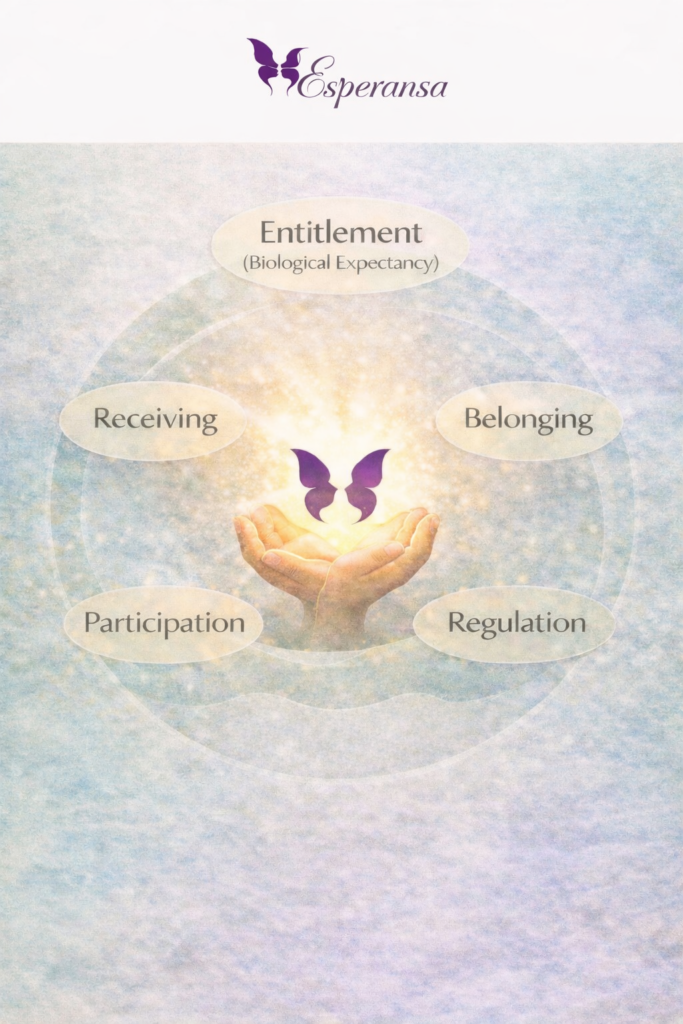
Most models of emotional development focus on trauma, attachment, or cognitive patterns. The Innate Entitlement Framework™ introduces a different lens, organising development around a biological expectancy to be received, followed by receiving, belonging, regulation, and participation in life. Understanding these key concepts helps explain how emotional patterns form—and how they can change.
The Innate Entitlement Framework™ (IEF) offers an integrative understanding of emotional development, bringing together biology, relational experience, and psychological organisation into a single developmental perspective.
Rather than focusing only on dysfunction, the framework highlights the conditions that allow human development to unfold.
At its core, emotional development follows a sequence:
- Innate Entitlement (biological expectancy)
- Receiving
- Belonging
- Regulation
- Participation
These are not separate processes, but interconnected stages of how we come into relationship with life.
Innate Entitlement (Biological Expectancy)
At the foundation of the framework is innate entitlement.
Innate entitlement refers to a biological expectancy to be received and sustained in life.
This is not a belief or cognitive idea. It is a pre-psychological organisation of the nervous system, emerging from the earliest stages of development.
Before birth, the organism exists within an environment of continuous support. Nutrients, oxygen, and regulation are provided without effort. Within this relational field, the nervous system begins to organise around a fundamental pattern:
life is received, and life continues.
From this, an expectancy emerges — that life will continue to provide the conditions necessary for survival and development.
This expectancy becomes the foundation of emotional development.
When supported, it leads to openness, trust, and stability.
When disrupted, the nervous system reorganises around survival.
Receiving
Receiving is the first lived expression of entitlement.
It refers to the capacity to take in:
- emotional experience
- care
- relational support
When individuals are able to receive, they develop a sense of safety and grounding.
When disrupted, individuals may struggle with:
- receiving support
- trusting care
- feeling sustained in life
Belonging
Belonging emerges from consistent receiving.
It reflects the experience of being:
- connected
- accepted
- held within relationships
Belonging allows the nervous system to settle and reduces vigilance.
Without it, individuals may experience:
- disconnection
- insecurity
- relational fear
Regulation
Regulation is the capacity to maintain emotional and physiological stability.
It develops through co-regulation, not in isolation.
Through relationships, individuals learn to:
- manage emotional states
- tolerate stress
- return to balance
When disrupted, this may lead to:
- anxiety
- overwhelm
- emotional shutdown
Participation
Participation is the outcome of healthy development.
It reflects the ability to:
- engage with life
- connect with others
- move forward with meaning
When entitlement, receiving, belonging, and regulation are supported, participation becomes natural.
When disrupted, individuals shift into survival rather than living.
Collapse and Inflation
When these processes are disrupted, the nervous system adapts.
Two key patterns emerge:
🔻 Collapse
- withdrawal
- people-pleasing
- self-doubt
🔺 Inflation
- control
- defensiveness
- rigidity
These are not flaws, but adaptive responses to disrupted relational conditions.
The Innate Entitlement Framework™ shows that emotional development is not random—it is relational.
Psychological wellbeing emerges when individuals are supported in:
- being received
- experiencing belonging
- developing regulation
From this foundation, individuals regain the capacity to participate in life coherently.