


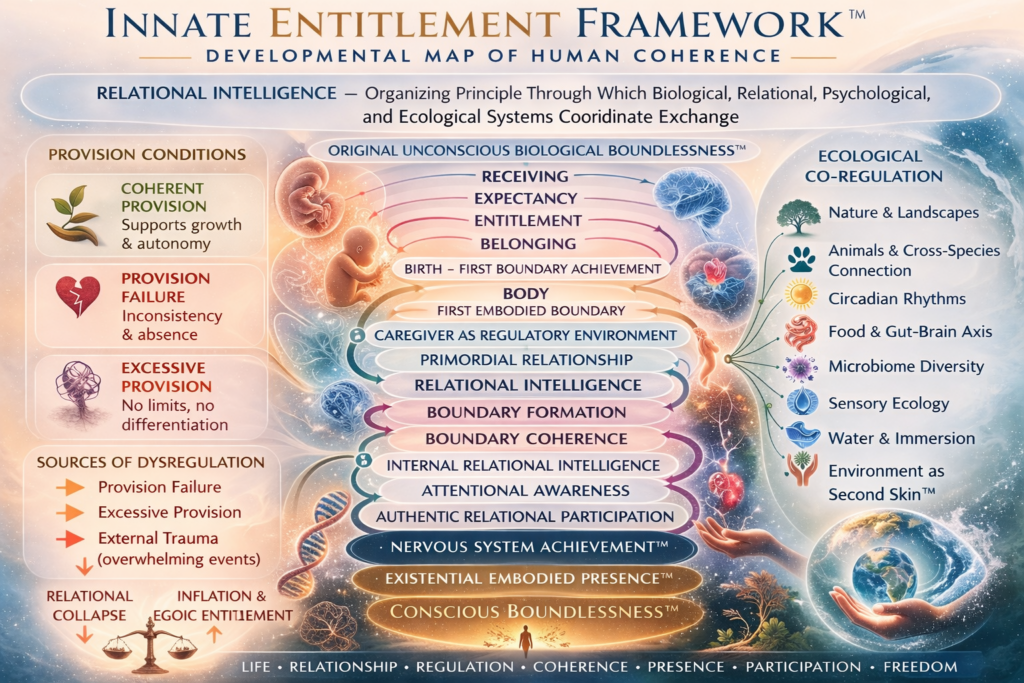
Figure 1. Conceptual architecture of the Innate Entitlement Framework™, illustrating the developmental progression from biological receiving to conscious participation in the relational field of life.
A relational organism–environment model explaining how receiving, belonging, boundaries, relational intelligence, and conscious presence develop across the human lifespan.
Introduction to the Innate Entitlement Framework™
This article introduces the conceptual foundations of the Innate Entitlement Framework™, a relational organism–environment model that describes how receiving, belonging, boundary formation, relational intelligence, and conscious presence emerge and develop across the human lifespan.
Core Concepts of the Innate Entitlement Framework™
The Innate Entitlement Framework™ introduces a developmental model describing how human coherence emerges through the interaction of biological regulation, relational experience, and boundary formation across the lifespan.
To support clarity, several core concepts organise the framework’s developmental logic.
Receiving
Human development begins within a state of biological receiving.
In prenatal life, the organism exists within a continuous regulatory field in which oxygen, nutrients, warmth, and protection are provided through the maternal body.
Within the Innate Entitlement Framework™, receiving refers to this original condition in which life is met through provision. This early biological experience forms the first template through which the organism learns that existence is supported through relational exchange.
Regulatory Expectancy (Entitlement)
From repeated experiences of receiving, the organism develops an implicit regulatory expectancy that life will continue to provide what is necessary for survival and development.
Within this framework, entitlement refers to this developmental expectancy.
It does not refer to narcissistic self-importance or moral privilege. Rather, it describes the organism’s intrinsic expectation that its existence, needs, and participation in life are legitimate and may be met within relational exchange.
Healthy entitlement therefore functions as a regulatory foundation for later development.
Boundary
Boundaries emerge developmentally as the organism differentiates while remaining in relationship with its environment.
Within the Innate Entitlement Framework™, boundaries are not understood merely as interpersonal rules or behavioural limits. Instead, they function as regulatory structures that allow the organism to maintain differentiation while participating in relational exchange.
Boundary coherence allows individuals to remain both connected and distinct without collapsing into fusion or defensive isolation.
Relational Intelligence
Relational intelligence refers to the organising principle through which biological, relational, psychological, and ecological systems coordinate exchange.
Within the framework, life is understood as fundamentally relational. Regulation, development, and adaptation occur through ongoing exchanges between organism and environment.
Relational intelligence therefore describes the processes through which living systems continuously adjust, respond, and reorganise within these exchanges.
Coherence
Coherence refers to the integrated functioning of biological regulation, relational experience, and self-organisation.
When receiving, entitlement, and boundaries develop within supportive relational environments, the organism is able to participate in life while maintaining internal continuity and regulation.
Human coherence therefore emerges not through effort alone, but through the successful organisation of these developmental processes across time.
Despite extensive research across biology, neuroscience, and psychology, a coherent developmental account explaining how biological regulation, relational experience, and boundary formation integrate across the human lifespan remains largely absent. While each of these disciplines has generated important insights into different aspects of human functioning, their explanations often remain fragmented, leaving the developmental continuity between biological processes, relational environments, and psychological organisation insufficiently articulated.
The Innate Entitlement Framework™ is proposed as a developmental model that seeks to clarify this continuity by describing how receiving, boundaries, and relational regulation interact to shape human coherence and psychological development across the lifespan.
Understanding this developmental continuity requires examining how biological processes and relational environments remain interconnected throughout human development. The concept of boundary provides a crucial point of integration through which this continuity can be more clearly understood.
Boundary as the Missing Bridge Between Biology and Psychology
Across the history of psychological and biological sciences, human development has been examined from multiple disciplinary perspectives. Biology has described the emergence and regulation of living organisms, neuroscience has investigated the functioning of the nervous system, and psychology has explored the development of cognition, emotion, and relational behaviour. Despite these advances, these domains have often remained conceptually fragmented, each explaining particular levels of human organisation without a unifying principle that integrates biological processes with psychological experience.
One possible reason for this fragmentation lies in how the concept of boundary has historically been understood within psychological discourse. In much of contemporary psychology and psychotherapy, boundaries are commonly framed as interpersonal skills: behavioural limits, protective rules, or defensive barriers used to regulate social interaction. Within this perspective, boundaries are frequently conceptualised primarily as forms of separation between individuals.
Seen from a wider perspective, this metaphor of boundary as separation may have unintentionally shaped the way disciplines themselves have evolved. When boundaries are understood primarily as walls, the concept itself subtly reinforces division rather than connection. In this sense, the psychological framing of boundaries as protective barriers may have inadvertently mirrored a similar conceptual boundary between fields of knowledge. Biology came to study the organism, psychology came to study the mind, and the regulatory processes that connect biological life with relational experience remained conceptually obscured.
While this interpretation has practical value in clinical contexts, it obscures the deeper biological foundations of boundary formation. In biological systems, boundaries do not primarily function as walls of separation. Rather, they serve as regulatory interfaces that allow living organisms to maintain internal organisation while engaging in regulated exchange with their environment. At the most fundamental level of life, cellular membranes establish the first boundary of the organism, simultaneously differentiating self from environment while enabling the exchange of nutrients, gases, and information necessary for survival.
When viewed through this biological lens, boundary formation is not merely an interpersonal skill but a fundamental organisational principle of life. From the earliest stages of embryological development, the organism emerges within a continuous process of biological regulation and environmental interaction. The developing nervous system does not arise in isolation but within a relational field that includes the maternal body, physiological rhythms, and environmental conditions. Development therefore begins not at birth but at fertilisation, when the organism first enters an ongoing process of regulated exchange with its environment.
The Innate Entitlement Framework™ proposes that human psychological development can be more fully understood when this biological continuity is recognised. Within this perspective, boundaries function as regulatory hinges rather than defensive walls. Boundary coherence allows the organism to regulate participation between inner and outer worlds, enabling the emergence of several interconnected developmental processes: the biological expectancy of receiving provision, the experience of belonging within a sustaining relational field, and the formation of differentiated selfhood capable of reciprocal participation in life.
From this standpoint, psychological boundaries represent the continuation of biological organisational processes into relational and experiential domains. When boundary is understood as a regulatory hinge rather than a barrier, the conceptual divide between biology and psychology begins to dissolve, revealing a continuous developmental architecture linking cellular life, nervous system regulation, relational experience, and psychological organisation.
What Is the Innate Entitlement Framework™?
The Innate Entitlement Framework™ (IEF™) is proposed as a biologically grounded relational–developmental paradigm that integrates insights from developmental psychology, neuroscience, epigenetics, and clinical psychotherapy in order to provide a unified account of human regulation, boundary formation, and relational functioning.
The initial insight that led to the formulation of this framework emerged from lived experience and clinical observation. Long before the theoretical model was articulated, recurring relational patterns became visible through both personal experience and years of psychotherapeutic practice. These observations raised fundamental questions about how human beings develop their sense of internal belonging, relational boundaries, and regulatory stability within the environments that shape them.
Over time, these lived and clinical observations revealed a consistent developmental pattern: human psychological functioning appeared closely linked to the quality of relational environments and the organism’s capacity to establish coherent internal boundaries while remaining in relationship with others and with life itself. The process of articulating the Innate Entitlement Framework™ therefore emerged from a gradual effort to organise these observations within the context of existing scientific knowledge.
The framework proposes that human psychological development unfolds through a lawful relational sequence beginning before birth and continuing across the lifespan. Within this model, the organism initially exists in a state of biological and relational continuity with its environment. From this early condition emerge processes of differentiation, boundary formation, regulatory calibration, and ultimately the development of coherent relational selfhood.
Rather than presenting a single therapeutic technique, the Innate Entitlement Framework™ offers a conceptual architecture for understanding how biological regulation, relational experience, and boundary development interact throughout human development. The framework introduces several constructs — including relational intelligence, boundary coherence, and entitlement regulation — as organising principles linking biological processes with psychological and relational functioning.
This conceptual review presents the theoretical foundations of the framework and situates its propositions within existing scientific knowledge. It outlines the developmental arc proposed by the model, examines the biological and relational conditions that shape human regulation, and explores implications for psychotherapy and human development.
The intention of this series is not to provide definitive empirical proof of every component of the framework, but rather to articulate its conceptual architecture clearly and invite dialogue, exploration, and research. In this sense, the conceptual review functions as an evolving theoretical map through which observations from lived experience, clinical practice, and contemporary science may be brought into a coherent developmental perspective.
The Innate Entitlement Framework™ proposes that human psychological coherence emerges from the integration of biological receiving, relational development, and boundary formation, organised through the regulatory capacity of relational intelligence operating across the lifespan.
The Conceptual Review Series
This introduction is the first entry in a developing conceptual review of the Innate Entitlement Framework™.
Subsequent articles will explore the core components of the framework in greater depth, including:
• Original Boundlessness™
• Prenatal Relational Templates™
• The Developmental Arc of Human Coherence
• ARC-E™ (Attunement–Regulation–Connection–Entitlement)
• Nervous System Achievement™
• Mindful Attribute Boundaries™
• Conscious Boundlessness™
Together, these articles aim to clarify the developmental logic of the framework and open a space for further dialogue, research, and application.
Authorship, Intellectual Property, and Editorial Transparency
Authorship and Intellectual Ownership
The Innate Entitlement Framework™ (IEF™), including its concepts, terminology, developmental architecture, and theoretical formulations, constitutes the original intellectual work of Janaína Mahé. The framework has emerged through the author’s lived experience, clinical practice in psychotherapy, and sustained conceptual reflection on human development, relational life, and biological organisation.
All core concepts, theoretical propositions, and interpretations presented within this conceptual review originate from the author and reflect the author’s independent intellectual contribution.
Original Theoretical Contribution
The Innate Entitlement Framework™ is presented as an integrative conceptual model that organises insights from multiple domains — including developmental biology, neuroscience, psychology, and relational theory — into a coherent developmental architecture describing how human beings move from biological receiving toward differentiated relational participation in life.
While the framework draws upon existing scientific knowledge across disciplines, the organisation of these insights, the developmental architecture proposed, and the conceptual terminology used to describe this process represent the author’s original theoretical synthesis and contribution.
Editorial Assistance Transparency
In the preparation of this conceptual review and the accompanying website materials, AI-based tools were used as editorial and organisational support, assisting with language clarity, text structuring, and proofreading.
These tools functioned solely as editing support. All conceptual content, theoretical insights, interpretations, and the development of the Innate Entitlement Framework™ remain entirely the author’s own intellectual work.
Copyright and Intellectual Property Notice
© Janaína Mahé, 2026. All rights reserved.
The Innate Entitlement Framework™ (IEF™) and all associated theoretical concepts, terminology, developmental models, diagrams, and explanatory structures presented within this conceptual review constitute the original intellectual work and conceptual authorship of Janaína Mahé.
The framework, including its conceptual architecture, developmental mapping, theoretical propositions, diagrams, and terminology, is protected under applicable copyright and intellectual property law.
Terminology associated with the framework — including but not limited to Innate Entitlement Framework™, Nervous System Achievement™, Mindful Attribute Boundaries™, Conscious Boundlessness™, Original Boundlessness™, Prenatal Relational Templates™, and ARC-E™ — forms part of the author’s trademarked intellectual work.
No part of this framework, including its terminology, conceptual structure, diagrams, or explanatory formulations, may be reproduced, adapted, or distributed without appropriate attribution or written permission from the author.
All terminology, conceptual distinctions, diagrams, and theoretical formulations associated with the Innate Entitlement Framework™, whether currently presented or developed in future publications and materials, form part of the author’s ongoing intellectual work and conceptual development.
The conceptual architecture, terminology, and theoretical propositions presented within the Innate Entitlement Framework™ remain the sole intellectual authorship of Janaína Mahé.
This conceptual review constitutes the foundational presentation of the Innate Entitlement Framework™.