


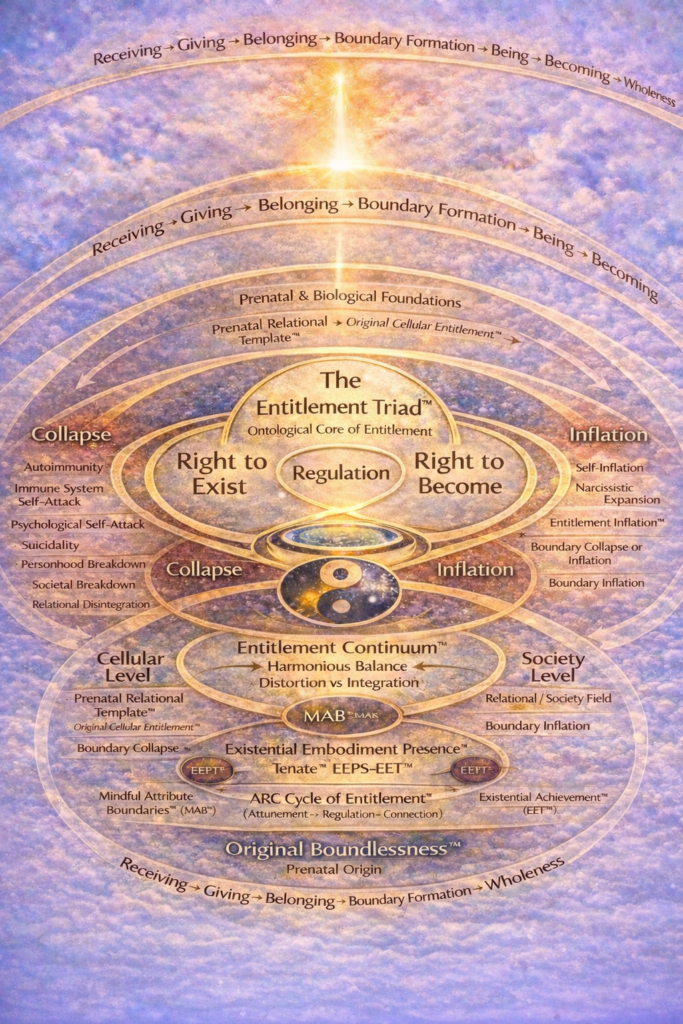
- About the Sky in This Image
The sky in this illustration is not simply a background — it represents the entire field in which human development unfolds. Its soft purple–gold horizon symbolises the original receiving state of prenatal life, where existence is held without earning, effort, or separation. This sky also reflects the body’s most regulated state — safety, openness, and ventral vagal calm — the physiological foundation required for healing and restoration.
As the developmental steps rise, the sky reminds us that growth does not remove us from our origin; we evolve within the same field that first held us. The luminous upper horizon symbolises Conscious Boundlessness — not an early developmental state, but a mature integration where boundaries, selfhood, and nervous system coherence allow the individual to experience both grounded presence and spacious awareness.
In this way, the sky links biology, embodiment, regulation, and consciousness. It represents the non-dual field — not as bypass or escape, but as the natural expansion available once the self is anchored, differentiated, and regulated. It is also a signature element of the Esperansa identity, reflecting compassion, depth, safety, and the spiritual warmth at the heart of this work.
An Emerging Practice-Informed Psychotherapeutic Framework
Introduction
Welcome to the Innate Entitlement Framework™
Welcome to the Innate Entitlement Framework™ — a living, evolving model that brings together biology, boundaries, nervous system science, mindfulness, and existential presence. This framework is my life’s clinical work distilled into a developmental arc that helps us understand why we become who we become — and how we return to ourselves. It invites you to explore how entitlement, boundaries, receiving, and embodiment shape the human journey from before birth into adulthood, and how therapeutic work can restore what was interrupted.
What Is the Innate Entitlement Framework™?
The Innate Entitlement Framework™ is an emerging developmental and relational psychotherapeutic model grounded in lived human experience, clinical practice, and reflective theoretical integration. It offers a way of understanding human development, nervous system organisation, boundary formation, and embodied presence as a continuous developmental process that begins in the earliest stages of biological life and unfolds across relational, psychological, and existential experience.
A Living, Evolving Therapeutic Model
This framework is in active development. It is not presented as a fixed, complete, or finalised theory, but as a practice-informed model that remains open to refinement, clarification, and further articulation. It has emerged through lived human experience and over a decade of clinical psychotherapy work, sustained reflective practice, and the integration of embodied therapeutic experience with developmental insight.
Development Begins With Biology — Not Cognition
At its essence, the Innate Entitlement Framework™ proposes that human development begins not with cognition, identity, or attachment, but with biology.
Before birth, the human organism exists in a state of uninterrupted receiving, where survival, growth, and regulation are provided effortlessly by the maternal environment. This prenatal receiving state imprints the first embodied truth of existence — life comes toward me — forming the foundation of innate, existential entitlement.
After birth, this embodied expectation is mirrored or fractured by caregivers, shaping early relational patterns and nervous system organisation.
From Boundlessness to Boundaries: The Developmental Paradox
As development progresses, the human being must move through a paradoxical arc: from original biological boundlessness into the formation of self-boundaries, differentiation, and internal structure.
Boundaries do not oppose our original receiving nature; they integrate it, allowing the organism to give, relate, and serve from abundance rather than depletion.
When this process is disrupted, adaptive survival strategies emerge — such as:
- hyper-independence
- collapse
- over-responsibility
- emotional numbing
- compulsive caregiving
Each of these reflects attempts to cope with fractured entitlement.
Mindful Attribute Boundaries™ (MAB™): Restoring Internal Clarity
To repair and reorganise this developmental journey, the framework introduces Mindful Attribute Boundaries™ (MAB™) — a mindfulness-based, body-anchored process that:
- restores internal clarity
- re-establishes presence through the breath and body
- strengthens self-boundaries
- prevents self-abandonment
- supports relational openness
- anchors the individual in embodied presence
Through MAB™, individuals learn to return to themselves, regulate from within, and build the internal structures necessary for grounded selfhood.
Nervous System Achievement™: A Milestone of Internal Leadership
This developmental process continues into Nervous System Achievement™, the milestone where the individual’s nervous system becomes capable of:
- internal regulation
- emotional flexibility
- relational presence
- stability without collapsing into survival responses
From here, the human being can enter Existential Embodied Presence — a mature state where entitlement, boundaries, regulation, and selfhood converge into grounded, differentiated, connected being.
The Developmental Arc: From Receiving to Embodiment
Together, these developmental movements describe a coherent arc:
- prenatal receiving
- early entitlement and disruption
- boundary formation
- mindful re-organisation of the self (MAB™)
- nervous system coherence (Nervous System Achievement™)
- existential embodied presence
The Innate Entitlement Framework™ positions this arc not as a path toward perfection, but as a return to the original truth of existence, integrated with adult developmental capacities that allow us to live fully, relationally, and authentically in the world
The Entitlement Triad: The Foundational Architecture of Human Development
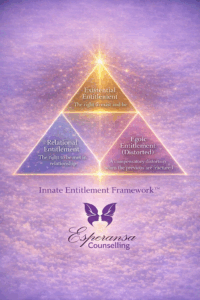
Within the Innate Entitlement Framework™, entitlement is not understood as a personality trait, behavioural expectation, or cognitive belief. Instead, it is recognised as an innate developmental condition that begins before birth and organises human experience across the lifespan.
The Entitlement Triad describes three core expressions of entitlement that shape nervous system organisation, relational patterns, boundary formation, and the development of selfhood. These expressions are not stages to be achieved, but structural conditions that operate across all phases of development.
Existential Entitlement: The Right to Exist and Be
Existential entitlement emerges in the womb, where the human organism exists in a state of uninterrupted receiving. Survival, growth, and regulation are provided effortlessly by the maternal environment, imprinting the first embodied truth of existence: life comes toward me.
This form of entitlement establishes the biological foundations of safety, presence, and belonging. It is pre-verbal, pre-cognitive, and pre-relational — a bodily knowing that existence itself is permitted and supported.
Relational Entitlement: The Right to Be Met in Relationship
After birth, existential entitlement becomes expressed and negotiated through relationship. Relational entitlement reflects the expectation that signals of need will be noticed, responded to, and held within caregiving relationships.
When relational entitlement is consistently met, the nervous system develops coherence, trust, and flexibility. When it is disrupted, the organism adapts, shaping later attachment patterns, emotional regulation strategies, and relational expectations.
Egoic Entitlement (Distorted): Adaptive Compensation Following Fracture
Egoic entitlement is not a primary entitlement, but a compensatory adaptation that emerges when existential and/or relational entitlement are fractured.
It may present as:
- over-claiming or under-claiming needs
- hyper-independence or collapse
- entitlement inflation or self-erasure
- rigid self-sufficiency or chronic dependency
Within this framework, egoic entitlement is not viewed as pathology, but as an intelligent survival response developed to protect the organism when foundational entitlement has been compromised.
Entitlement as a Developmental Dimension Across the Framework
The Entitlement Triad functions as the grounding architecture beneath every stage of the Innate Entitlement Framework™. It shapes how individuals move through boundlessness, boundary formation, nervous system regulation, and embodied presence.
Rather than being resolved cognitively, entitlement is reorganised developmentally through embodied, relational, and nervous-system–informed therapeutic work — particularly through Mindful Attribute Boundaries™ (MAB™).
1. Original Biological Unconscious Boundlessness
Long before language, cognition, or relational meaning emerge, the human organism begins life in a state of pure receiving.
In the womb, the developing being is entirely sustained by its environment.
Every requirement for survival, growth, and regulation is met automatically:
- oxygen
- nourishment
- temperature regulation
- protective containment
- rhythmic movement
- biochemical attunement
For approximately nine months, the fetus exists in uninterrupted receiving.
There is no doing.
No deserving.
No earning.
No self-evaluation.
No identity.
There is only being held.
During this time, the nervous system becomes habituated to receiving.
Not psychologically — biologically.
The very first truth the organism knows is:
Life comes toward me.
When birth happens, this receiving state does not vanish.
The newborn’s cry is not manipulation or learned behaviour.
It is a continuation reflex of the prenatal receiving pattern:
I signal → I expect to be met.
This expectation is not dependency.
It is existential entitlement — the inherent biological truth that:
I exist, therefore I should be met.
Attachment theory begins here, observing how caregivers confirm or disrupt this expectation.
But the Innate Entitlement Framework™ begins earlier:
Entitlement is not created by the caregiver.
It is already present as a biological state.
Caregivers simply mirror or fracture what the body already expects.
This is the foundational truth that shapes the entire human developmental arc.
2. The Paradox of Boundlessness and Boundaries
Human development unfolds through a profound paradox:
**We begin life boundless —
but to become healthy adults, we must become bounded.**
Boundlessness is our original state:
mergence, receiving, openness, unstructured being.
But as we grow, we must form:
- differentiation
- identity
- internal structures
- self-holding
- self-regulation
- boundaries
- relational clarity
Boundaries are not the opposite of receiving.
They are the integration of receiving.
Boundaries allow the life force that once sustained us to become:
- contained
- protected
- directed
- sustainable
- organised
Without boundaries, receiving collapses into dependency.
With boundaries, receiving becomes internal abundance.
From abundance, giving becomes natural and clean —
not self-sacrifice, not compensation, not depletion, not people-pleasing.
In this view:
Service to others becomes a byproduct of self-boundaries, not a replacement for them.
Healthy boundaries allow a person to:
- stay connected without losing themselves
- give without draining
- love without self-abandonment
- regulate without isolation
- receive without collapsing
This is the paradox at the heart of development:
Boundaries exist to preserve the original receiving state in an adult, sustainable form.
3. Receiving, Healing, and the Biology of Restoration
The original receiving state is not just the beginning of development —
it is the template for healing.
Across spiritual traditions, remission research, trauma recovery, and mind–body studies, a universal pattern appears:
When people heal profoundly, they enter a state of deep receptivity.
This state includes:
- surrender
- gratitude
- openness
- allowing
- being held by something larger
- letting life move toward them
Biologically, this corresponds to:
- ventral vagal activation
- reduced threat vigilance
- increased immune functioning
- cellular repair
- systemic coherence
Remarkably, this is the same physiological state that sustained us in the womb.
Healing does not require deserving.
Healing does not require worthiness.
Healing does not require earning.
Healing occurs when the body remembers how to receive.
What medicine calls remission, what spirituality calls miracles, and what psychology calls transformation all reflect the same truth:
Growth and repair happen in the receiving state —
the state we were born from.
4. From Boundlessness to Boundaries: How Entitlement Becomes Selfhood
As development continues, existential entitlement must evolve into selfhood.
This requires the formation of:
- internal boundaries
- emotional differentiation
- relational clarity
- embodied agency
- self-holding
When early environments are consistent, attuned, responsive, and reliable, this transition unfolds naturally.
But when environments are:
- neglectful
- inconsistent
- intrusive
- overwhelming
- role-reversing
- emotionally unavailable
the nervous system adapts.
These adaptations can look like:
- hyper-independence
- collapse
- compulsive caregiving
- chronic self-reliance
- emotional numbing
- people-pleasing
- survival-driven self-forgetting
These are not personality flaws.
They are intelligent reorganisations in the face of disrupted entitlement.
Therapy within the Innate Entitlement Framework™ is not simply supportive or insight-based.
It is developmental and reparative.
It restores the biological entitlement that was interrupted,
and rebuilds the boundaries that were never allowed to form.
To do this, the framework uses its core applied process:
5. Mindful Attribute Boundaries™ (MAB™)
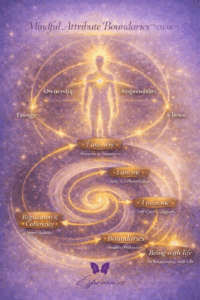
Mindfulness → Presence → Embodied Basic Needs → Boundaries → Regulation → Coherence
Mindful Attribute Boundaries™ (MAB™) is the applied, moment-to-moment method within the Innate Entitlement Framework™.
It unifies mindfulness, embodied presence, basic needs care, internal boundaries, and nervous system organisation into one coherent developmental pathway.
MAB™ is not a technique — it is a developmental re-sequence that restores what was interrupted, helping individuals return to themselves, regulate from within, and build the internal structures needed for grounded selfhood.
Step 1: Mindfulness — Returning to the Body and Breath
This is presence: I am here.
Every MAB™ process begins by returning to:
- the body
- the breath
- grounding sensations
- the present moment
This anchors the person in immediate presence, interrupting old survival patterns, emotional fusion, and learned adaptations.
Mindfulness here is not about observation — it is the doorway back into the body, the first step in reorganising the self.
Step 2: Presence — Internal Differentiation
This is clarity: I am me.
From present-moment awareness, internal clarity becomes possible:
- What is mine?
- What is not mine?
- What emotion belongs to me?
- What emotion belongs to someone else?
- What is authentic?
- What is conditioned?
- What is happening now?
- What is a repetition of the past?
This subtle internal sorting is the beginning of embodied boundaries — a re-establishing of the self as a differentiated, located being.
Step 3: Embodied Basic Needs — “I need me”
This is resourcing: My body is my first boundary.
Before boundaries can be expressed outwardly, they must be supported biologically.
The body is the first boundary we ever receive, and tending to it is not luxury — it is boundary maintenance.
When hydration, nourishment, sleep, rest, movement, and physical care are neglected, the body receives the message:
I am not worth caring for.
I am alone.
I do not matter.
This recreates early entitlement fracture.
When basic needs are met consistently, the body learns:
I matter.
I am held.
I can hold myself.
Caring for the body reinstates existential entitlement in action.
It is the living practice of:
“You need you.”
“I choose me.”
“I am here for myself first.”
This step stabilises the system, making boundaries and regulation possible.
Step 4: Boundaries — Self-Protection Without Disconnection
This is protection: Where I end and you begin.
Once presence and basic needs are stabilised, boundaries arise naturally:
- protection of energy
- clarity of roles
- orientation of identity
- preservation of dignity
- support for relational honesty
Boundaries do not push others away — they keep the self intact.
They make connection clean, sustainable, and safe.
Step 5: Regulation — Nervous System Coherence
This is stability: I can hold myself.
When boundaries are in place and the body is supported,
the nervous system shifts from adaptation to coherence.
This includes:
- groundedness
- safety
- breath stability
- emotional flexibility
- reduced vigilance
- a stable internal sense of “I”
Regulation is not relaxation — it is internal organisation.
It prepares the system for the next developmental milestone in the framework.
From Regulation to Integration → Nervous System Achievement™
Once the nervous system repeatedly experiences coherent regulation,
the individual begins to internalise self-holding, emotional leadership, and embodied agency,
setting the stage for:
Nervous System Achievement™
where regulation becomes self-generated, flexible, and stable,
and the person can meet life as it arises without fragmentation.
This is the bridge between healing and embodiment,
between receiving and relating,
between selfhood and presence.
6. Nervous System Achievement™
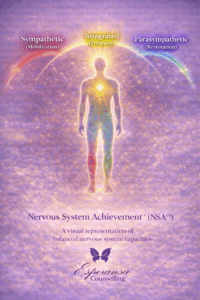
Nervous System Achievement™ is the developmental point at which internal regulation becomes self-generated, stable, and no longer dependent on external conditions.
It reflects a mature nervous system capable of holding experience without collapsing into survival responses.
At this stage, the individual becomes capable of:
•self-holding
•self-soothing
•emotional leadership
•embodied decision-making
•relational openness without self-abandonment
•staying present without fragmentation
Here, the nervous system transitions through the full developmental arc:
survival → stability → flexibility → coherence → presence
This milestone forms the bridge between:
•healing and embodiment
•receiving and relating
•selfhood and presence
Nervous System Achievement™ does not mean the absence of stress, activation, or emotion.
Rather, it is the capacity to meet life as it arises — with groundedness, integration, and internal steadiness.
From here, the organism becomes capable of entering the next and final developmental state: Existential Embodied Presence.
7. Existential Embodied Presence
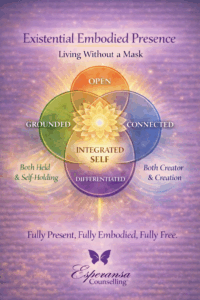
Living Without a Mask
Existential Embodied Presence is the culmination of the entire developmental arc within the Innate Entitlement Framework™. It is the point at which existential entitlement, embodied mindfulness, basic needs care, internal boundaries, and coherent nervous system regulation have been repeatedly integrated and stabilised through Nervous System Achievement™.
At this stage, the individual is no longer living through layers of adaptation, performance, protection, or emotional camouflage. The mask — the psychological shell created to survive fractured entitlement — gently dissolves. What remains is the person’s undivided, unconstructed self.
In this state, the individual experiences themselves as:
• grounded
• open
• differentiated
• connected
• regulated
• abundant
• clear
• compassionate
• present
Here, the nervous system is not simply regulated — it is available.
The self is not defended — it is anchored.
Belonging is no longer something to negotiate — it is inherent.
There is no longer a drive to earn worth, prove existence, gain approval, or justify belonging. The person rests into themselves with a quiet, embodied confidence: I am here, and that is enough.
To live without a mask is to live in unfiltered contact with reality — not lost in thoughts, not fused with emotion, not performing an identity, not abandoning oneself to secure connection. It is a return to the natural, uncontrived state that existed before fragmentation: the state where being and presence are the same.
In Existential Embodied Presence, the individual becomes:
• both the receiver and the boundary
• both the held and the self-holding
• both the creator and the creation
• both form and flow
This is not transcendence or bypassing — it is integration.
It is not an escape from the self — it is a homecoming.
Existential Embodied Presence represents the developmental apex of the Innate Entitlement Framework™:
a human being who is fully present, fully embodied, fully differentiated, and fully free — living without a mask, anchored in their own existence, and in authentic relationship with life.
Healthy Connection & Being in Relationship With Life
When the self becomes grounded, differentiated, and regulated, connection with others becomes clean, steady, and unburdened. In this state, relationships are no longer fused, performative, or compensatory. They arise from clarity rather than adaptation, from abundance rather than depletion.
Healthy connection is the natural expression of Existential Embodied Presence.
Because the individual is no longer seeking permission to exist, they can finally relate from wholeness.
In this integrated place, connection feels like:
- meeting others without losing oneself
- offering care without self-abandonment
- receiving care without collapsing
- staying open without becoming overwhelmed
- being authentic without fear of rejection
This is the relational expression of internal entitlement.
It is connection that flows from presence rather than from survival.
Being in healthy relationship with others becomes the foundation for an even deeper relational movement:
being in relationship with life itself.
This does not mean detaching from identity or dissolving the self.
It means living with a grounded openness — sensing oneself as both a differentiated individual and a participating expression within a larger unfolding.
Healthy connection is not the beginning of the developmental arc.
It is the flowering of it.

About this image:
This illustration represents Conscious Boundlessness as the horizon-state of the Innate Entitlement Framework™ — not a therapeutic demand, not a spiritual bypass, and not a transcendence goal.
It symbolises the integration of all developmental layers beneath it:
mindfulness, basic needs care, boundaries, nervous system coherence, embodied presence.
The image is not intended to imply perfection, enlightenment, or a permanent state.
Instead, it visually expresses the felt sense that becomes possible when the nervous system, boundaries, presence, and entitlement are integrated over time.
This visual is a metaphor for:
- a softened, open relationship with oneself
- grounded connection to life
- a sense of being both held and self-holding
- the matured version of the “receiving state” we begin life with
It is a symbolic horizon, not a step or requirement.
It reflects the natural expansion that may arise when a person feels safe, embodied, grounded, and whole — the culmination of the developmental arc, not an expectation to achieve.
Future Horizon: Conscious Boundlessness
While the Innate Entitlement Framework™ culminates in Existential Embodied Presence, the arc naturally opens into a wider, unnumbered horizon that I call Conscious Boundlessness.
This is not a developmental stage, achievement, or expectation.
It is a symbolic orientation — the felt sense that when a person becomes grounded, differentiated, regulated, and present, they may begin to experience themselves not only as a self in the world, but also as a participating expression of life itself.
This horizon represents the union of structure and openness, form and flow, creator and creation.
It is not a requirement of healing, nor a standard of progress.
It is simply the natural spaciousness that becomes available when the nervous system, boundaries, entitlement, and presence are fully integrated.
Ethical and Professional Clarity
The Innate Entitlement Framework™ is not presented as a validated psychological classification, diagnostic system, or replacement for established therapeutic models. It is offered as a conceptual and applied psychotherapeutic lens intended to support deep developmental, relational, and embodied work.
The framework invites further exploration, dialogue, and refinement, and remains grounded in clinical responsibility, embodied reflection, and ethical transparency.
Academic Positioning & Disclaimer
The Innate Entitlement Framework™ is an original theoretical and applied model developed by Janaína Mahé (2025). This overview presents its conceptual foundations for educational and professional purposes.
A formal academic paper articulating the theoretical rationale, interdisciplinary grounding, and clinical implications of the model is currently in development. A complementary practice-based book, Innate Entitlement Framework™: In Practice- What happened to me — and how do I come back to myself, will translate the framework into applied clinical, therapeutic, and embodied contexts.
While drawing from mindfulness and non-dual traditions, the Innate Entitlement Framework™ remains firmly grounded in embodiment and developmental psychology. It does not aim to dissolve the self, but to restore it to a state of relaxed, de-identified presence within the body’s natural boundaries, allowing openness and connection without self-erasure.
© 2025–2026 Janaina Mahe. All Rights Reserved.
Innate Entitlement Framework™, Mindful Attribute Boundaries™ (MAB™),
and Nervous System Achievement™ (NSA™) are trademarks of Janaina Mahe.