


I’ve always believed that life leaves us clues — little signs that we’re moving in the right direction, even when everything feels impossible. And nothing felt more impossible than the moment I first decided I wanted to go to London.
Because the truth is simple and brutal:
I didn’t have a penny.
Not for the flight.
Not for accommodation.
Not even for the first week.
All I had was a feeling — a knowing — that my life needed to change.
But desire without action doesn’t get you across the Atlantic.
So I created a plan.
If life wouldn’t give me the opportunity, I would create the opportunity myself.
• I asked my mother to pawn her jewellery so I could buy the flight. That was the only way to get the ticket — and within four months of arriving in London, I paid her back in full, even if that meant I wasn’t going to eat properly for the week, because that was the reality at the time.
. I asked my boss to sack me — because they were already making redundancies — so I could receive the redundancy pay. That became my survival money.
• And with the little savings I had, I paid for six months of English school upfront.
That was all I had.
The school.
The flight.
And a month’s worth of survival money — if I stretched it like elastic.
People think courage looks glamorous, but sometimes courage looks like being completely broke and still moving forward.
I didn’t have the money to go to London — so I created the money.
I didn’t have the conditions — so I created the conditions.
I didn’t have a guarantee — just determination.
So when I arrived in Heathrow and was locked in immigration for five hours, questioned and nearly turned away, it wasn’t just fear I felt — it was the weight of everything I had fought for.
And when they finally told me I could enter the country, I stepped out of Heathrow trembling, exhausted, but with a fire inside me:
I didn’t build this whole path just to stop at the airport.
The Friend Who Backed Out — and the Moment I Chose Myself
For a while, I wasn’t planning to go to London alone.
I told a friend my dream, and she said, “I’ll come with you.”
She already spoke English and had travelled before. The idea of going with someone felt safer. It felt like a sign that everything was aligning.
Then, three months before the trip, she sent a strange message:
“Can you meet me at our friend’s house? I need to talk to you.”
When I arrived, they both looked tense, almost like someone had died.
And then she said:
“I’m not going to London anymore. I got a job offer. I can’t refuse.”
I took a breath, digested the words, and said calmly, “Okay. Good for you.”
The other friend stared at me.
“So what are you going to do now?”
And without thinking — absolutely spontaneous — I said:
“I’m still going. I don’t walk with her legs.”
They were stunned.
“But what are you going to do? You don’t speak English!”
“I don’t speak English,” I said, “but I’ll learn. My brain works.”
That moment, that sentence, was a declaration:
I wasn’t walking away from my life because someone else changed their mind.
From then on, apart from my mother, my father, and two dear friends — Carol and Jeff — almost everyone doubted me. Some even expected me to be deported.
I remember telling them, without fear or hesitation:
“If I’m deported, so what? At least I tried.
The difference between me and you is that I don’t live afraid of what people will think.
My life is entirely mine.”
Courage doesn’t begin when you board the plane.
Courage begins when you decide to go, even when no one believes you can.
⸻
How the Friend at Heathrow Reappeared
At that same time — after my friend backed out — something unexpected happened.
I received a phone call from someone I hadn’t spoken to in two years: the man who would eventually wait for me at Heathrow.
My mother never let me talk to him in the past because she knew he wasn’t good for me. He used to let me down, upset me, disappoint me. I had no interest in reopening that chapter.
But that day, for some reason, I picked up the phone.
He said he wanted to say goodbye because he was moving to London.
“I’m going to London too,” I told him.
But I wasn’t leaving for another two months, and he was leaving in a couple of weeks.
We hung up, and then the phone rang again.
“I’ve got an idea,” he said.
“I’ll go first… and I’ll wait for you at the airport.”
And that is how he came to be standing there when I walked out of Heathrow immigration after five hours of interrogation.
He had a European passport, which meant he could enter the UK freely.
He knew London. He had lived there before.
To immigration, he looked like someone stable, legitimate — and he was waiting for me.
I truly believe his presence is what tipped the scales.
If I had walked out alone, shaking, with my broken English, they might have sent me back.
He appeared in my life for that purpose — to help me cross that border.
And as soon as that purpose was done, life made it clear our paths were not meant to stay connected.
He arrived exactly when he needed to.
No more, no less.
⸻
The First Horizon
Those first days in London were a blur of noise, colour, and possibility. And then Monday came: my first day of English school.
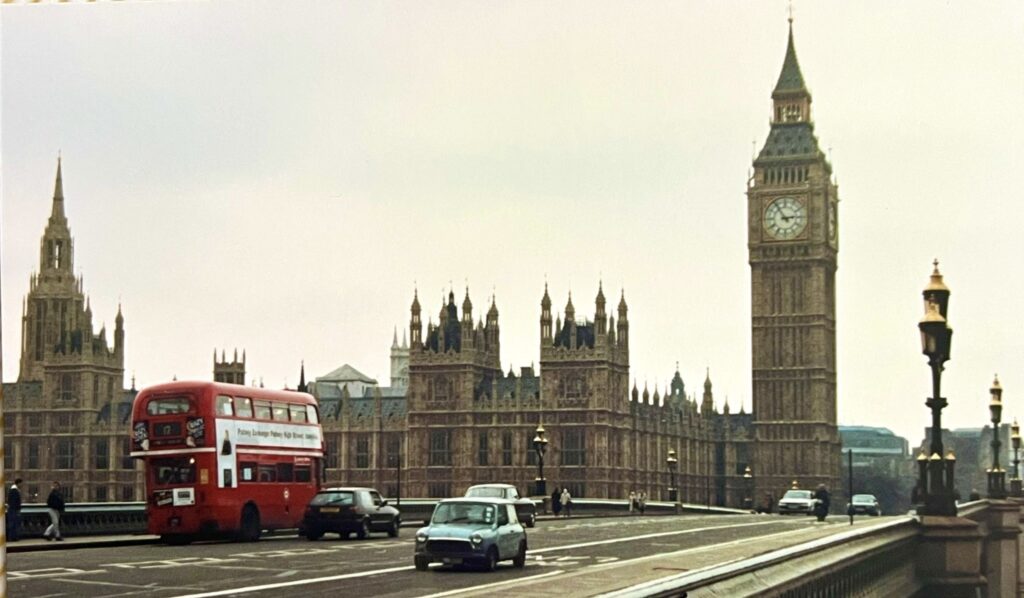
I climbed to the top deck of a double-decker bus and sat right at the front. When I sat down, something inside me went still.
The sun warmed my face, and the city stretched endlessly ahead.
And then I saw it:
The horizon.
A simple line of light, but for me, it was everything.
In São Paulo, you don’t see the horizon — only buildings, stacked and crowded. To see the sky, you have to look straight up.
That morning, on that bus, I realised how starved I had been for space, for openness, for possibility.
Just that moment — sun on my face, horizon ahead — made the entire journey across the ocean worth it.
⸻
Twenty Pounds and a Decision
And yet, beautiful moments don’t pay rent.
I had already paid the rent for the week. I had bought food for the week.
And when I counted what was left, I had £20 — a single note — to my name.
But panic didn’t come.
I felt something else: determination.
I grabbed my pocket dictionary, sat on the edge of the bed, and carefully created a sentence that could change my life:
“I need a job to eat and survive. I am a student in London.”
I folded the paper, put it in my pocket, stood up, and said out loud — to myself, to God, to the universe:
“Today, I’m going to find a job.”
Someone had told me that a certain building near Oxford Street had many agencies.
So I trusted my feet and walked in.
I knocked on one door, walked in with my biggest smile, and handed the mother and son behind the desk my little paper.
They had no idea what I was saying, and I had no idea what they were saying, but something shifted. They looked at each other, smiled, and motioned for me to come in.
My English was nearly zero.
My confidence, somehow, was not.
They wrote “Hotel – cleaning” on a paper.
I recognised the words.
And that was how I got my first job in London.
Two years later, I met the son again by complete coincidence. He ran over, hugged me, and then froze:
“Wait, wait — you’re SPEAKING English!”
We sat and talked the whole night. At one point he laughed and said:
“Now I know why you learned so fast… you don’t stop talking.”
Then he told me the truth:
The day I asked for a job, they didn’t understand half of what I said —
but they understood my smile, my energy, my presence.
That was why they hired me.
⸻
Working at the Marriott — and the Polish Family Who Held Me
My first job was as a housekeeper at the Marriott Hotel in London.
Hard work, long hours, but it was life-changing — not because of the job, but because of the people.
A Polish family worked there too — housekeepers, linen staff, cleaners.
They lived together in a buzzing little house near the hotel, and somehow, they adopted me within days.
Jarek, who carried sheets up and down the corridors all day, became my first real best friend in London.
We didn’t share a language at first, but we shared laughter, jokes, and late nights playing pool or having pints in the pub.
He taught me Polish.
I taught him Portuguese.
We both tried English.
And between all those languages, we understood each other perfectly.
That family gave me community, belonging, and joy — things I didn’t even realise I had been missing.
⸻
Leaving the “Friend” Who Was No Friend
Twenty days after arriving in London, things fell apart with the friend who had met me at the airport. The argument was explosive, ugly, and final.
I knew I couldn’t stay there.
So I did the only thing that made sense to me:
I went dancing.
At a Brazilian club, I met a group — a couple, an auntie, a cousin — who welcomed me instantly.
We danced, we laughed, we talked.
It felt like I had known them forever.
At the bus stop on the way home, my phone rang — it was him.
My body started shaking.
I told them what happened.
They looked at each other and said:
“You’re not going back there. We’re going with you.
We’ll get your things now.”
And they did.
They waited for me outside.
I packed my belongings.
I walked away and never looked back.
I stayed with them for two weeks, until I found my own place.
That was how life in London truly began for me — through connection, compassion, and strangers who became family overnight.
⸻
The Casino Job I Didn’t Take
Before I got the hotel job, a Portuguese man approached me in a café and told me about a “waitressing job.”
He brought me to a casino basement in Piccadilly.
Smoke. Men with big bellies. A blonde woman showing the “uniform” — a corset and a skirt barely covering anything.
Then came the truth:
I had to let them touch me.
The more I let them do, the more money I’d make.
£300 a day minimum.
Cash.
I went home that night…
The money was temptation, but I didn’t come here for this!
The next morning, I woke up with absolute clarity:
I didn’t come to London for money.
I came to find myself.
And I am not on sale.
I said no.
He kept insisting for days.
I kept saying no. Eventually, I never saw him again!
⸻
Learning English — My Way
Everywhere I went — buses, pubs, work, school — I practiced English.
I laughed at my mistakes.
I used my hands, my face, my whole body to communicate.
And I spoke non-stop.
London wasn’t easy, but it was alive.
Every day was a lesson.
Every person was a teacher.
And slowly, beautifully, the language came.
⸻
Reflections: Horizons Then and Now
Sitting on that double-decker bus in London, feeling the sun on my face and seeing the horizon for the first time in years, I realised something profound:
Freedom is not just leaving a place —
it’s discovering possibilities you didn’t know existed.
That horizon showed me that life is bigger than we think, that opportunities can be created from nothing, and that the smallest moments — a bus ride, a smile, a sentence written with a dictionary — can redirect an entire life.
Now, in Swansea, when I watch the sunrise in the early morning from my car window on my way to Hotpod Yoga, or see the sunset from my bedroom window across my front garden, I carry that same feeling with me.
Gratitude.
Wonder.
Possibility.
Every horizon reminds me of that girl arriving in London with no money, a pocket dictionary, and a determination that could move mountains.
She didn’t know what was ahead of her —
but she knew she would create it.
And she did.
“Leaving Brazil was not an escape from pain, nor a pursuit of a better future. It was a relational movement. At some point, I understood something very simply: if life could not meet me where I was, then I had to go and meet life where it was. I remember an old phrase coming to mind — if Mohammed can’t go to the mountain, the mountain must come to Mohammed. For me, it was never about forcing life to change. It was about restoring contact. I had lived for years with a deep sense of being in relationship with life itself, yet I was inhabiting environments where that relationship could not breathe. Leaving was not the moment I found myself; it was the moment I stopped abandoning myself. What follows is not theory imposed on experience, but language that emerged from it — an attempt to name what happens when the relationship with oneself, and with life, is lost, and how it can be restored without force”