


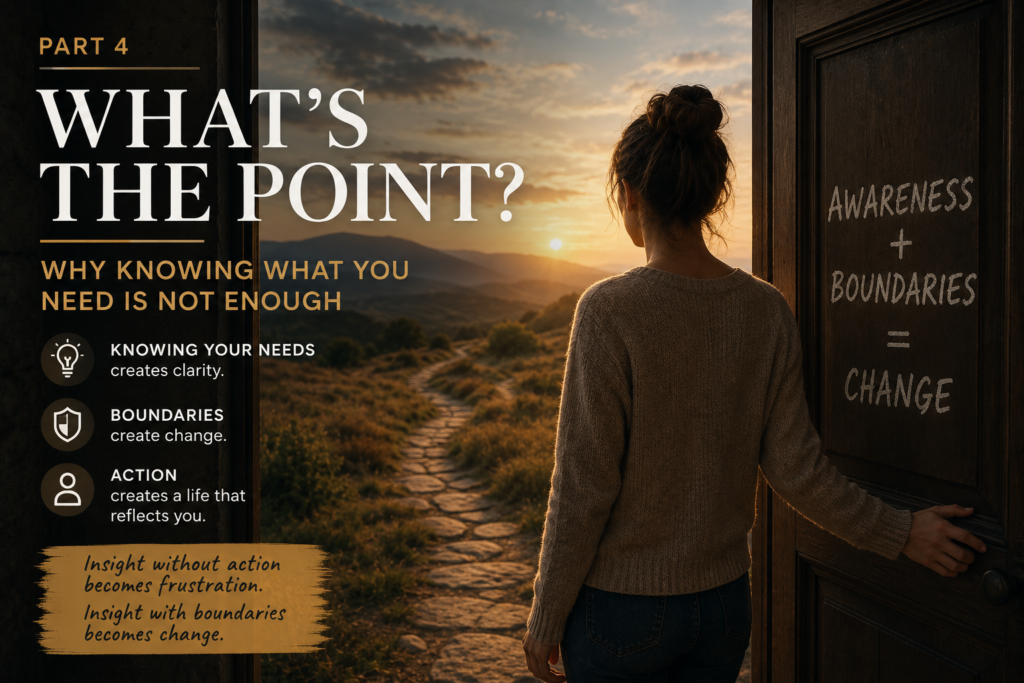
Knowing what you need seems like the answer—but for many people, it changes nothing. They can identify their needs clearly, yet still feel stuck, frustrated, or unable to act. Because awareness alone does not create change. Something else is required to bring what you know into the reality of your life.
There is a moment that happens for many people.
Sometimes in therapy.
Sometimes in quiet reflection.
Sometimes after months or years of feeling disconnected.
They pause.
And for the first time, they say:
“I know what I need.”
And it is real.
Not theoretical.
Not performative.
Not what sounds right.
Not what other people would approve of.
The answer comes from somewhere honest.
And yet…
Nothing changes.
They still say yes when they want to say no.
They still tolerate what is draining them.
They still hold back what they feel.
They still remain in the same patterns.
And this is where people often become deeply frustrated.
Because now they can see clearly.
And still feel stuck.
What’s Really Happening When Nothing Changes
When this happens, a very specific pattern is usually present:
- You recognise your needs
- You understand what would help
- You can see what is not working
- You may even know exactly what needs to change
- But you do not act
- You remain in the same patterns
- You continue overriding yourself despite the awareness
In other words:
You are aware—but not moving.
And awareness without movement creates frustration.
Because now you are not just disconnected.
Now you are consciously watching yourself stay disconnected.
And that can feel exhausting.
Why Awareness Is Not Enough
Many people assume that insight creates change.
That once you know what the issue is, everything should shift.
But awareness and action are not the same thing.
Knowing what you need creates clarity.
But clarity alone does not create movement.
Instead, it often reveals the gap.
The gap between:
What you know
And how you live.
What you feel
And what you express.
What you need
And what you actually allow yourself to have.
And that gap can feel painful.
Because once you can see it, it becomes harder to ignore.
So… What Is Missing?
Here is the shift:
It is not more awareness.
It is not more thinking.
It is not more insight.
What is missing is boundaries.
And boundaries are often deeply misunderstood.
They are not rules.
They are not walls.
They are not punishments.
They are not ways of controlling other people.
Boundaries are the capacity to:
- Take space
- Hold your position
- Say yes honestly
- Say no clearly
- Protect what matters
- Act on what you know
- Stay connected to yourself while in relationship with others
Without boundaries:
Needs stay internal.
Awareness stays private.
Life stays unchanged.
Because knowing what you need is one thing.
Living from that knowledge is something else entirely.
The Real Reason It Feels So Hard
Acting on your needs often comes with emotional consequences.
Not necessarily because something bad will happen.
But because something inside you expects that it will.
So when you begin to move differently, you may feel:
- Guilt
- Fear of disappointing others
- Fear of rejection
- Fear of conflict
- Anxiety
- Shame
- Self-doubt
And because those feelings are uncomfortable, many people retreat.
Not because they were wrong about their needs.
But because the emotional cost of acting feels too high.
So they override themselves again.
And again.
And again.
Until awareness becomes another place where they feel stuck.
Boundaries Are Not Just Psychological
This is important.
Because many people think boundaries are simply a communication skill.
A mindset shift.
A confidence issue.
But boundaries are much deeper than that.
Boundaries are regulatory.
They reflect your capacity to stay present while holding your position.
To remain grounded while someone disagrees with you.
To tolerate discomfort without abandoning yourself.
To say no without collapsing into guilt.
To stay connected to yourself without needing everyone else to approve.
This is why boundaries can feel so difficult.
Because they are not just about what you think.
They are about what your system can tolerate.
The Real Question Changes
At first, the question is:
“What do I need?”
And that matters.
But eventually, the question changes.
It becomes:
“Can I stay with myself while I act on what I need?”
That is a completely different level of work.
Because now the issue is not awareness.
It is embodiment.
It is action.
It is relational courage.
The Way Back Is Not More Thinking — It’s Movement
If you already know what you need, thinking about it more is unlikely to be the answer.
The way back is movement.
Not dramatic action.
Not a life overhaul.
But real, grounded movement.
Small acts of alignment.
One honest no.
One boundary.
One decision that reflects what you know.
One moment where you choose not to abandon yourself.
Because this is how change begins.
Not through awareness alone.
But through action that honours awareness.
Because:
Awareness comes first.
Boundaries bring it into life.
A Final Thought
Knowing what you need reconnects you with yourself.
But only when you act on it does your life begin to reflect that connection.
Because insight without action becomes frustration.
But insight with boundaries becomes change.
And that is where participation becomes real.