


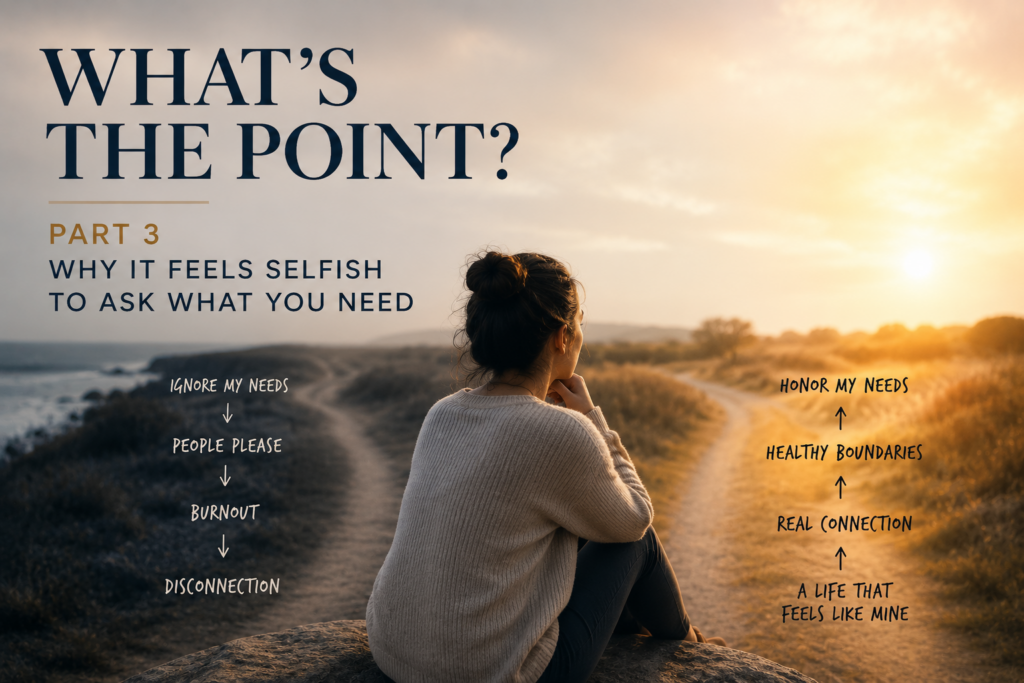
If asking “what do I need?” feels uncomfortable or wrong, you’re not alone. Many people have learned that focusing on themselves is selfish, and that their role is to give, to help, and to adapt. But this belief doesn’t create connection, it creates disconnection from self, and eventually, from life.
There is a reason people don’t ask what they need.
It’s not because they don’t have needs.
It’s not because they don’t care.
It’s not because they are incapable of knowing.
It’s because asking feels wrong.
Selfish.
Uncomfortable.
Like they shouldn’t be doing it.
Like turning towards themselves somehow means turning away from others.
And this is where many people begin to lose themselves.
And often, this is exactly where self-compassion becomes necessary.
Not as indulgence.
Not as self-excusing.
But as the willingness to turn toward the part of you that learned to disappear in order to remain connected.
What’s Really Happening When It Feels Selfish?
When asking what you need feels selfish, a very specific pattern is usually present:
You prioritise others automatically
You feel responsible for how others feel
You equate being good with giving
You suppress your own needs
You feel guilty when you consider yourself
You confuse self-abandonment with kindness
You believe your value comes from being helpful
In other words:
You are relating to others without including yourself.
And over time, that creates disconnection.
Because you may still be giving.
You may still be helping.
You may still be showing up.
But you are no longer present in the relationship as a whole person.
You are present as a function.
The helper.
The giver.
The strong one.
The one who understands.
The one who does not ask for too much.
And when that becomes the only position you are allowed to occupy, something essential gets lost.
You stop experiencing yourself as someone who is also allowed to receive.
Where This Comes From?
Many people grow up with an idea:
That they are here to help.
To serve.
To be good.
To cooperate.
To make things easier for others.
To not be difficult.
To not ask for too much.
And of course, caring for others matters.
Being kind matters.
Being generous matters.
But something becomes distorted when service to others requires abandonment of the self.
Because then care stops being relational.
It becomes performance.
It becomes survival.
It becomes the way a person earns permission to exist.
And this is why self-compassion can feel surprisingly difficult for some people.
Because compassion is not simply a feeling.
It is a relational stance toward the self.
If your internal world has been organised around usefulness, self-suppression, or earning your place, compassionate self-inclusion may initially feel unfamiliar, uncomfortable, or even unsafe.
The Misunderstanding About Serving Others
There is a common belief that putting yourself first means you are being selfish.
But this is a misunderstanding.
Because including yourself is not the same as excluding others.
And caring for yourself is not the opposite of caring for others.
There is a principle many people recognise:
Do not do to others what you would not want done to yourself.
At the heart of that is something important:
The way we treat others reflects the way we treat ourselves.
If we are harsh with ourselves, our care for others becomes strained.
If we abandon ourselves, our giving eventually becomes resentful.
If we do not listen to ourselves, we often struggle to truly hear others.
So the relationship with the self is not separate from the relationship with others.
It is the ground from which relational life is lived.
So… What Gets Lost?
Here is the shift:
It’s not that caring for others is wrong.
It’s that excluding yourself is.
Because when you ignore your needs:
Your care becomes effortful
Your presence becomes fragmented
Your giving becomes draining
Your relationships become organised around obligation
Your kindness becomes mixed with resentment
Your body carries the cost of your silence
At first, this may look like love.
But over time, it becomes depletion.
And depletion cannot sustain genuine connection.
You may still be doing everything right on the outside.
But inside, something begins to disappear.
Your aliveness.
Your clarity.
Your sense of self.
Your sense that you matter too.
The Real Reason It Feels Wrong
When you begin to ask what you need, it may feel uncomfortable because it challenges an old identity.
The identity of:
The helper
The giver
The good one
The one who copes
The one who holds everything together
The one who does not need much
And if that identity has kept you safe, loved, accepted, or needed, then moving away from it can feel threatening.
Not because asking what you need is wrong.
But because your nervous system may have learned that needing is unsafe.
It may have learned that needing leads to rejection.
That needing makes you too much.
That needing disappoints people.
That needing creates conflict.
So instead of asking what you need, you override yourself.
And the more you override yourself, the more distant you become from your own life.
Compassion interrupts that pattern.
Not by demanding instant change, but by creating enough internal safety to notice what has been ignored without shame.
Sometimes the first compassionate act is simply recognising: Of course this became my pattern. It helped me survive.
Where Entitlement Gets Lost
At a deeper level, something even more fundamental becomes obscured.
The sense that:
I am here because I am entitled to exist.
Not entitlement as ego.
Not entitlement as superiority.
Not entitlement as special privilege.
But entitlement as the most basic biological and existential fact:
You were given life.
And with that life comes the right:
To exist
To take space
To have needs
To be met
To participate
To receive
To matter
When this is lost, people do not simply stop asking what they need.
They stop believing they are allowed to need anything at all.
So they move through life trying to justify their existence through usefulness.
They become helpful instead of present.
Available instead of honest.
Good instead of real.
And eventually, they become exhausted from living as if their right to exist depends on what they provide.
The Way Back Is Not Less Care — It’s Inclusion
The solution is not to stop caring for others.
It is not to become selfish.
It is not to withdraw from relationship.
The way back is to include yourself in the relationship.
To ask:
What do I need right now?
And if that question feels difficult, compassion is what allows you to stay with it rather than abandoning yourself again.
Not as an act of selfishness.
But as an act of honesty.
Because when you service yourself, your service to others becomes a byproduct.
Not forced.
Not resentful.
Not performed.
Real.
When you are connected to yourself, your care becomes cleaner.
Your yes becomes more honest.
Your no becomes more respectful.
Your presence becomes more whole.
And your relationships no longer depend on you disappearing in order to keep them stable.
A Final Thought
Compassion is not selfishness.
It is the refusal to relate to yourself through neglect while trying to love others well.
When you abandon what you need in order to care for others, you do not become more loving.
You become more disconnected.
But when you include yourself, your care stops being something you force yourself to do.
It becomes something that flows from a self that is present, nourished, and real.
And that is when service becomes relational.
Not self-sacrifice.
Not performance.
Not depletion.
But coherent participation in life.