


Visual overview of the relational, biological, and ecological architecture through which receiving, entitlement, belonging, boundary formation, and relational participation unfold across the human lifespan.
SECTION 0 — THE SKY AS THE ORIGINAL FIELD
The sky in this illustration is not aesthetic decoration; it is the first teacher of the Innate Entitlement Framework™. Its widening gradient — deep indigo dissolving into gold — represents the original field into which every human organism arrives. Before consciousness, before self-representation, before the first breath, life begins inside a continuous environment that gives without demand. This is the primordial truth: existence begins in receiving.
Inside the womb, everything arrives effortlessly — oxygen, nutrients, biochemical regulation, temperature stability, rhythmic attunement, containment. The organism does not earn safety or belonging; it is given safety and belonging. This is the first movement of life:
Life comes toward me.
Receiving is only possible because something is giving.
This mutuality — environment and organism, giver and receiver — is the first relational act, the template from which all future nervous-system regulation, relational trust, and internal coherence emerge.
Birth transforms the relational exchange: the first breath becomes biological giving — the organism’s first act of participating in the regulatory field. Belonging then unfolds postnatally through attuned caregiving, forming the foundation of all later psychological and relational development.
⸻
About the Framework
The Innate Entitlement Framework is a biologically grounded, relational–developmental psychotherapy paradigm integrating insights from Developmental Psychology, Neuroscience, Epigenetics, and Clinical Psychology.
The framework proposes that human psychological development unfolds through a lawful relational sequence beginning before birth and continuing across the lifespan. Within this model, biological regulation, relational experience, and boundary formation interact to shape the emergence of coherent relational selfhood.
This conceptual review presents the theoretical foundations of the framework and situates its propositions within contemporary scientific knowledge.
———-
0.1 ORIGINAL BOUNDLESSNESS™ AND THE FIRST BOUNDARY
The early horizon in the illustration represents Original Boundlessness™ — the prenatal state in which the organism exists without separation, without demand, and without the need to defend itself. In this state, the maternal body functions as:
• the first boundary,
• the first environment,
• the first regulatory field.
This is where Prenatal Relational Templates™ are formed:
the implicit biological expectations of safety, continuity, nourishment, and holding.
These expectations are not psychological; they are regulatory expectancies embedded into the organism’s developing neurobiology. They shape how attention, regulation, and later boundaries emerge.
Within this field, the organism experiences Original Cellular Entitlement™ — the cellular-level expectancy that needs will be met and that life arrives through connection rather than effort.
⸻
0.2 THE DEVELOPMENTAL SEQUENCE
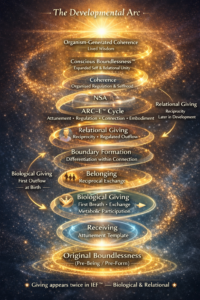
As colours rise and intensify across the sky, they mirror the organism’s natural developmental arc — an arc that begins in the prenatal field and unfolds across the lifespan.
Human development follows a lawful sequence:
Receiving → Biological Giving → Belonging → Boundary Formation → Relational Giving → Being → Becoming → Integration → Coherence
Each movement emerges from the integrity of the one before it.
Each depends on the organism’s internal regulatory architecture — first formed in the prenatal field through attunement, containment, continuity, and Original Cellular Entitlement™.
When this sequence unfolds in order, the organism becomes coherent.
When the sequence is disrupted, fragmentation, collapse, or inflation appear.
Healing restores the sequence.
⸻
Structural Symmetry of the Developmental Arc
Although presented above as a developmental sequence for clarity, the movements illustrated in the arc follow a regulatory architecture commonly observed across living systems.
Biological systems typically organise themselves through a progression that begins within an environmental field, moves through processes of receiving and internalisation, establishes boundary differentiation, and then stabilises through regulated exchange and integration. The developmental arc described in the Innate Entitlement Framework™ follows this same structural pattern. Human development begins in Original Boundlessness™, the organism existing within a containing relational field. From this field, the organism first receives, then participates through biological giving, establishes belonging within relational environments, forms boundaries that allow differentiation within connection, and later engages in reciprocal relational exchange. As regulatory capacities stabilise, the system moves toward nervous system organisation, integration, and organismic coherence. The arc concludes with Conscious Boundlessness™, in which the individual maintains coherent boundaries while recognising their participation within the larger relational field of life. This symmetry illustrates that the developmental movements described in the Innate Entitlement Framework™ do not represent arbitrary stages but reflect a regulatory structure consistent with the organisational patterns of living systems.
THE DEVELOPMENTAL MOVEMENTS
Receiving
The prenatal truth of being held, nourished, and supported without effort.
Biological Giving
The first breath — the organism entering reciprocal exchange with the world.
Belonging
Postnatal relational safety: the experience of existing within something that holds you.
Boundary Formation
Differentiation within connection — containment without collapse.
Relational Giving
Reciprocity, participation, regulated outflow — giving without self-abandonment.
Being
The capacity to occupy one’s own existence within relationship.
Becoming
Emergent agency, expression, movement toward possibility.
Integration
The reorganisation of inner experience into coherence.
Coherence
The adult expression of developmental alignment: clarity, regulation, relational openness, grounded being.
Although presented sequentially, the developmental movements of the Innate Entitlement Framework™ do not unfold as a simple linear progression. Rather, they organise through an iterative spiral in which the organism repeatedly revisits receiving, boundary formation, and reciprocal exchange at progressively deeper levels of integration across the lifespan.
IMPORTANT CLARIFICATION: Biological vs Relational Giving
“Giving” appears twice in the Innate Entitlement Framework™ for two distinct reasons:
1. Biological Giving (first breath / metabolic participation)
2. Relational Giving (reciprocity, relational contribution)
These must never be conflated — they arise from different stages of the developmental arc.
THE DIAGRAM AS A FRACTAL MAP OF HUMAN DEVELOPMENT
The visual architecture presented at the beginning of this review is not decorative symbolism. It is a structural map of the Innate Entitlement Framework™. The diagram illustrates a fractal principle: the same organising dynamics that govern life at the cellular level repeat at the level of the organism, the relational field, and society.
Across every scale of life, three fundamental dynamics organise living systems: receiving, boundary coherence, and reciprocal exchange. These dynamics operate simultaneously within biological systems, psychological organisation, relational dynamics, and societal structures.
At the cellular level, life begins in receiving. Cells maintain internal stability through selective permeability: nutrients, oxygen, and biochemical signals are received from the environment while waste is released. This process preserves internal coherence while allowing continuous exchange with the surrounding field.
Importantly, nearly all cells in the body contain the same genetic blueprint of the entire organism. What differentiates one cell from another is not the presence of different information, but which portions of that information are expressed or silenced. Through regulatory signals, certain genes are activated while others remain inactive, allowing cells to specialise while remaining part of the same integrated system.
This biological reality illustrates an essential developmental principle:
Belonging precedes differentiation.
Cells belong to the organism before they specialise. Identity emerges from within connection, not outside it. Differentiation therefore does not require separation from the whole; rather, specialised function develops within an already existing field of belonging.
The same principle governs human development. In the prenatal environment the organism exists within a regulatory field that holds, nourishes, and stabilises it. Only within this field can differentiation occur.
Boundaries therefore emerge not as defensive walls but as coherent structures that allow differentiation within connection. In post-natal development this process becomes visible through the organism’s gradual movement from undifferentiated relational belonging toward embodied individuality.
This developmental transition follows a continuous arc: prenatal receiving establishes the organism’s first experience of belonging; post-natal co-regulation stabilises this belonging within the relational environment; and from this secure field of regulation, boundary formation gradually emerges.
Following birth, the infant continues to rely on the relational environment for regulation, attunement, nourishment, and safety. Through repeated cycles of co-regulation — being held, soothed, responded to, and recognised — the developing nervous system learns that it can remain connected to others while maintaining internal stability. Within this environment of relational safety, differentiation begins to emerge.
The child gradually experiences themselves as a distinct organism within relationship. They discover that their sensations, impulses, emotions, and movements belong to them, while the caregiver remains a separate yet connected presence. This marks the beginning of boundary formation.
Healthy boundaries therefore arise not from separation but from secure belonging. When belonging is stable, the organism can safely differentiate without losing connection. Boundaries become the structures that allow the individual to maintain internal integrity while remaining open to relational exchange.
When early relational environments support receiving, attunement, and repair, boundary formation unfolds naturally. The child learns that they can express needs, experience emotions, and explore the world while remaining held within the relational field. Differentiation becomes an expansion of the self within connection rather than a defence against it.
However, when receiving is inconsistent, misattuned, or disrupted, the developing system may reorganise around protection rather than differentiation. In such conditions, boundaries may collapse, leading to fusion, self-loss, or over-adaptation; or they may inflate, producing rigidity, defensive autonomy, or relational distance.
Boundary formation therefore represents a developmental achievement rather than a defensive strategy. It reflects the organism’s growing capacity to maintain its own coherence while remaining in relational contact with others.
In this sense, boundaries are not barriers to connection but the very structures that make authentic connection possible. They allow differentiation to emerge within belonging, enabling the organism to remain whole while engaging with others and the wider world.
FRACTAL PRINCIPLE ACROSS SCALES
|
Level |
Belonging / Unity |
Differentiation |
Coherent Exchange |
|
Cellular |
genomic unity within organism |
cell specialisation |
biochemical signalling |
|
Organism |
attachment and internal safety |
identity and boundaries |
nervous system regulation |
|
Relational |
connection and mutual recognition |
differentiation within relationship |
reciprocity |
|
Societal |
belonging within social field |
individual roles and structures |
cooperative exchange |
Cellular Parallels in Relational Regulation
The regulatory dynamics described in the Innate Entitlement Framework™ (IEF™) mirror a fundamental pattern observed across living systems. At the cellular level, life is maintained through three interdependent processes: the capacity to receive resources from the environment, the maintenance of selective boundaries that preserve internal integrity, and the continuous exchange of energy and information with the surrounding field. Cellular membranes do not function as rigid walls but as dynamically regulated boundaries that allow selective permeability, enabling the organism to remain both differentiated and connected to its environment.
Although the Innate Entitlement Framework™ (IEF™) does not claim that human relational life operates at the cellular level, the relational dynamics it describes — receiving, boundary coherence, and reciprocal exchange — reflect a broader biological architecture through which living systems sustain coherence. This correspondence illustrates how the same organisational principles that maintain life at the cellular level can be observed, at increasing levels of complexity, in human development, relational dynamics, and social organisation.
Because these dynamics repeat across scales, they form a fractal architecture of coherence. When receiving remains possible and boundaries remain coherent, systems develop toward stability and integration. When receiving is disrupted or boundaries destabilise, systems reorganise defensively and move toward collapse or inflation.
Collapse represents implosion of the system: self-attack, withdrawal, fragmentation, and loss of belonging. Inflation represents compensatory expansion: domination, boundary rigidity, entitlement distortion, and relational imbalance.
The diagram therefore functions as a fractal map of human development. It shows how biological organisation, psychological formation, relational dynamics, and societal structures all emerge from the same organising relational intelligence of life.
The Innate Entitlement Framework™ traces how these dynamics first appear in the prenatal field, shape the developing nervous system, organise relational experience, and can later be restored through the re-establishment of receiving, boundary coherence, and reciprocal exchange.
Identifying the Core Dynamics
Within this fractal architecture, three fundamental relational dynamics organise the stability of living systems across scales. These dynamics govern how organisms remain connected to their environment while maintaining internal integrity. They therefore form the biological foundation upon which psychological regulation and relational development emerge.
The three biological dynamics described above — receiving, boundary coherence, and reciprocal exchange — become organised within human psychological development as three regulatory capacities: relational intelligence, boundary coherence, and entitlement regulation. The regulatory triad illustrated below represents how these foundational biological dynamics are expressed and stabilised within the human organism.
CORE LAW OF THE INNATE ENTITLEMENT FRAMEWORK™
Across all scales of living systems, development unfolds through three organising dynamics: receiving, boundary coherence, and reciprocal exchange, expressions of the underlying relational intelligence of life.
When these dynamics remain intact, biological, psychological, relational, and societal systems move toward integration and coherence.
Restoration therefore consists not of constructing new structures, but of re-establishing the organism’s original relational architecture, allowing receiving, boundary coherence, and reciprocal exchange to function again.

FIGURE 2.3- Two-Layer Relationship of the IEF™ Regulatory Triad- Biological Dynamics and Regulatory Capacities in the Innate Entitlement Framework™
Receiving → Entitlement Regulation
Boundary Coherence → Boundary Coherence
Reciprocal Exchange → Relational Intelligence

Figure 2.4- Regulatory Triad of the Innate Entitlement Framework™.
Human coherence emerges through the dynamic interaction of Relational Intelligence, Boundary Coherence, and Entitlement Regulation.
The regulatory triad presented here reflects a broader organisational pattern within the Innate Entitlement Framework™. Across biological, developmental, and psychological levels, the same relational architecture repeats: connection through receiving, differentiation through coherent boundaries, and participation through reciprocal exchange. This recurring structure forms the fractal regulatory logic of the framework.
Relational Architecture Across Levels in the IEF™
|
Level |
Relational Architecture |
|
Biological |
Receiving – Boundary Coherence – Reciprocal Exchange |
|
Developmental |
Belonging – Boundary Formation – Relational Giving |
|
Regulatory |
Entitlement Regulation – Boundary Coherence – Relational Intelligence |
RELATIONAL ORIENTATION OF THE ORGANISM
At the deepest level, the Innate Entitlement Framework™ understands human coherence as the organism’s capacity to remain in relationship with life itself. Before the development of identity or narrative selfhood, the human organism exists within a relational field of life.
This orientation toward life is consistent with findings in developmental neuroscience and embodied cognition, which show that the nervous system is organised through ongoing regulatory exchange between organism and environment rather than through isolated internal processing.
In the prenatal environment the organism participates in continuous regulatory exchange with the environment that sustains it, receiving oxygen, nourishment, and metabolic regulation through the maternal system. This early relational architecture establishes the biological template through which the organism later learns to remain connected with life even while developing individuality and boundaries.
When attention becomes organised primarily around internal narratives, past experiences, or external emotional pressures, this orientation toward life can become obscured. Restoration of coherence therefore involves the organism re-establishing direct orientation toward the living relational field through receiving, boundary coherence, and reciprocal exchange.
0.3 RELATIONAL LOGIC: HOW DEVELOPMENT UNFOLDS
Development follows a lawful relational sequence:
• Where Receiving is restored, Belonging reappears.
• Where Belonging is restored, Boundaries form safely.
• Where Boundaries stabilise, Giving becomes possible without depletion.
• Where Giving is allowed, Being becomes coherent.
• Where Being is coherent, Becoming unfolds.
• Where Becoming is grounded, Integration develops.
• Where Integration stabilises, Coherence becomes the default state.
This sequence is not optional; it is the organism’s biological logic.
Within the Innate Entitlement Framework™, early relational experience does not merely produce attachment patterns; it progressively organises the nervous system’s capacity for regulation. In this way, the developmental movements described above culminate in Nervous System Achievement™ — the organism’s capacity to remain regulated, differentiated, and relationally engaged. The framework therefore offers a developmental bridge between attachment theory and contemporary neurophysiological models of regulation.
Disruption of this sequence produces Relational Inversion™ — where collapse or inflation replaces coherence.
• Collapse corresponds to self-attack, seen biologically (autoimmunity) and psychologically (suicidality, shame).
• Inflation corresponds to boundary inflation, entitlement inflation, or narcissistic expansion.
Both patterns represent distortions of the original relational field and must be understood as interruptions of receiving, not personality flaws.
Understanding “Interruptions of Receiving” (IEF™ Definition)
In the Innate Entitlement Framework™, receiving is the organism’s first developmental function — the biological template through which safety, nourishment, attunement, continuity, containment, and belonging are first established. Because receiving forms the basis of every later stage in the developmental arc, any disruption to the organism’s ability to receive inevitably disrupts the nervous system’s capacity for coherence.
When receiving becomes unsafe, inconsistent, or unavailable, two predictable adaptations emerge: collapse or inflation. These are not personality traits but survival reorganisations.
Collapse occurs when the organism’s capacity to receive support, attunement, or relational safety has been interrupted. Without the ability to take in support, the system turns against itself — biologically (autoimmunity), psychologically (self-attack, shame), or existentially (suicidality, self-erasure). Collapse is not weakness; it is the organism attempting to survive by reducing activity in a field where receiving feels dangerous.
Inflation arises from the same interruption of receiving, but through an opposite compensatory pattern. When the organism cannot trust that support will arrive, it expands outward — through boundary inflation, entitlement inflation, narcissistic expansion, or relational dominance. Inflation replaces receiving with self-generated signalling. It is not grandiosity but defensive amplification: the system inflates because receiving has been compromised.
Both collapse and inflation therefore emerge from the same root disruption:
the nervous system can no longer rely on the original giving–receiving field that forms the basis of entitlement and coherence.
In IEF™, this constitutes an interruption of the organism’s earliest boundary template. When receiving collapses, boundaries collapse. When receiving cannot be trusted, boundaries inflate. When receiving is restored, boundaries become coherent again. This is why restoration of receiving reorganises collapse, deflates inflation, and returns the organism to its original architectural sequence of balance, belonging, and coherent selfhood.
This developmental progression is consistent with contemporary understandings of nervous system organisation, in which regulation evolves from environmental support toward increasingly differentiated self-regulation and relational participation.
0.4 THE GOLDEN HORIZON — CONSCIOUS BOUNDLESSNESS™
The upper golden horizon represents Conscious Boundlessness™ — the adult capacity to maintain one’s own boundaries while recognising oneself as part of the larger relational field of life.
This is not transcendence or escape.
It is the mature expression of Existential Entitlement™ — the embodied knowing that one belongs to life simply by existing.
At this stage, the individual becomes both:
• content (the lived experience), and
• context (the holding field of awareness).
This mirrors the prenatal truth — the organism within the environment — now restored with adult agency and differentiation.
⸻
0.5 THE SKY IS NOT A METAPHOR — IT IS A MAP
The sky is not symbolic; it is structural.
It maps the field in which development, regulation, boundaries, and coherence emerge.
Where attention flows, regulation follows.
Where regulation stabilises, boundaries form.
Where boundaries hold, relational giving emerges.
Where relational giving emerges, coherence becomes possible.
Healing is the restoration of receiving.
And receiving is restored through attention — the inward giving that reactivates the original relational field within the self.
Coherent adulthood is the capacity to live in relationship with life — through the life within oneself and in connection with others — from the same field that first held us.
This is why the sky stands at the beginning of the Innate Entitlement Framework™.
Everything that follows — from Original Boundlessness™ to ARC-E™, from MAB™ to Conscious Boundlessness™ — emerges from this foundational truth:
Life begins in receiving.
Healing is the restoration of receiving.
Coherence is the return to relational life.
A lived narrative of the origins of this paradigm is available in the companion blog on my website.